
BlackRock Pivots to RWA, With Planned Ethereum Tokenized Asset Fund

Institutional asset management giant BlackRock has continued its foray into digital assets with a new tokenized asset fund on Ethereum.
On March 19, BlackRock revealed that it is preparing to offer a fund through a partnership with digital asset tokenization specialist Securitize.
According to a filing to the US Securities and Exchange Commission, the Wall Street giant plans to launch the “BlackRock USD Institutional Digital Liquidity Fund.” However, the total size of the fund was not disclosed.
It feels very good for Ethereum, commented Galaxy CEO Mike Novogratz on March 20.
This feels very important for $Eth !!! https://t.co/UJVnIhm5pJ
— Mike Novogratz (@novogratz) March 19, 2024
BackRock Pivot to RWA
The fund will be based on the Ethereum blockchain and will trade under the ticker BUIDL. The Ethereum address hosting it had its first transfer around two weeks ago, according to Etherscan. It contains 100 BUIDL tokens and has one holder.
BlackRock’s real-world asset (RWA) tokenization partner, Securitize, is already working with KKR, Hamilton Lane, and others on tokenized funds, reported Bloomberg.
However, the new product is only available to institutional investors, with the minimum investment accepted set at $100,000.
RWA tokenization is a process of putting traditional assets such as gold, commodities, treasuries, and real estate on the blockchain. It has been predicted to become a multi-trillion-dollar industry over the next decade, and Wall Street wants in on the action.
Big banks such as JPMorgan, Citi, and Bank of America are all experimenting with RWA tokenization.
Private wealth management firm Bernstein has estimated that around 2% of the global money supply, roughly $3 trillion, could be tokenized on the blockchain over the next five years. Additionally, Citigroup has estimated the tokenization market could swell to $5 trillion by 2030.
ETH Price in Retreat
Moreover, the news of the fund comes amid hopes that a spot Ethereum ETF may be approved by the SEC in May. However, analysts have been lowering their odds of approval since the regulator has disengaged from fund issuers, and staking complications could arise.
BlackRock is among the fund managers that have applied for a spot ETH ETF following the approval and success of its Bitcoin product.
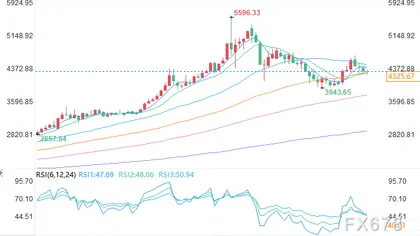
Ethereum prices did not react to the news and retreated a further 5.8% on the day, falling to $3,150 during early Asian trading on Wednesday.
ETH had recovered marginally to trade just above $3,200 at the time of writing, but the crypto correction looks set to deepen.
Ethereum has fallen 21% from its 2024 high of $4,070 on March 12 and remains 34% down from its peak price in late 2021.
Disclaimer: The content of this article solely reflects the author's opinion and does not represent the platform in any capacity. This article is not intended to serve as a reference for making investment decisions.
You may also like
The 5% U.S. Treasury yield storm is coming! The refinancing time bomb countdown begins—who will be the first victim?
The 10-year US Treasury yield has surpassed 5%, reaching a new high since 2007. The longer high interest rates persist, the greater the refinancing pressure will be on real estate companies, commercial real estate, and highly indebted firms, with systemic risks likely to accelerate and emerge within the next 12 to 18 months.

Don't Fight the Profit Cycle! Will U.S. Stocks Break 8,000 Points This Year?
Jefferies predicts that, driven by the dual engines of the AI investment boom and stronger-than-expected corporate earnings, the S&P 500 index is expected to soar to 8,000 points by the end of 2026 and further reach 9,000 points in 2027. AI-driven profit expansion has spread from the "Magnificent Seven" to the entire market, with the S&P 500's EPS forecast to surge by 35% this year, far exceeding market consensus—marking the strongest earnings supercycle since 1995! The only real threat: if US Treasury yields continue to spike, the risk of valuation compression cannot be ignored.
Will “continual learning” AI extend the memory “shortage” until 2031?
Citi believes that as AI enters the era of "continuous learning" beyond simple training and inference stages, demand for HBM, server DDR5, and enterprise SSDs (eSSD) will experience explosive and simultaneous growth starting from 2027. While demand will surge rapidly, the supply side is constrained by HBM production capacity usage and slower technology migration, leading to expansion lagging far behind demand. This supply-demand imbalance is expected to continue until 2031.
Crypto prices
More


