
Bitcoin Trades Below $58,000 – How Much More Downturn Can We Expect?
The price of Bitcoin (BTC) recently slipped below a significant support level at $60,000, even dropping below $58,000.
Over the past 24 hours, the price of BTC has dropped by about 5%, trading for $57,400 at the time of writing (July 4).

Discussing the declines during the previous trading days, Andrew Kang, co-founder of Mechanism Capital, expressed serious concerns about current market trends, which he said were reminiscent of the conditions that led to the significant crash in May 2021.
He further highlighted the critical nature of current market dynamics that many are ignoring:
Most market participants do not appreciate the significance of the potential loss of a 4-month range in Bitcoin. The closest parallel we can draw is with that of the May 2021 range, when we also exited a parabolic rally in BTC and altcoins.
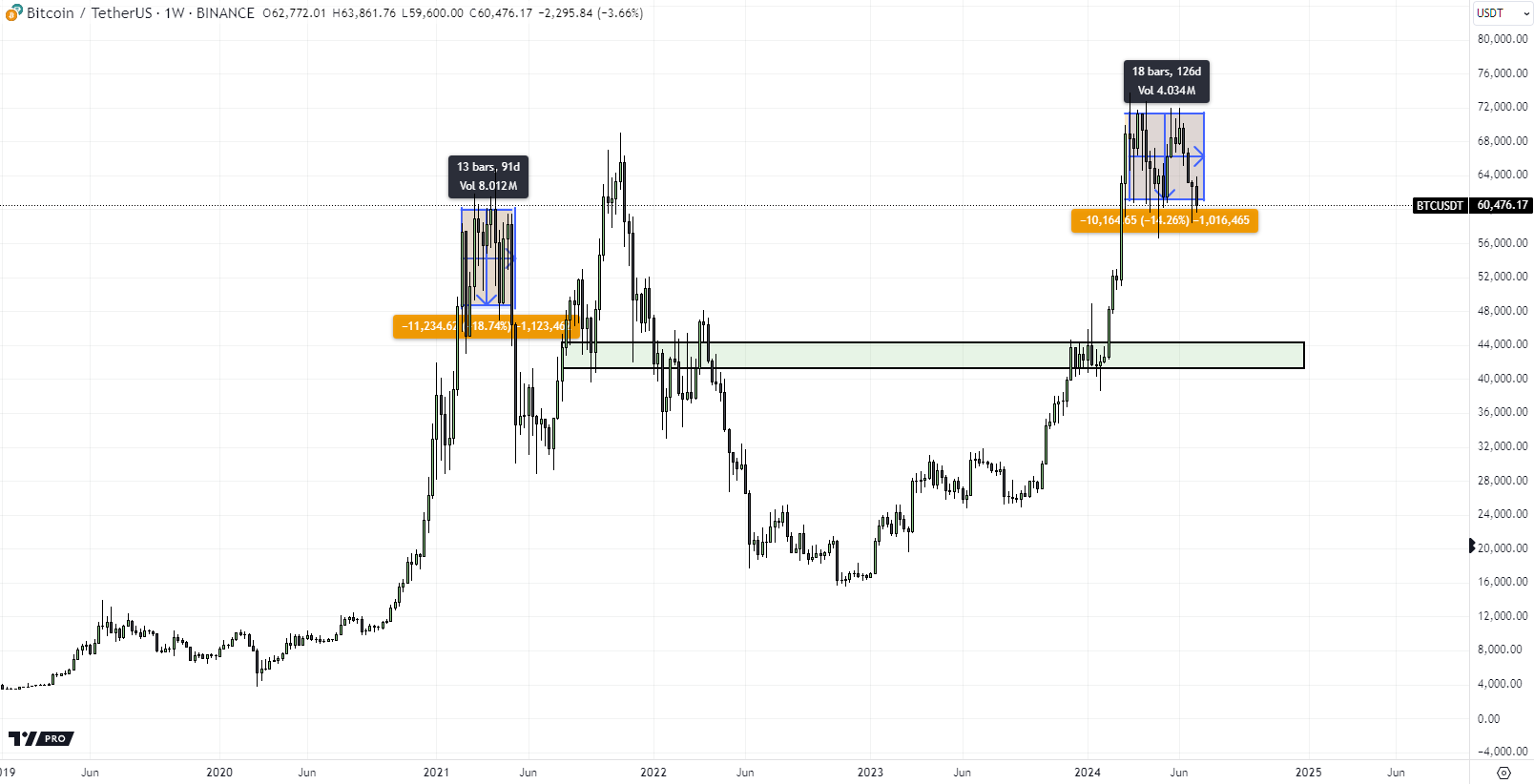
Kang pointed out the similarities in current market conditions, especially in terms of leveraged positions, which now exceed $50 billion:
That figure doesn’t include the Chicago Mercantile Exchange (CME)… but it’s compounded by the fact that in this scenario we have an even longer range (18 weeks versus 13) and we haven’t had extreme washouts yet, whereas in the middle of the 2020-2021 bull market we had several.
Kang also revised his forecast for the bottom of Bitcoin, suggesting a more significant decline than previously expected:
Perhaps my initial low estimates of $50,000 were too conservative and we may see more extreme [losses] to $40,000.
He cautioned that such a decline could have a severe impact on the market, and it would take several months of consolidation and a downtrend before any upside reversal could occur.
In retrospect, the May 2021 downturn was marked by a rapid shift in investor sentiment, triggered by external shocks and further exacerbated by high market leverage.
To date, according to Kang, similar conditions appear to be forming, with high leverage and prolonged periods without significant price corrections suggesting that the market may be on the verge of another major downturn.
Disclaimer: The content of this article solely reflects the author's opinion and does not represent the platform in any capacity. This article is not intended to serve as a reference for making investment decisions.
You may also like
XRP eyes $2 target as Evernorth secures $30M for institutional XRP purchases
JPMorgan: Custom chip shipments will surpass GPU in 2027; Broadcom TPU's "supply chain invisibility" does not indicate questionable orders
J.P. Morgan expects that by 2027, the shipment share of ASICs/XPUs will reach 54%, surpassing GPUs, with custom chips becoming an important new driver of AI computing power. The five-year TPU agreement between Broadcom and Google covers 2026 to 2031; although supply chain information is not transparent, this does not imply doubts about the orders, and revenue visibility remains strong. During the same period, demand for wafer equipment and storage is also strengthening, supporting the continuation of the semiconductor cycle.
US stocks' September downturn not over yet? Citadel strategist warns: Downward pressure still exists before month-end, potential turnaround in October
Citadel Securities strategist Rubner stated that as US stocks face the $7 trillion options expiration on "triple witching day" this Friday, there is still room for quantitative strategies to sell off, and the overlap of the stock buyback blackout period and pension fund end-of-quarter rebalancing means bearish forces will prevail before the end of the month. However, with the sharp decline in AI trading mania, combined with seasonal tailwinds in the fourth quarter, earnings season catalysts, and the restart of stock buybacks, he is optimistic about the market outlook for Q4.
Crypto prices
More


