
Last updated:
September 24, 2024 23:00 EDT

Dealer hid drug stash on a remote mountainside and used crypto as a payment tool, police claim

South Korean police officers in South Jeolla Province say they have arrested seven suspects in a raid on a “ crypto -powered drug dealing” ring.
Per the media outlet KBC , police think the group smuggled methamphetamine into the country from overseas.
The Narcotics Crime Investigation Unit of the province’s Mobile Criminal Investigation Department said they had handed the case over to prosecution officials.
The unit announced on September 23 that they had arrested an unnamed 33-year-old suspected drug dealer on charges of violating the Narcotics Control Act.
It also announced it had charged six people aged between 20 and 49 with buying and using methamphetamine.
The suspected dealer is accused of “colluding with a drug distribution organization” to hide methamphetamine in 118 locations in Gwangju’s West and North districts.
Officers think the suspect was active “between March and April of this year,” and took unnamed cryptoassets as payment.
They think he hid a stash of smuggled narcotics under a tree in a remote mountainside location.
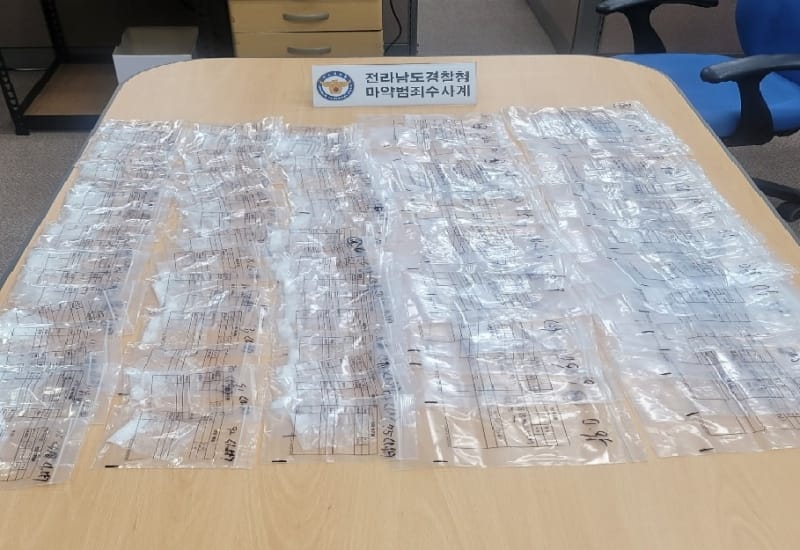 The Jeonnam Provincial Police Agency shows off bags of methamphetamine seized during a raid on a suspected drug dealer. (Source: Jeonnam Provincial Police Agency)
Officers said that the dealer covered bags of narcotics “with plastic and paper” and used “double-sided tape” to attach “deliveries.”
The suspected dealer’s “dead drop” locations included “the railings of a one-room apartment block.”
Police spokespeople said the dealer also left drugs in “the inside of a communication terminal box,” as well as a “fire hose” and an “outdoor air conditioning unit.”
The investigators appear to have set up a sting operation to catch the suspected dealer. They explained that they “searched social media” for crypto-related slang terms.
They then used a chat app (presumably Telegram) to contact the suspect. They then used crypto to pay for drugs, as part of a bid to discover the suspect’s identity.
This eventually allowed them to find not only the suspect, but also his “drug den.” Officers said they confiscated 103.4g of the drug “hidden in a mountain in Gyeonggi Province.”
 Jeonnam Provincial Police Agency officials dig up a package containing narcotics, hidden on a remote mountain path. (Source: Jeonnam Provincial Police Agency)
Police also said they had confiscated 83.35g of methamphetamine that the suspect had “hidden around” the city of Gwangju.
Officers said the drug haul had a street value of “approximately 620 million won (over $465,000).” They said the haul constituted “6,200 individual doses.”
The police said they were expanding their investigation to “identify the true nature of the drug distribution organization.”
Earlier this year, media outlets claimed that Telegram has become a “crypto-powered narcotics department store” for South Korean users.
And earlier this month, South Korean customs officials blamed “the spread of crypto” for an 18% rise in drug smuggling cases .
Customs service spokespeople said they seized 769kg worth of narcotics last year, up from 624kg in 2022.
Some have claimed that this is proof that the nation’s crypto-powered narcotics “epidemic” is continuing to worsen, in spite of police crackdowns.
Disclaimer: The content of this article solely reflects the author's opinion and does not represent the platform in any capacity. This article is not intended to serve as a reference for making investment decisions.
Has the poor performance of new stocks in the same track dampened subscription enthusiasm? Bamboo makes an emergency halt the night before pricing, doubling its valuation in a year but struggling to find a "buyer".
Bamboo, the master underwriter for homeowners insurance in California and Texas, postponed its IPO on Tuesday. The company had planned to issue 35 million existing shares at $18–$20 per share to raise $665 million.

Is the AI replacement wave overestimated? Barclays: Only 20% of core workplace skills can be highly replicated, but amplification effects are quietly spreading
The impact of AI on the workforce is milder, yet more profound than previously imagined. Barclays' latest research dispels the panic of a "replacement wave"—only about 20% of core professional skills can truly be replicated by AI, but its "amplification effect" permeates almost every corner of every profession. What is more concerning is that the demand for AI skills is spreading from tech positions to management roles, and the rise of physical AI could even make human professional skills a new, scalable form of intellectual property.
Costco Q4 Earnings Preview: Membership and Capital-Return Test After a Near-Bear Pullback