
Bitcoin (BTC) Breaks Below Realized Price, Hindering Hopes of $72,000 Rebound

Bitcoin’s recent drop below its realized price points to bearish trends, with potential lows of $66,575 if selling pressure persists.
Bitcoin (BTC) has fallen below its realized price—a crucial metric indicating the average purchase cost of all circulating coins. This dip has weakened hopes for a quick rebound to the $72,000 level, as breaking below the realized price typically indicates mounting selling pressure.
With Bitcoin’s price currently at $68,608, continued trading below this key threshold could suggest a prolonged bearish trend. But how low can BTC go?
Bitcoin’s On-Chain Support Becomes Weak, Whales Sell
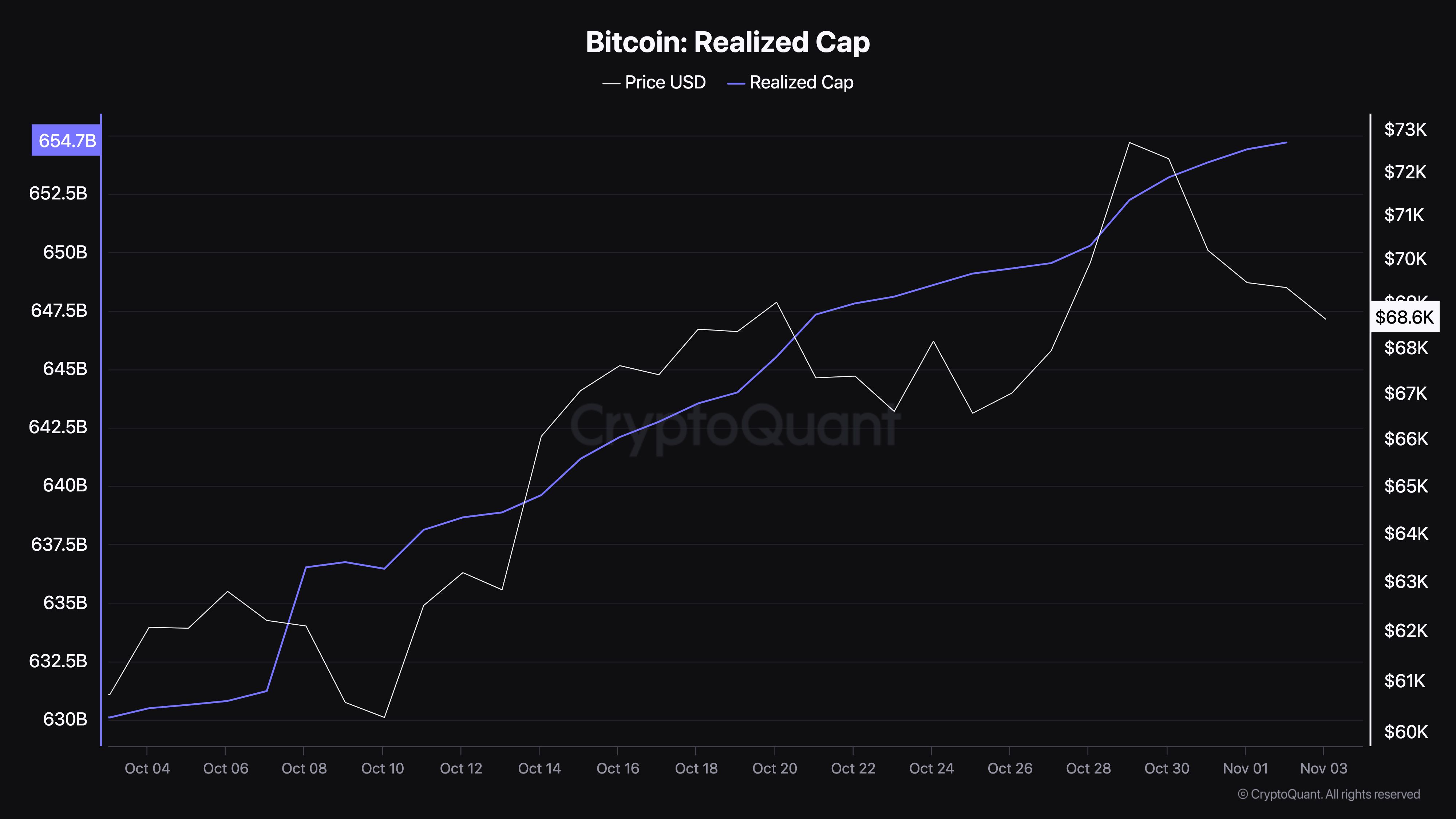
On October 20, BTC fell below the realized price, and within three days, the cryptocurrency’s value declined from $69,022 to $66,611. Later, on October 28, the Bitcoin realized price dropped below the spot value. One day after that, BTC rallied to $72,708, sparking speculation that the coin could soon break its all-time high.
However, that wasn’t the case. Data from CryptoQuant reveals Bitcoin’s realized price is $69,352, higher than its current value.
Typically, when the realized price sits below the market price, it acts as on-chain support, implying potential upward movement. But with it now above, BTC’s chances of reclaiming the $72,000 level in the short term appear limited.
Read more: 7 Best Crypto Exchanges in the USA for Bitcoin (BTC) Trading
 Bitcoin Realized Price. Source:
CryptoQuant
Bitcoin Realized Price. Source:
CryptoQuant
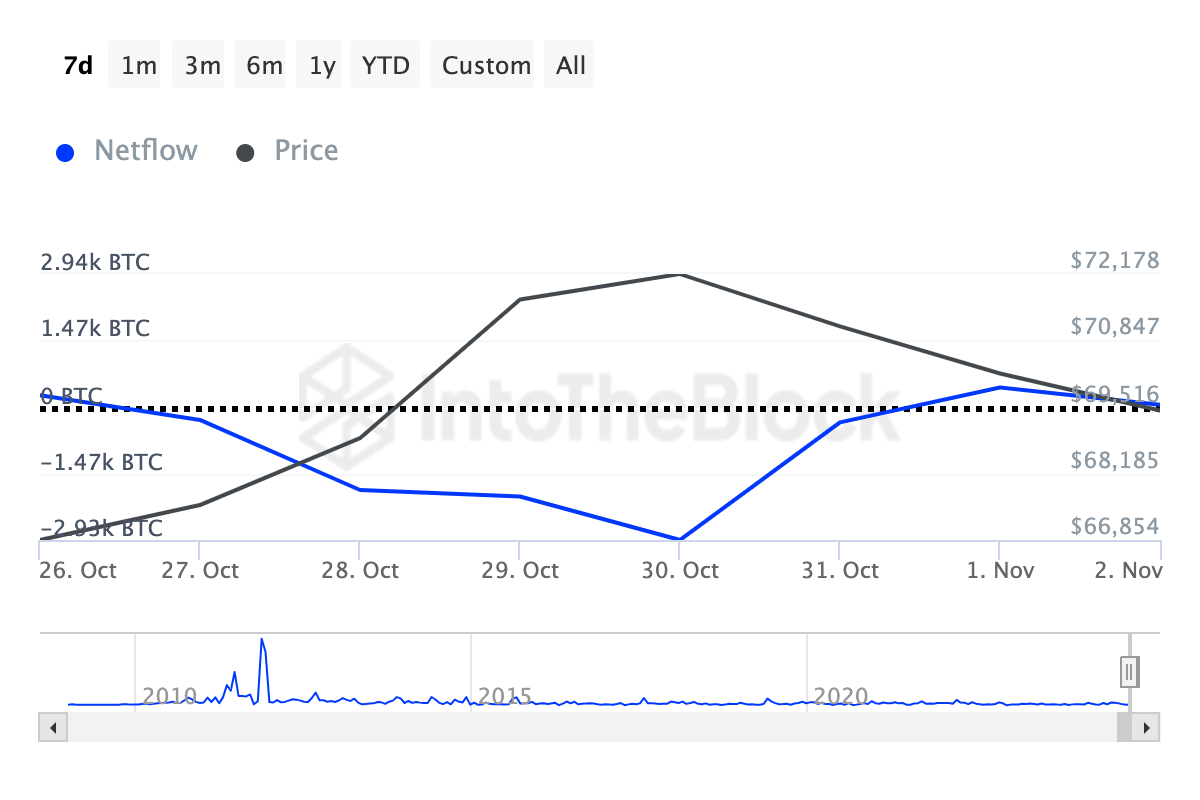
Another indicator suggesting that Bitcoin might find it hard to rebound is the large holders’ netflow. This metric looks at the activity of addresses holding between 01.% and 1% of the total circulating supply.
When the large holders’ netflow is positive, crypto whales are accumulating, and prices can increase. However, based on IntoTheBlock’s data, the netflow has decreased, meaning whales have sold more coins than they purchased within the last seven days.
If sustained, this current condition will align with Bitcoin’s realized price position of another potential decline.
 Bitcoin Large Holders Netflow. Source:
IntoTheBlock
Bitcoin Large Holders Netflow. Source:
IntoTheBlock
BTC Price Prediction: Retracement to $66,000 Looms
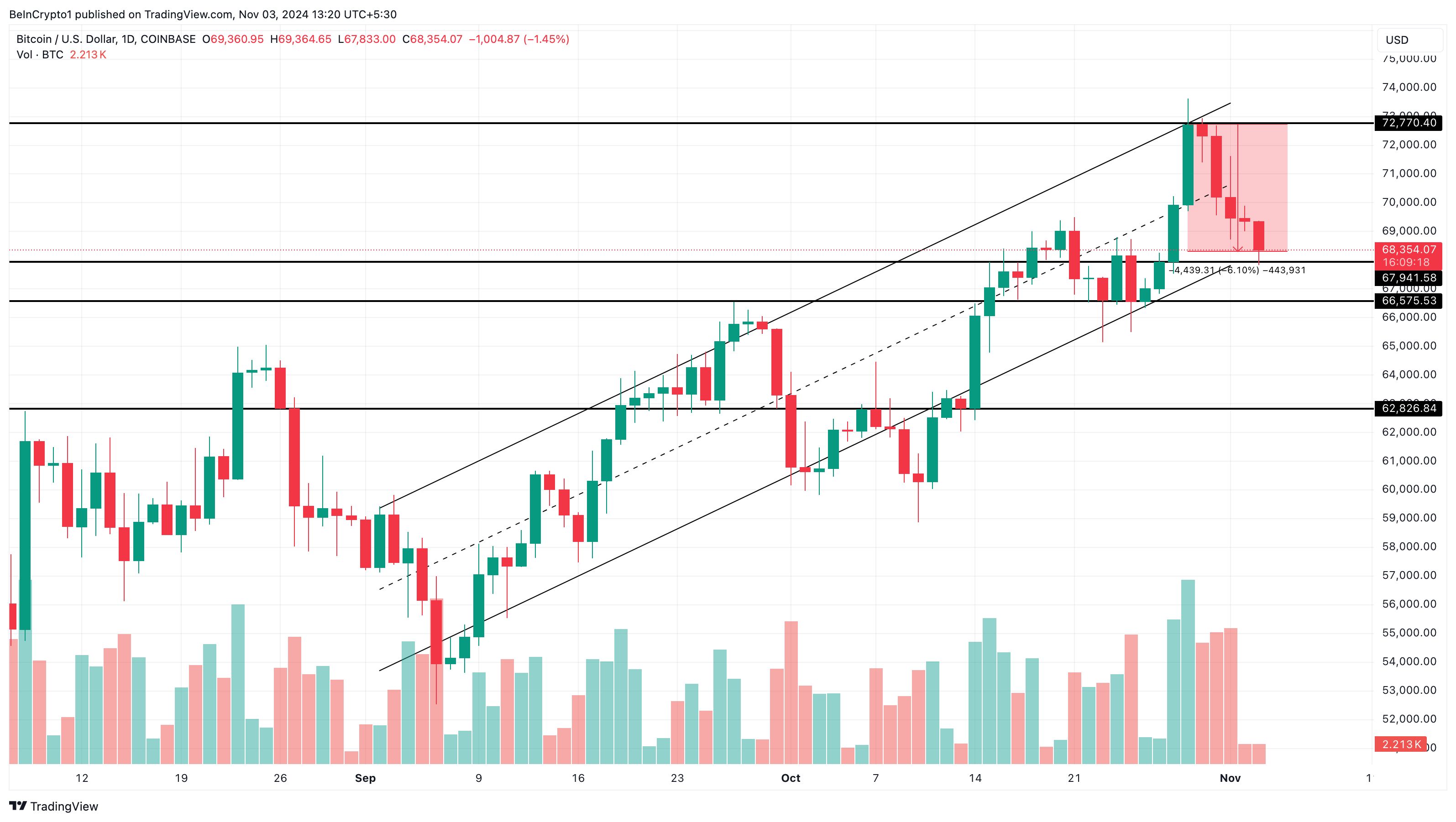
Bitcoin’s current price marks a 6% drop from its recent local top, placing it on the edge of breaking below an ascending channel on the daily chart.
This pattern, formed by two upward trendlines, shows resistance at the top and support at the bottom. Currently, Bitcoin is hovering near the support line at $67,941.
If BTC falls below this support, it could slide to $66,575, with a further decline to $62,826 in a more bearish outlook.
Read more: Bitcoin (BTC) Price Prediction 2024/2025/2030
 Bitcoin Daily Analysis. Source:
TradingView
Bitcoin Daily Analysis. Source:
TradingView
Conversely, if Bitcoin’s realized price drops below its current value, it could signal a trend reversal. In that case, BTC may rally toward $72,770, potentially setting the stage for a new all-time high.
Disclaimer: The content of this article solely reflects the author's opinion and does not represent the platform in any capacity. This article is not intended to serve as a reference for making investment decisions.
You may also like
Dow Jones Industrial Average bounces on Iran's latest Hormuz offer
U.S. stocks opened higher and fluctuated, the Japanese yen rebounded more than 1% intraday, 10-year U.S. Treasury yields broke above 5.22% again, and U.S. crude oil once fell nearly 3%.
After the release of U.S. consumer confidence data, the S&P and Nasdaq turned negative, while the Dow is poised to break a three-day losing streak but is set for a fourth consecutive weekly decline. Meta pulled back, falling more than 3% during the session. The U.S. 10-year Treasury yield surpassed 5.22% again, marking a new high for the third day in a row since 2007, while the 30-year yield reached its highest level since 2004. The yen/dollar pair surged 1.2% intraday, as Japanese and U.S. officials successively signaled concerns over the weak yen. Expectations for a diplomatic resolution between the U.S. and Iran are rising, halting crude oil's two-day climb.
US Treasury volatility surges, triggering alarms! BofA’s Hartnett warns of rising deleveraging risks as higher yields become main threat to the market
Bank of America strategist Michael Hartnett warns that the recent sharp rise in volatility in the US bond market is increasing the risk of broader deleveraging in financial markets.
U.S. diesel prices surge 83% this year! Apollo Chief Economist warns: Cost pass-through may make core inflation more stubborn, Federal Reserve can't ignore it
Torsten Slok, Chief Economist at Apollo Global Management, has warned that the inflation threat posed by the surge in U.S. diesel prices to historic highs may be more serious than the Federal Reserve currently realizes.
Crypto prices
More


