
Psychological Tactics Revealed: How Kalshi and a16z Manipulate Crypto Market Narratives?

Author: TM
Translation: Tim, PANews
Original Title: Revealing the Secrets Behind Kalshi and ai16z’s Hype: The “Psychological Warfare” Across the Crypto Market
I probably shouldn’t publish this article because it’s too insightful. Let’s dive deep into the world of crypto marketing: a masterclass in psychological warfare.
If you don’t know what psychological warfare means, it means you’ve been manipulated your entire adult life.
Welcome to the world of Meme Wars.

Milady
Example 1: Kalshi Enters the Crypto Market
Let’s start with Kalshi. This isn’t about spreading FUD; in fact, I admire their execution. I’m just sharing some personal thoughts on Kalshi-related events, and of course, none of this is confirmed.
As the Meme coin craze faded, prediction markets started to gain attention. Some KOLs began pushing this narrative, including John Wang.
There’s no doubt that prediction markets are fairer than Meme coins. Meme coins are a brutal 1 vs 1000 game, while prediction markets at least balance the odds. But to be honest: crypto market fanatics just love tokens, and always have.
So the question becomes: how do you capture Meme coin market share without issuing a new token, while also challenging top platforms like Polymarket?
The answer: psychological warfare
Here’s how it went down:
-
John Wang had already signed with Kalshi before the official announcement.
-
In the preceding months, social interactions and researcher citations boosted his account’s visibility.
-
When the news finally broke, the publicity campaign was coordinated: news media, influencers, and “research” pages all reported on the same KOL’s hiring.
News reports about hiring a crypto KOL
This was framed as a major event, as if Kalshi had just poached an executive from Google or Apple.
A simple yet clever psychological tactic: turning a personnel change into a full-blown marketing campaign.
Kalshi wasn’t just entering the crypto space; they made it look like a paradigm shift.
They paid these websites, research institutions, and influencers to discuss the announcement. A sensational personnel change. Kalshi officially enters the crypto market, with momentum comparable to a FAANG stock IPO.
A simple but effective psychological tactic: they released the announcement and turned it into a massive marketing campaign.
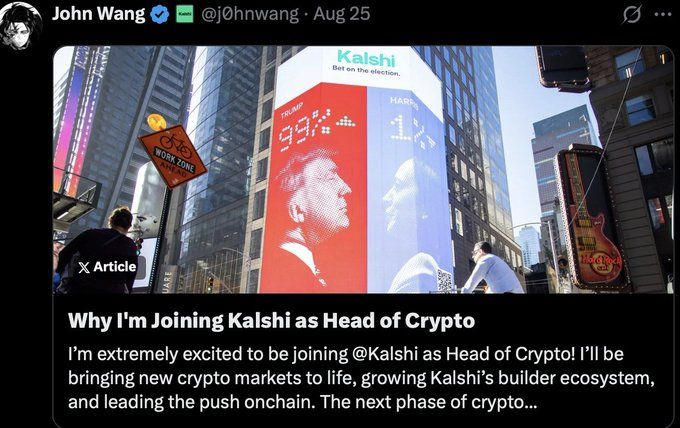
Is John Wang Kalshi’s marketing manager?
Example 2: The ai16z Flywheel
Now, let’s talk about ai16z.
This idea was truly genius. It made people (myself included) genuinely look forward to the future of Crypto x AI integration.
The script went like this:
-
They launched a Meme DAO around the idea of tokenizing the VC giant a16z.
-
Marc Andreessen himself responded, validating the Meme’s viral value.
-
Suddenly, the entire industry’s attention was focused on this “new AI fund.”
-
Then came the product launch: Eliza AI Agent.
It quickly shot to the top of GitHub. The timing was perfect, and the hype was unstoppable.
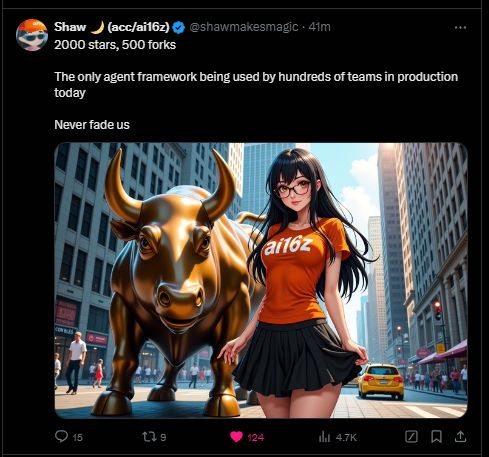
Shaw showing off
But underneath, it was just a GPT wrapper. Frankly, it simply connected the existing large language model API to the frontend—nothing groundbreaking.
Who cares? Actually, no one. The product was easy to use, the vibe was right, and that was enough.
The psychological tactic here was not just about technology, but about narrative.
Joining the ai16z DAO became a status symbol. Like wearing a Rolex in the early days, being an “ai16z partner” meant you were an insider. This title attracted developers from top universities and wealthy believers.
The DAO’s market cap soared to $2.5 billions (but with laughably low liquidity). The flywheel effect was formed: hype attracts liquidity, liquidity attracts investors, and investors generate more hype.
But then the problem arose: how do you cash out without destroying the chart?
The answer: you don’t need to. Instead, ai16z “sold” their technology to other crypto AI projects in exchange for up to 10% token allocation deals, and in return, received marketing support.
The result? A flood of half-baked AI projects. Support, pump, dump.

Shaw after dumping free crypto AI tokens
The psychological tactic worked. Liquidity was drained, and now ai16z is plotting a comeback.
The Essence of Psychological Warfare
The problem is: the same trick can’t work twice.
Once people see through the ruse, it loses its market. The masses will chase the next new thing. That’s why so many projects keep recycling those old buzzwords:
-
Airdrop
-
Roadmap
-
Buyback
-
Flywheel
-
Tokenomics
If you hear these, the project is still in its early stages. In this market, empty talk is outdated; delivering products is what matters.
Welcome to the Meme War
Today’s crypto marketing isn’t advertising—it’s war.
Narrative is the weapon, engagement is the ammunition. Every announcement, every partnership or controversy, is a battle for mindshare.
The winning projects aren’t just selling technology; they’re executing coordinated psychological warfare: weaving stories, memes, and strategies that their target audience wants to believe.
Not everyone plays by the same rules.
So if you want to capture market share in this industry, you’d better arm yourself. Build your team like a Roman warlord preparing for conquest.
Because in crypto, this is a war.
Disclaimer: The content of this article solely reflects the author's opinion and does not represent the platform in any capacity. This article is not intended to serve as a reference for making investment decisions.
You may also like
Here’s why BlackRock believes autonomous AI systems will drive next stablecoin boom
BlackRock expects exchange-traded compute futures as it pitches stablecoins for AI agents
Report: TSMC to Raise Wafer Foundry Prices by 3% to 6% Starting January Next Year, Order Visibility Extended to 2030
According to media reports, TSMC's advanced and high-priced processes such as 2nm and 3nm have seen the largest price increases; mature and specialty processes are subject to individual negotiation based on products, capacity utilization, and customer conditions. Currently, TSMC's 8-inch fabs have a capacity utilization rate exceeding 100%, and processes below 45nm are at full capacity. The construction of AI data centers is not only driving demand for GPU and HBM, but also boosting orders for mature processes such as PMIC, MCU, and analog ICs.
U.S. Treasury plans to repurchase up to $6 billion in long-term bonds, 30-year yield hits highest since 2007
This is the second round of enhanced long-term bond buybacks by the Treasury, this time focusing on 20- to 30-year government bonds. After the announcement of the planned upper limit, the yield on 30-year U.S. Treasury bonds continued to rise, at one point exceeding 5.4%. In the first round of enhanced buybacks two weeks ago, the upper buyback target was also $6 billion, which was lower than some market participants had expected, and the actual buyback amounted to only $5.2 billion due to insufficient competitive bidding, according to the Treasury.
Crypto prices
More


