
Avalon Labs Launches on Bitcoin Layer 2 Rootstock

Bitcoin lending market Avalon Labs is now live on Rootstock, the fourth largest Bitcoin sidechain by total value locked (TVL), according to a press release viewed by The Defiant.
The integration will see Avalon expand to Rootstock, and compete to be the chain’s largest lending market by providing access to Bitcoin-collateralized lending for digital assets such as Rootstock’s RBTC and RIF, as well as stablecoins like USDC.E and Tether’s cross-chain stablecoin protocol USDT0.
Avalon is the latest major integration for Rootstock, which already boasts support for USDT0, LayerZero, and Solv Protocol. These additions to Rootstock are meant to boost the chain’s capabilities as a leader in Bitcoin DeFi, also known as BTCFi, and are intended to help the network continue to scale to new highs.
Jason Twu, Avalon’s head of ecosystem, commented on the announcement, telling The Defiant: “This is a partnership between two BTCFi powerhouses and signals a leap forward for scaling all sorts of useful applications that use Bitcoin.”
Avalon’s current TVL sits at $752 million, a 113% increase over the last year. However, TVL in the lending market is still down 62% from its all-time high of $2 billion in January 2025.
“We’re both laser-focused on this shared vision of providing industry-leading financial products not just for retail users but also the growing number of institutional-size actors that desire to do more with their Bitcoin.” Twu concluded, referring to the partnership.
The Rootstock integration may help Avalon reclaim its strong growth trajectory from Q4 2024, as Rootstock has been steadily growing over the last two years, and commands a $255 million TVL today, compared to just $42 million at the beginning of 2023.
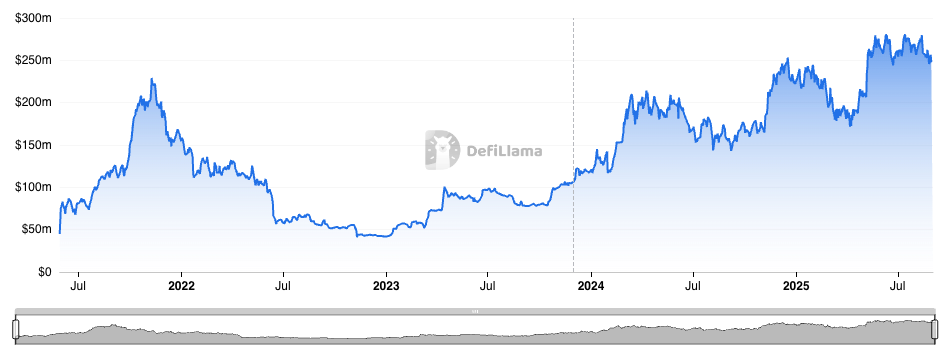
While the Rootstock network has been consistently growing in the past two years, the chain’s RIF token has yet to catch up with the network’s performance. RIF is down almost 25% over the last year, and changes hands at a $56 million market capitalization, an 82% decrease from its all-time high of $313 million in 2021.
Disclaimer: The content of this article solely reflects the author's opinion and does not represent the platform in any capacity. This article is not intended to serve as a reference for making investment decisions.
You may also like
Cloudflare Hits a New High: Is AI Turning From a Threat Into a Growth Engine?
Tonight, a "dovish rate hike"?
The Federal Reserve is almost certain to raise interest rates tonight, but the key issue is "what will be said after the hike." Citi characterizes this move as a "fine-tuning" adjustment, suggesting there is no inevitable future rate hike, yet warns that if Chairman Powell does not provide clear forward guidance, it will trigger significant market volatility. Goldman Sachs bluntly stated that there is insufficient economic foundation for this rate hike, with inflation being merely a one-off factor, and expects this to be a "signal-less rate hike."
JPMorgan: "Open source disruption" and "AI safety" are not issues, there is still room for capital expenditure in the next two years, semiconductor equipment will become the "new bottleneck"
JPMorgan believes that open-source models are not a threat, regulatory disruptions are only short-term, and cloud vendors’ leverage remains low—the fundamentals of computing power investment have not changed. It forecasts that the capital expenditure of the seven major tech giants will soar from $443 billion in 2025 to $1.577 trillion in 2027, with semiconductor equipment becoming the core bottleneck of the supply chain and a new round of price increases expected in wafer foundry and advanced packaging.
Micron executive: Storage determines AI limits, substantial new capacity will come after 2028
Micron executive Sumit Sadana stated that memory bandwidth and capacity have become the core factors determining the performance ceiling of AI systems. In the face of structural imbalances between supply and demand, Micron expects to increase capital expenditure to over $45 billion in fiscal year 2027, but due to process complexity, substantive new capacity will not be released until 2028. Additionally, long-term supply agreements are reshaping the industry's business model, and humanoid robots will trigger the next wave of massive demand.
Crypto prices
More


