
Ethereum ETFs extend losses for fourth day as ETH slips to $3,900

Ethereum ETFs have suffered another day of outflows, dragging ETH below the key $4,000 mark as institutional sentiment turns bearish.
- Ethereum ETFs posted outflows reaching $251 million on Sept 25, the largest single-day redemption this week, reflecting sharp institutional pullback.
- Fidelity’s FETH fund accounted for over 60% of the day’s losses, with $158 million withdrawn.
- ETH price has dropped to $3,900, currently testing support around $3,800.
Ethereum ETFs recorded net outflows of $251.20 million on Sept. 25, marking the fourth consecutive day of withdrawals. Per SoSoValue data , the bulk came from Fidelity’s FETH fund, which saw $158 million leave the market, underscoring the sustained bearish sentiment around Ethereum-focused institutional products.
Grayscale’s ETHE and Bitwise ETHW followed far behind with $30 million and $27 million, respectively, while VanEck ETHV posted the lowest figure of $1.4 million.
The latest withdrawals marked the largest single-day redemption this week and pushed the week’s total losses to more than $547 million, underscoring waning demand for Ethereum exposure among institutional investors.
By comparison, Bitcoin ETFs have fared better. While they also posted similar outflows in the latest session, their weekly performance has been significantly stronger than their ETH ( ETH ) counterparts.
Ethereum ETF outflows deepen price woes
The heavy withdrawals in the exchange-traded funds come as Ethereum continues to trade lower, now below the 4,000 mark. At press time, ETH sits at $3,939, down roughly 2.3% on the day and 13% over the past week.
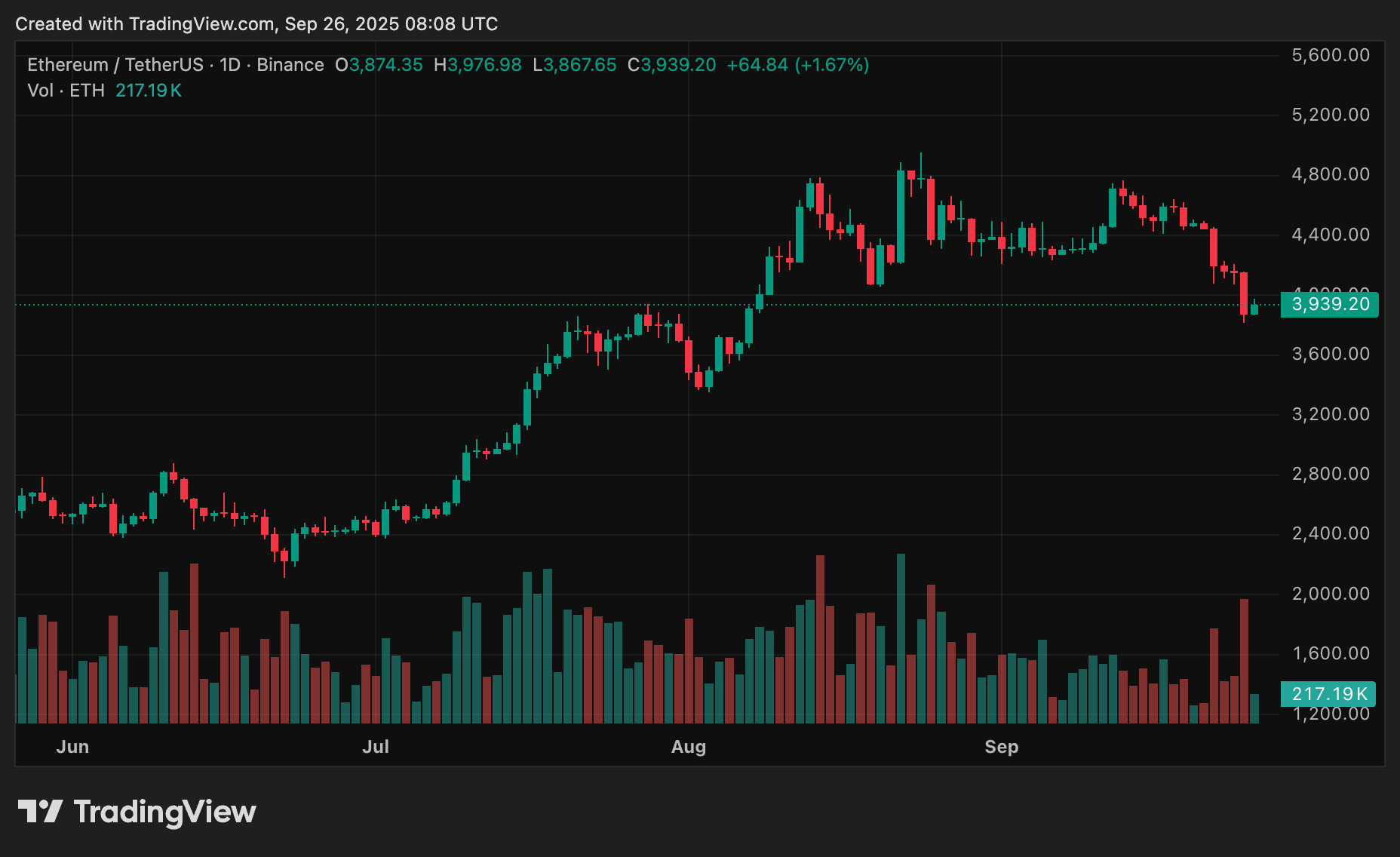
The second-largest cryptocurrency has seen a consistent downtrend that has erased a large chunk of its recent gains, now close to the $3,800 support zone. On the technical side, indicators suggest weakened momentum and potential for a technical rebound if buyers step in.
If the decline persists and Ethereum fails to hold above $3,900, the next key support sits near $3,750–$3,800, while upside attempts will face resistance around $4,100.
Overall, market sentiment appears fragile, with ETH’s inability to stabilize suggesting caution in the short term. A reversal will likely require a clear bullish catalyst or macro shift.
Disclaimer: The content of this article solely reflects the author's opinion and does not represent the platform in any capacity. This article is not intended to serve as a reference for making investment decisions.
You may also like
Crude Oil sells off and takes it all back on Saudi cargoes through Oman
Jensen Huang: Nvidia chip sales will double next year compared to this year, AI cannot be regulated like social media
Jensen Huang opposes applying social media regulations directly to AI, arguing that social media is a product, while AI is an underlying technology that supports other technologies and products. He believes regulation should target products, not the technology itself. He emphasizes rigorous testing and states that products should be withheld from release if they are not safe enough. "AI safety is of utmost importance."
What to buy after the Federal Reserve raises interest rates? Historically, US energy and technology stocks outperform while real estate lags. Goldman Sachs: The pace of rate hikes determines the US stock market.
U.S. stock performance in the 12 months after the first Federal Reserve rate hike: According to Jefferies, the energy sector led with an average return of 22.4%, followed by information technology at 15.4%. According to Charles Schwab, real estate underperformed the S&P 500 by 4.3%, making it the worst of the 11 sectors. Goldman Sachs states that the pace of rate hikes is the core variable affecting U.S. stocks; currently, if the 10-year U.S. Treasury yield rises by 50 basis points within a month, it will create "rapid rate hike" pressure.
Bank of America Ripple Report Fuels XRP Debate
Crypto prices
More


