
Wisconsin bill to exempt crypto businesses from money licenses

Wisconsin lawmakers have introduced a bill on Monday that, if enacted, would exempt individuals and businesses in the state from requiring money transmitter licenses to participate in mining, staking and exchanging digital assets.
According to a document from the Wisconsin Legislative Reference Bureau, the bill seeks to clearly define exemptions from requiring a license from the Department of Financial Institutions for money transmission-related activities.
Under the proposed exemptions of Wisconsin Assembly Bill 471, individuals or businesses would not need DFI licences for crypto mining, staking and developing blockchain software.
It also exempts the exchanging of digital assets if the transactions don’t involve the “conversion to legal tender” or bank deposits.
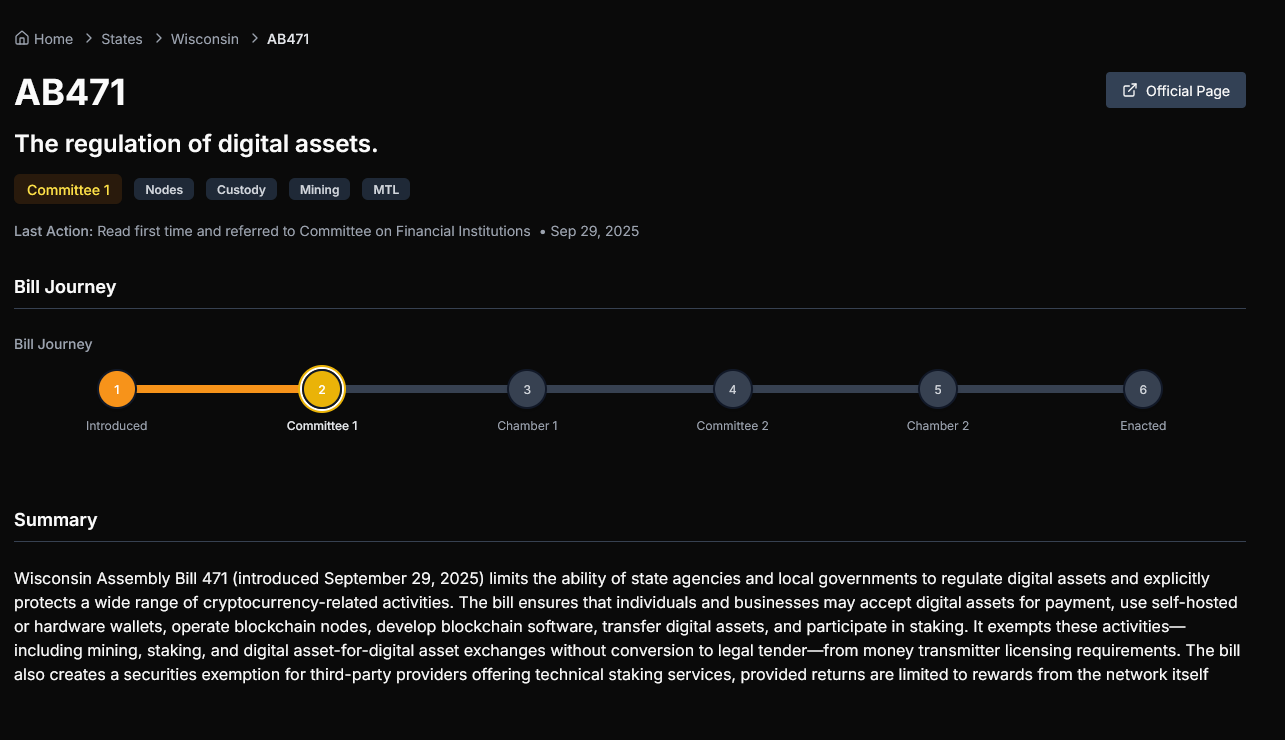
“Under the bill, neither a state agency nor a political subdivision may prohibit or restrict a person in accepting digital assets as a method of payment for legal goods and services or in taking custody of digital assets using a self-hosted wallet or hardware wallet,” the document reads, adding that:
“The bill also specifies that a person in this state may 1) operate a node for the purpose of connecting to a blockchain protocol and participating in the blockchain protocol’s operations; 2) develop software on a blockchain protocol; 3) transfer digital assets to another person utilizing a blockchain protocol; and 4) participate in staking on a blockchain protocol.”
The bill marks another attempt to reduce some of the legal gray area surrounding state-based crypto regulation. There is still a lack of clear rules across the country for crypto despite increasing adoption.
Wisconsin bill still has hurdles to pass
The bill is sponsored by seven Republican members at the House level, and two Republican co-sponsors from the Senate, and has since been referred to the Committee on Financial Institutions.
According to Legiscan, the bill has a current progression rate of 25%, as it still has to pass through one chamber and two more committees before it could potentially be enacted.
Disclaimer: The content of this article solely reflects the author's opinion and does not represent the platform in any capacity. This article is not intended to serve as a reference for making investment decisions.
You may also like
Overnight US Stocks | Probability of Fed Rate Hike in October Rises to 69.7%, All Three Major Indexes Fall, SK Hynix (SKHY.US) Drops Over 3%
At the close, the Dow Jones Industrial Average dropped 351.27 points, or 0.68%, to 51,512.42 points; the S&P 500 Index fell 58.25 points, or 0.75%, to 7,706.39 points; and the Nasdaq Composite Index declined 308.24 points, or 1.13%, to 26,936.04 points.
Here’s why BlackRock believes autonomous AI systems will drive next stablecoin boom
BlackRock expects exchange-traded compute futures as it pitches stablecoins for AI agents
Report: TSMC to Raise Wafer Foundry Prices by 3% to 6% Starting January Next Year, Order Visibility Extended to 2030
According to media reports, TSMC's advanced and high-priced processes such as 2nm and 3nm have seen the largest price increases; mature and specialty processes are subject to individual negotiation based on products, capacity utilization, and customer conditions. Currently, TSMC's 8-inch fabs have a capacity utilization rate exceeding 100%, and processes below 45nm are at full capacity. The construction of AI data centers is not only driving demand for GPU and HBM, but also boosting orders for mature processes such as PMIC, MCU, and analog ICs.
Crypto prices
More


