
Bitget App
Trade smarter
Buy cryptoMarketsTradeFuturesStocksEarnInstitutionAI & More
Crypto market’s weekly winners and losers – POL, JASMY, NIGHT, ZEC

Crypto market’s weekly winners and losers – POL, JASMY, NIGHT, ZEC

AMBCryptoAMBCrypto2026/01/11 19:03
By:AMBCrypto

The new year started with a bang, but the excitement didn’t last long.

After a strong first week, the crypto market has fallen back into its all-too-familiar cycle of ups and downs. Bitcoin [BTC] and Ethereum [ETH] both made negligible moves, with weekly losses of 0.95% and 1.60%.

So how did the rest of the market hold up?

Weekly winners

Polygon [POL] –  Usage numbers skyrocket

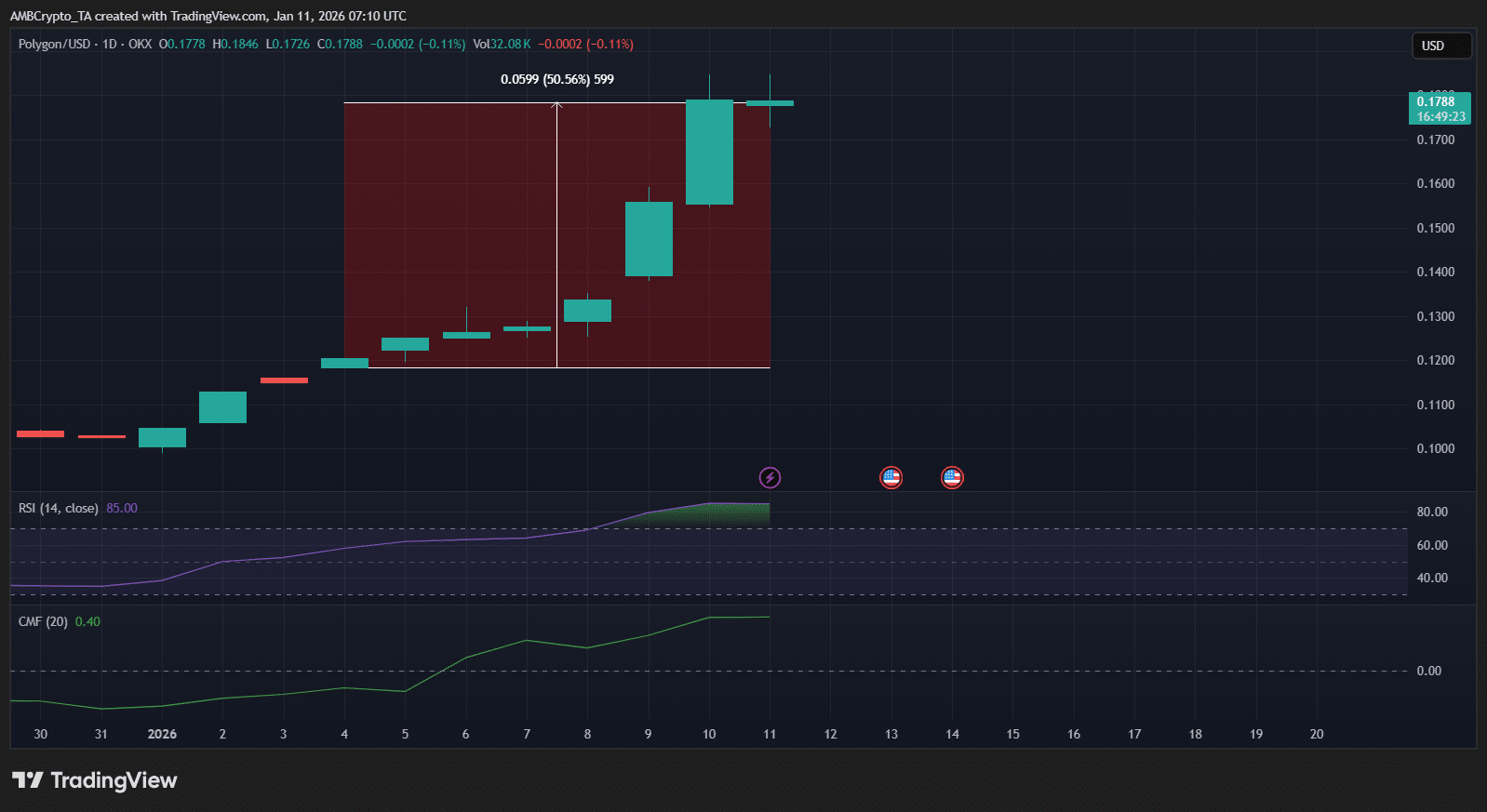
What makes POL’s rally stand out is that the network didn’t flinch while the price took off. Daily active addresses held steady through early January, with transactions climbing in step with other major EVM chains.
Crypto market’s weekly winners and losers – POL, JASMY, NIGHT, ZEC image 0

Source: TradingView

Polygon [POL] pushed nearly 50% higher in a short span, breaking out cleanly with expanding volume. RSI was overbought, and capital didn’t rush out yet.

As long as activity stays firm and users keep showing up, the move up is set to go much higher.

Virtuals Protocol [VIRTUAL] – Hitting supply with little panic selling

After a run-up, Virtuals Protocol [VIRTUAL] price action has slowed down too. However, this looks like momentary trouble, with gains of 22% posted at press time.

The coin pulled back after a high-volume supply zone just above the $1.05-$1.10 range.

Volume Profile data showed heavy prep around the $1.00 mark, which may be why price stalled and slipped instead of pushing straight through.

Importantly, this wasn’t a breakdown. RSI hit 63 at the time of writing, which means momentum was slowing without giving in. Price held well above the $0.85 support zone, where earlier demand stepped in.

For now, it may be consolidation under resistance.

JasmyCoin [JASMY] – Rose and stopped just as fast

JasmyCoin [JASMY] had a strong week, going from the $0.0065 region and pushing above $0.0095 before slowing down. The surge came with higher volume, which means the rally had real substance and is likely to hold.

Since then, price has started to go sideways in a tight range, so the market is probably taking a moment to assess after the run.

RSI was elevated and MACD was in positive territory, so bullish momentum was intact. As long as JASMY holds above the $0.0065-$0.0067 support zone, it is expected that the coin will consolidate.

Other notable winners

Privacy coin Monero [XMR] climbed around 11%, which is interesting, considering other top privacy coins posted big losses.

Render [RENDER] surged nearly 25%, benefiting from recent interest in decentralized compute and AI-linked infrastructure. Meanwhile, Artificial Superintelligence Alliance [FET] posted gains of about 15%.

By the looks of it, traders seem to be rotating into specific themes and narratives.

Weekly losers

Midnight [NIGHT] – Certainly exhausted, but not worn down yet

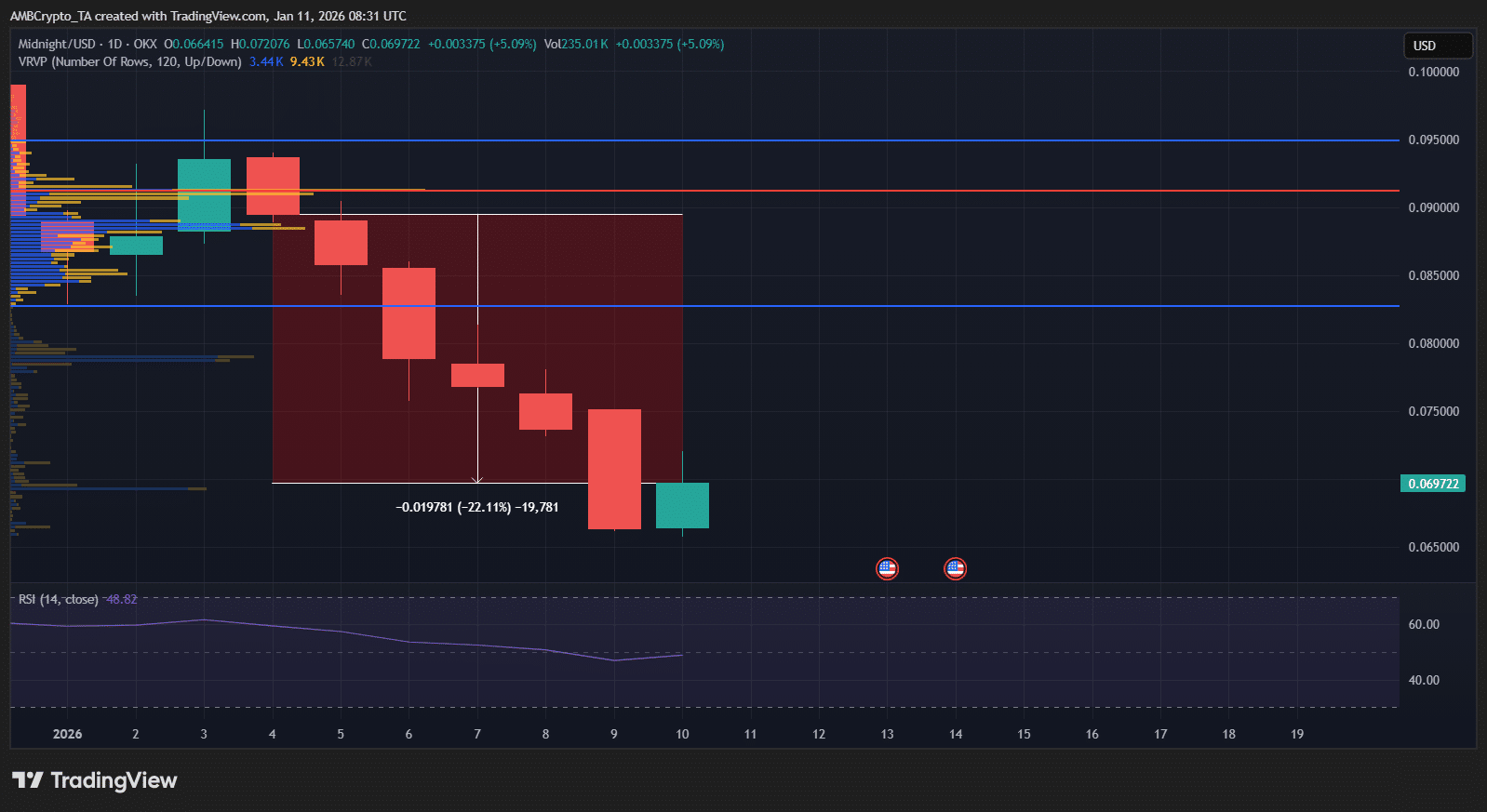
Midnight [NIGHT] had a rough stretch, down 22% from its local high before finding some footing. It looked like the coin lost steam than anything else.
Crypto market’s weekly winners and losers – POL, JASMY, NIGHT, ZEC image 1

Source: TradingView

The red candles came as price hit a dense supply zone near $0.09, where Volume Profile showed heavy prior positioning. What’s interesting is what followed.

Selling pressure fell quickly, and the price has started to stabilize around $0.067. RSI was in neutral territory at press time, so the bears weren’t fully in control.

If buyers defend this zone, Midnight could build a base that traders often miss.

ZCash [ZEC] – Fell hard, but selling is losing its bite

Zcash [ZEC] took a hit this week, sliding nearly 26% from the $510 area before finding support near $370. On the surface, that looks ugly. But the worst of the selling may already be behind it.

RSI dipped deep into oversold territory, while CMF stopped accelerating lower. Capital outflows are slowing.

The reaction near support is notable. Despite heavy red candles earlier, recent price action had started to flatten, so sellers were running out of urgency.

If ZEC holds this zone, the next move is likely to be an uncomfortable bounce.

Canton Network [CC] – Tripped, but didn’t quite fall

Most privacy-focused tokens have had a rough week, with several names struggling to hold recent gains. Canton [CC], however, has more to it than just a surface-level fall.

After an early push higher, price pulled back about 18% from local highs and has since settled near the $0.13 region. That retracement looks controlled.

Price was above the lower Bollinger Band, so volatility is low. RSI was firmly neutral, while OBV flattened instead of breaking down; distribution hasn’t taken over… yet.

Sellers are present, but confidence is weak. If privacy narratives regain footing, Canton looks positioned to stabilize first.

Other notable losers

Uniswap [UNI] slipped about 7%, as trading activity cooled across major DEXs. Dash [DASH] fell nearly 13%, with weakness in the privacy coin bracket.

Dogecoin [DOGE] dropped around 8%, so even the high-visibility memecoins weren’t immune.

Conclusion

At the end of the day, this market doesn’t reward rushing in or out. Some moves will stick, some won’t… and sometimes it isn’t obvious which is which in real time.

So take the signals, double-check the data, and DYOR before making any calls.

Final Thoughts

  • While Bitcoin and Ethereum slipped under 2%, select altcoins surged as high as 50%.
  • Usage, volume, and narrative strength mattered more than talk this week.
0
0

Disclaimer: The content of this article solely reflects the author's opinion and does not represent the platform in any capacity. This article is not intended to serve as a reference for making investment decisions.

Understand the market, then trade.
Bitget offers one-stop trading for cryptocurrencies, stocks, and gold.
Trade now!

You may also like

Updated: Delta Air Lines warns that as fuel prices hit profits, airline capacity will tighten further

Delta Airlines lowers its annual profit forecast due to an expected increase in fuel costs to $6 billion. The CEO stated that ticket prices have risen by about 20% this year, with limited passenger resistance. Analysts warn that maintaining high ticket prices in 2027 is critical for improving profitability. The article includes comments from the earnings call and analyst remarks. Rajesh Kumar Singh/Shivansh Tiwary, Reuters Chicago, October 9 - Delta Airlines (DAL.N) said on Friday that, despite strong travel demand and rising ticket prices, soaring fuel costs have forced it to cut its 2026 profit expectations by nearly a quarter. So, the airline industry may need to further limit flight growth next year to protect profitability. This warning highlights the increasingly tough challenges faced by U.S. airlines. While strong demand and restricted seat growth have allowed airlines to significantly raise ticket prices and offset higher fuel costs, aggressively increasing flights to capture more demand may intensify competition, making it harder to maintain high fares and protect profits. Based in Atlanta, Delta now expects its annual fuel expenditure to increase by about $6 billion compared to last year—about $2 billion higher than its July forecast—due to the Iran war (link) causing global jet fuel prices to spike. Airlines worldwide are preparing for a prolonged fuel shock. Michael O’Leary, CEO of Ryanair Group RYA.I, said Thursday that high jet fuel prices could persist for another 12-18 months (link), adding more pressure on airlines to raise fares and control costs. https://www.reuters.com/graphics/AUTOMATED-20261008/A4A-JET-FUEL-DAILY-1Y/xmpjwjnmbvr/chart.png “In a high-cost environment, you can’t simply grow your way out,” Delta CEO Ed Bastian said on the earnings call. He noted that the industry has already taken steps to restrict capacity, but more measures will be needed next year to improve profitability. Bastian said Delta raised ticket prices about 20% this year, and passenger resistance has been limited. He is confident that even if fuel costs eventually drop, the high fares can still be maintained. Delta lowered its adjusted annual earnings per share forecast from the July prediction of $6.50-$7.50 to $5.10-$5.60. According to LSEG data, the midpoint of the new range is below analysts’ average expectation of $5.46. Third-quarter adjusted earnings per share were $1.72, four cents below analysts’ average forecast. In midday trading, shares of Delta dropped 1.7%, United Airlines UAL.O fell 1.4%, and both American Airlines AAL.O and Southwest Airlines LUV.N were down about 1%. Delta partly shields itself from rising fuel costs by owning a refinery outside Philadelphia (link), which is expected to generate over $700 million in profits this year. Even with this buffer, the airline expects its fourth-quarter fuel price to rise from $3.61 per gallon in Q3 to $4.25 per gallon. Delta forecasts adjusted fourth-quarter earnings per share to be between $1.15-$1.65, with the $1.40 midpoint roughly matching analysts’ average expectation of $1.39. Fare increases Government data shows that in the first eight months of 2026, U.S. airlines spent $42.9 billion on fuel, an increase of $13.2 billion compared to the same period last year despite slightly reduced consumption. According to the U.S. Bureau of Labor Statistics, strong demand and limited seat growth pushed average U.S. airline ticket prices up by about 25% year-on-year between April and August. https://www.reuters.com/graphics/USA-AIRLINES/FUEL/lbpgdnbzwvq/chart.png Analysts at Melius Research said that despite surging fuel costs, Delta’s ability to raise fares helps keep second-half profits roughly stable. Still, they warn that the company’s profit margin has struggled to improve over the years. “It is critical for margin improvement to maintain or raise fares in 2027,” they wrote in their research report. With industry capacity growth expected to accelerate in Q4, this challenge will likely become even tougher. Deutsche Bank analysts expect the proportion of fuel costs recouped through revenue measures to fall in Q4 and predict full recovery won’t happen until early 2027. Bastian noted that low industry returns are another reason for limiting capacity growth. He said Delta will be cautious with its 2027 capacity plan until the fuel price outlook becomes clearer. He added that international routes may account for a larger share of Delta’s capacity expansion compared to domestic routes. Currently, Delta says its premium cabins and corporate travel business remain strong, and its economy cabin business is gradually improving. With Q4 ticket bookings already exceeding 60%, Delta expects revenue to increase about 20% year-on-year, despite limited capacity growth. Executives said early booking trends for Q1 2027 are also encouraging. (For the convenience of non-native English speakers, Reuters automatically translates its reports into several

路透社•2026/10/09 17:36

Wall Street giants to release financial reports next week: stock trading revenue expected to approach $19 billion, "everyone is a winner" may be a thing of the past

According to analyst expectations compiled by Bloomberg, the combined equity trading revenue of the five major U.S. banks in the third quarter will approach $19 billion, but fixed income trading revenue is expected to drop to its lowest point of the year, and M&A activity has also cooled. Meanwhile, AI-driven cash optimization tools may lead to deposit outflows, sparking concerns about bank stocks in the market. Analysts believe that while the profit performance of each bank may further diverge, market concerns about the impact of AI may be overblown.

华尔街见闻•2026/10/09 16:11