
Bitcoin: Institutional Wallets Strengthen Their Position Despite Price Drop

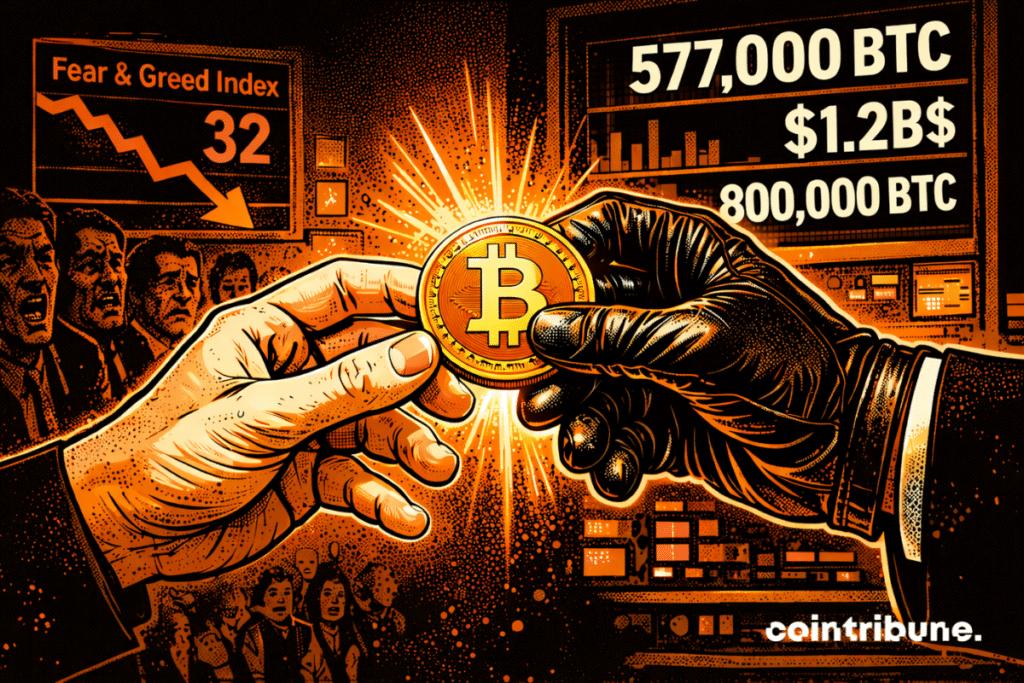
The data confirms it: while retail investors are wary of bitcoin, institutional investors are rushing in. In one year, they have accumulated the equivalent of 53 billion dollars in bitcoin, or 577,000 BTC. A figure that illustrates a silent turning point within the crypto market.
In Brief
- Institutional investors have accumulated 577,000 BTC, confirming a massive long-term strategy.
- Despite retail fear, Bitcoin ETFs strengthen institutional adoption and market stability.
Institutional Wallets Strengthen Their Grip on Bitcoin
Institutional wallets group entities holding between 100 and 1,000 bitcoins, excluding crypto exchanges and miners. They include funds, Bitcoin ETFs, as well as treasuries such as those managed by Michael Saylor. His company Strategy, which has just relaunched purchases, now holds over 260,000 BTC.
This trend has accelerated since the approval of spot Bitcoin ETFs in the United States at the beginning of 2024. These digital assets have attracted more than 1.2 billion dollars since January. The total held by Bitcoin ETFs today exceeds 800,000 BTC. These figures reflect a long-term strategy based on diversification and growing confidence in bitcoin.
According to CryptoQuant CEO Ki Young Ju, institutional accumulation continues. And this is just the beginning! One indicator confirms this: the Fear and Greed Index has dropped to 32. This signals dominant fear among retail investors. A perfect climate for crypto whales, who buy against the trend.
Signals of a Bitcoin Locked by Strong Hands
While the BTC price drops from $95,000 to $91,000, buying continues. Whales practice DCA (regular buying) and now control a growing share of the circulating supply. Result: bitcoin is increasingly in the hands of holders with strong conviction.
This development changes the structure of the crypto market. Less exposed to panic selling, BTC could eventually show more stable movements. But this dynamic has a downside: price-setting power shifts to the most capitalized entities, relegating small holders to the background.
Meanwhile, bitcoin options reveal a bearish bias. Derivative markets anticipate a drop below $80,000 by the end of June. A tension between long-term accumulation and short-term speculation that highlights the current complexity of the crypto market!
In any case, institutional investors seem to be reshaping the future of bitcoin. The crypto landscape will never be the same.
Disclaimer: The content of this article solely reflects the author's opinion and does not represent the platform in any capacity. This article is not intended to serve as a reference for making investment decisions.
You may also like
Here’s why BlackRock believes autonomous AI systems will drive next stablecoin boom
BlackRock expects exchange-traded compute futures as it pitches stablecoins for AI agents
Report: TSMC to Raise Wafer Foundry Prices by 3% to 6% Starting January Next Year, Order Visibility Extended to 2030
According to media reports, TSMC's advanced and high-priced processes such as 2nm and 3nm have seen the largest price increases; mature and specialty processes are subject to individual negotiation based on products, capacity utilization, and customer conditions. Currently, TSMC's 8-inch fabs have a capacity utilization rate exceeding 100%, and processes below 45nm are at full capacity. The construction of AI data centers is not only driving demand for GPU and HBM, but also boosting orders for mature processes such as PMIC, MCU, and analog ICs.
U.S. Treasury plans to repurchase up to $6 billion in long-term bonds, 30-year yield hits highest since 2007
This is the second round of enhanced long-term bond buybacks by the Treasury, this time focusing on 20- to 30-year government bonds. After the announcement of the planned upper limit, the yield on 30-year U.S. Treasury bonds continued to rise, at one point exceeding 5.4%. In the first round of enhanced buybacks two weeks ago, the upper buyback target was also $6 billion, which was lower than some market participants had expected, and the actual buyback amounted to only $5.2 billion due to insufficient competitive bidding, according to the Treasury.
Crypto prices
More


