Bitget App
Trade smarter
Buy cryptoMarketsTradeFuturesEarnAISquareMore
Bitcoin Collateral Dominance Holds as Whales Accumulate During Market Dips

Bitcoin Collateral Dominance Holds as Whales Accumulate During Market Dips

CoinEditionCoinEdition2026/02/10 11:03
By:CoinEdition

Bitcoin continues to function as the primary collateral asset for crypto-backed credit, even as market volatility triggers price pullbacks and increased liquidations. Data from CryptoQuant and platform-specific metrics tied to Nexo indicate that borrowers and large holders have maintained exposure to Bitcoin rather than rotating into alternative assets.

Quarterly collateral composition data for Nexo, covering the period from 2024 Q1 through 2026 Q1, shows Bitcoin consistently accounting for the largest share of loan backing. Over the period observed, Bitcoin represented roughly 54% to 60% of total collateral.

After a brief decline in early 2024, Bitcoin’s share increased through late 2024 and early 2025, reaching just under 60%. By Q1 2026, Bitcoin dominance stood at 56.2%, even as broader market conditions softened.

Other crypto assets formed the second-largest category, fluctuating mostly between the mid-20% and low-30% range. Ethereum’s share declined from mid-teens levels in early 2024 to single digits in early 2025 before recovering to just above 12% later in the period. Stablecoins remained below 4% throughout.
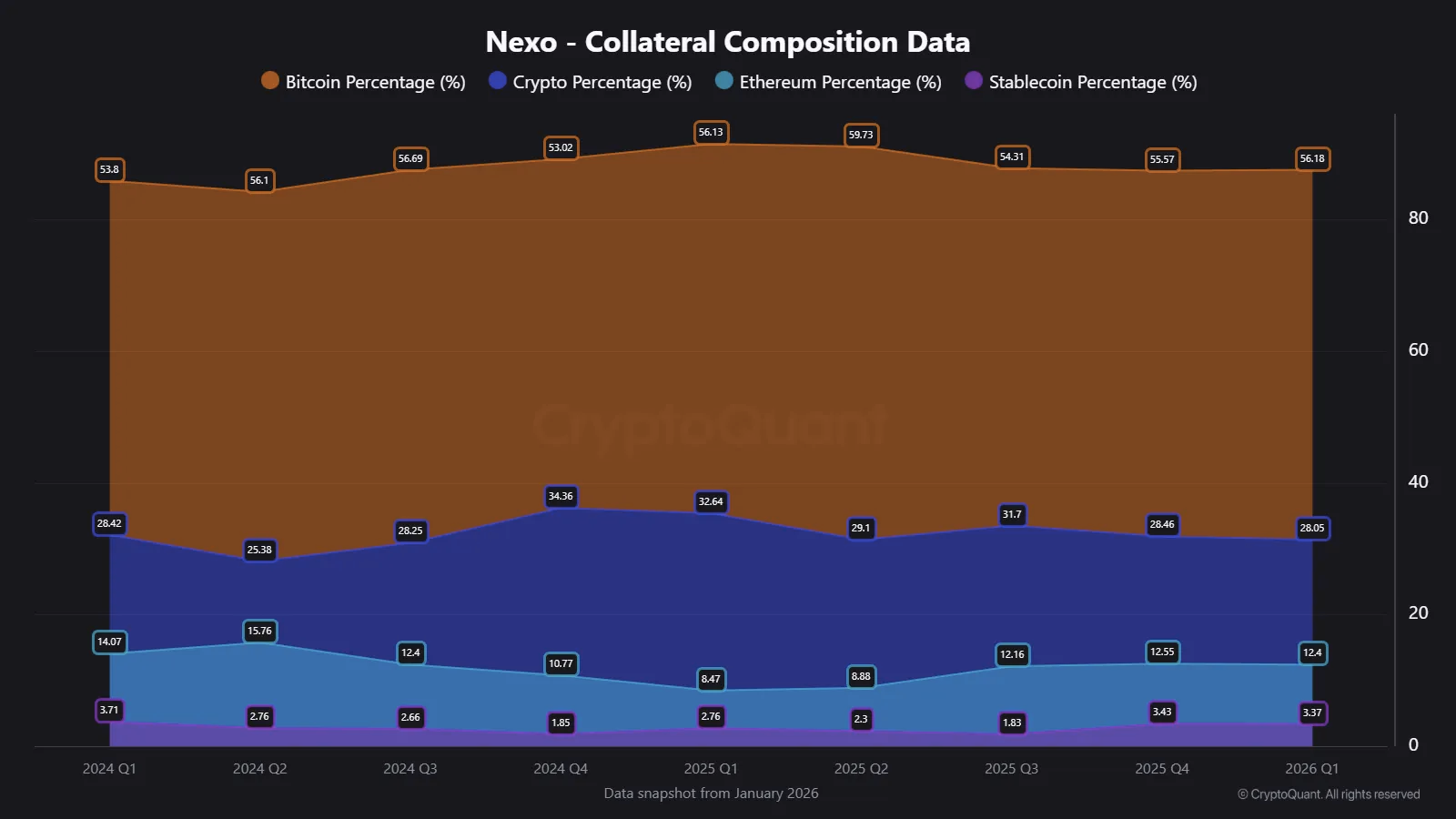
Bitcoin Collateral Dominance Holds as Whales Accumulate During Market Dips image 0 Source: CryptoQuant

On-chain data from CryptoQuant also points to renewed accumulation by large holders during recent price weakness. On February 6, accumulator addresses recorded inflows of 66,940 BTC, marking the largest single-day inflow observed during the current market cycle.

(adsbygoogle = window.adsbygoogle || []).push({});

Historical data shows similar accumulation spikes during prior downturns in 2020–2021 and 2022–2023. The recent surge, supported by a rising 30-day moving average, indicates sustained inflows rather than isolated transfers.

Furthermore, on Feb 9, spot Bitcoin ETFs saw inflows of $145M, with the Grayscale (GBTC) seeing the largest inflow of about $130.54M, followed by Ark & 21Shares (ARKB) with $14.09M, VanEck (HODL) with $12M, Franklin (EZBC) seeing $6.14M, and lastly Fidelity (FBTC) getting inflows of $3.08M. BlackRock’s IBIT saw the only outflow of the day with $20.85M.

Related: Bitcoin Steadies Around $70,000 After Violent Sell-Off Shakes Market Confidence

0
0

Disclaimer: The content of this article solely reflects the author's opinion and does not represent the platform in any capacity. This article is not intended to serve as a reference for making investment decisions.

Understand the market, then trade.
Bitget offers one-stop trading for cryptocurrencies, stocks, and gold.
Trade now!

You may also like

Report: OpenAI expected to spend $750 billion on computing power by 2030! The company still states that "computing power is extremely insufficient"

OpenAI has raised its 2030 computing power expenditure forecast to $750 billion, an increase of more than 25% compared to the previous estimate of around $600 billion. Bottlenecks exist in multiple supply chain segments such as chips, electricity, and land. Whether massive orders can be converted into usable computing power on schedule has become a key test for the AI infrastructure sector.

华尔街见闻2026/09/10 00:01

Trump presses the Federal Reserve to "cut rates to save the economy," but the market is betting on a 60% probability of a rate hike in September

Ahead of the Federal Reserve’s September monetary policy meeting (scheduled for September 15-16), U.S. President Trump and senior administration officials have made intensive statements, urging the central bank not to raise interest rates and even calling for a cut in the benchmark rate.

智通财经2026/09/09 23:31
Trump presses the Federal Reserve to "cut rates to save the economy," but the market is betting on a 60% probability of a rate hike in September

US energy stocks remain "cheap" after surging: High oil prices may lead to a valuation recovery

The Energy Select Sector SPDR ETF, which tracks US energy stocks, has surged over 43% year-to-date, far outperforming other S&P 500 sectors. Despite this, the energy sector remains one of the lowest-valued sectors within the S&P 500. High oil prices have led to excess profits for energy stocks; although Wall Street previously viewed this round of earnings growth as a temporary phenomenon, if elevated oil prices persist longer than expected, the valuation recovery of energy stocks may have only just begun.

华尔街见闻2026/09/09 23:21