
CNY: Clock Reversal

The ultimate principle is simplicity. Exchange rates are determined based on the balance of payments, which can be further broken down into trade logic (current account) and financial logic (capital account). However, the trade and financial attributes carry different weights for different currencies; even for the same currency, these attributes change dynamically over time.It's like a clock constantly swinging back and forth.
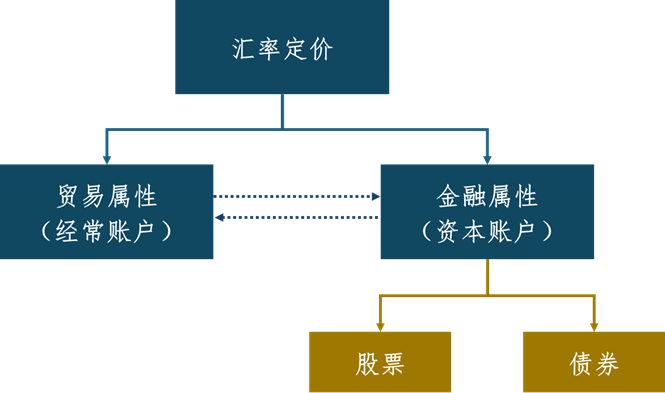
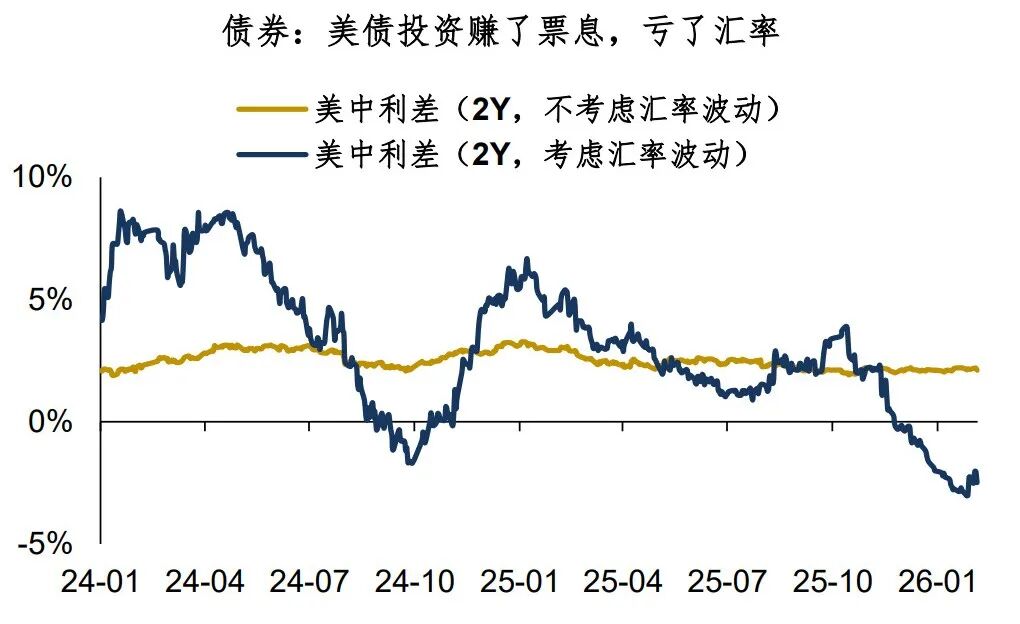
Historically, the RMB was purely a trade currency, but in recent years, the financial attribute of CNY has significantly increased.Many of the factors suppressing the CNY exchange rate in recent years are essentially capital account logic.For example, the China-US interest rate differential turning from positive to negative is a typical interest rate logic; even the issue of export companies settling foreign currency earnings, which appears to be a current account issue on the surface, actually also has a strong financial attribute.
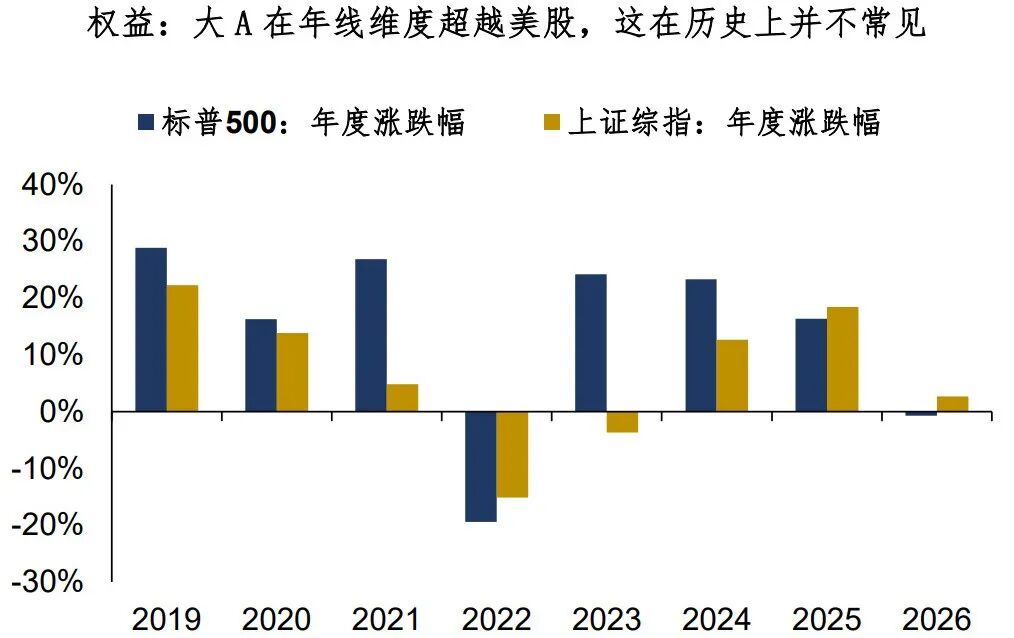
However, many signs in 2025-2026 indicate that the trade attribute of the RMB exchange rate is making a comeback.For example, the profit effect of US stocks is clearly declining; also, CNY's negative carry is easing, so while US Treasury investments earn coupon income, they lose on exchange rates; commodities may be in a super cycle, but it doesn't matter whether commodity investments are overseas or domestic...Overall, the cost-effectiveness of overseas USD investments is declining, and naturally, the trade attribute of the RMB exchange rate will return.
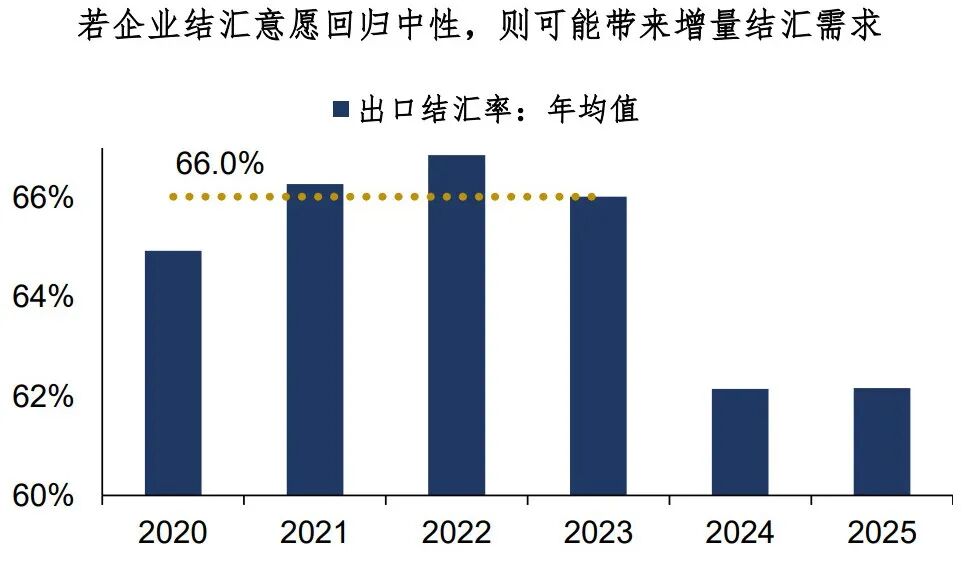
In the early years of the pandemic, the average export settlement ratio in China was around 66%, dropping to 62% in the past two years. Assuming export companies' willingness to settle returns to neutral in the future, the interbank foreign exchange market will see an additional $15 billion in settlement demand each month (equivalent to RMB 100 billion).The rebound in settlement demand at the beginning of the year, in my view, is not a temporary phenomenon; it may reflect the force of the cyclical clock swinging back.
If so, the return of the trade attribute will bring a medium-term strengthening of the RMB exchange rate.
To summarize today's discussion:
1. Exchange rate pricing is based on the balance of payments, which can be further split into trade logic (current account) and financial logic (capital account).It is important to note that trade and financial attributes change dynamically, like a clock constantly swinging back and forth;
2.Many signs in 2025-2026 indicate that the trade attribute of the RMB exchange rate is returning.The relative advantage of USD assets over RMB assets is weakening, while commodity investment is super-sovereign, making the location irrelevant... Overall, the suppressive effect of CNY's financial attribute is easing, so its trade attribute will naturally return;
3. For the RMB exchange rate, strong exports and a strong trade surplus are clear advantages. What remains uncertain is the sustainability of settlement. In my view, the rebound in settlement demand at the beginning of the year is not a temporary phenomenon; it may reflect the force of the cyclical clock swinging back. Without a doubt, the return of the trade attribute will bring a medium-term strengthening of the RMB exchange rate.
Disclaimer: The content of this article solely reflects the author's opinion and does not represent the platform in any capacity. This article is not intended to serve as a reference for making investment decisions.
You may also like
Trump Rejects Iran's Proposal for Talks; Global Stocks and Bonds Under Pressure, Oil Prices Up Over 2%, Gold Falls Below 4200
Trump rejected Iran's latest proposal to reopen the Strait of Hormuz, causing the optimistic sentiment in the market last Friday to quickly reverse amidst the Middle East diplomatic stalemate. Brent crude oil rose over 2%, gold fell below $4,200, and silver dropped more than 4%. Asia-Pacific stock markets broadly declined, with South Korea's KOSPI falling over 2%. Global bond markets came under pressure, and the yield on the US 2-year Treasury rose to 4.90%. Market focus will shift to this week's PCE inflation data and the non-farm payroll report.
Indian Rupee starts the week negatively amid higher oil prices
AI demand drives TSMC to accelerate capacity expansion, 2nm monthly production aims for 120,000 wafers by year-end
According to reports, industry giants such as Apple, Nvidia, and AMD have collectively increased their orders by 10% to 20%, directly boosting TSMC's 2nm monthly production capacity to 120,000 wafers by the end of the year, which exceeds the previous estimate by more than 20% and brings forward the 2027 target by two years. For the first time in history, five factories will ramp up production simultaneously, and the annual compound growth rate of capacity from 2026 to 2028 will reach as high as 70%.
Long-term US Treasury Sell-off Continues! 10-Year Treasury Yield Breaks 5.2% Again, “AI Boom vs. Rising Financing Costs” Narrative Showdown Intensifies
On Monday, oil prices rose and US Treasury bonds were sold off again as former US President Donald Trump rejected Iran's latest proposal to reopen the Strait of Hormuz, heightening concerns about inflation.
Crypto prices
More


