
Bitnomial launches first US-regulated Tezos futures, allowing retail exposure to XTZ

The Chicago-based cryptocurrency exchange Bitnomial has launched futures tied to Tezos’ XTZ token, marking the first time the asset has a futures market on a US Commodity Futures Trading Commission-regulated exchange.
According to Wednesday’s announcement, the futures contracts are live and allow institutional and retail traders to gain exposure to XTZ (XTZ) price movements using either cryptocurrency or US dollars as margin.
Futures contracts let traders hedge risk or gain price exposure by agreeing to buy or sell an asset at a set price on a future date, without holding the asset itself.
Regulated futures markets are often viewed as a prerequisite for broader institutional participation in the US, including potential spot exchange-traded funds (ETFs), because they provide standardized price discovery and oversight under the CFTC.
“CFTC-regulated futures market with six months of trading history checks a key box under the SEC's generic listing standards for spot ETFs," Bitnomial president Michael Dunn said.
Dunn told Cointelegraph the company is “actively looking at new tokens” for potential US institutional and retail derivatives markets, but declined to comment on specific assets.
Previously, Bitnomial listed US-regulated futures tied to assets including Cardano (ADA), XRP (XRP) and Aptos (APT), positioning it among the few venues offering regulated crypto derivatives beyond Bitcoin (BTC) and Ether (ETH) in the US.
Bitnomial’s push to list futures tied to altcoins has not been without regulatory hurdles. In August 2024, the exchange sought to self-certify XRP futures with the CFTC, but the Securities and Exchange Commission (SEC) objected, arguing the contracts required registration as a securities exchange.
After suing the SEC in October 2025 and later dropping the case, Bitnomial launched XRP futures in March, citing the agency’s evolving approach to crypto policy.
Related: CFTC issues no-action letter to Bitnomial, clearing way for event contracts
A brief history of Tezos
Tezos’ mainnet launched in June 2018 following a 2017 initial coin offering that raised about $232 million in Bitcoin and Ether. While not the first proof-of-stake blockchain, Tezos was among the earliest layer-1 networks to combine proof-of-stake with formal onchain governance, enabling token holders to approve protocol upgrades that allowed the network to evolve without hard forks.
During the 2021–2022 non-fungible token boom, the blockchain carved out a niche as a lower-cost, energy-efficient alternative to Ethereum for minting and trading NFTs. As Ethereum gas fees surged, artists and game publishers such as Ubisoft gravitated to Tezos, citing lower transaction costs and the network’s proof-of-stake design.
During these years, Tezos also secured high-profile sports partnerships with Red Bull Racing and McLaren Racing, and was later reported to be preparing a multi-year training kit sponsorship with Manchester United valued at more than $27 million per year.
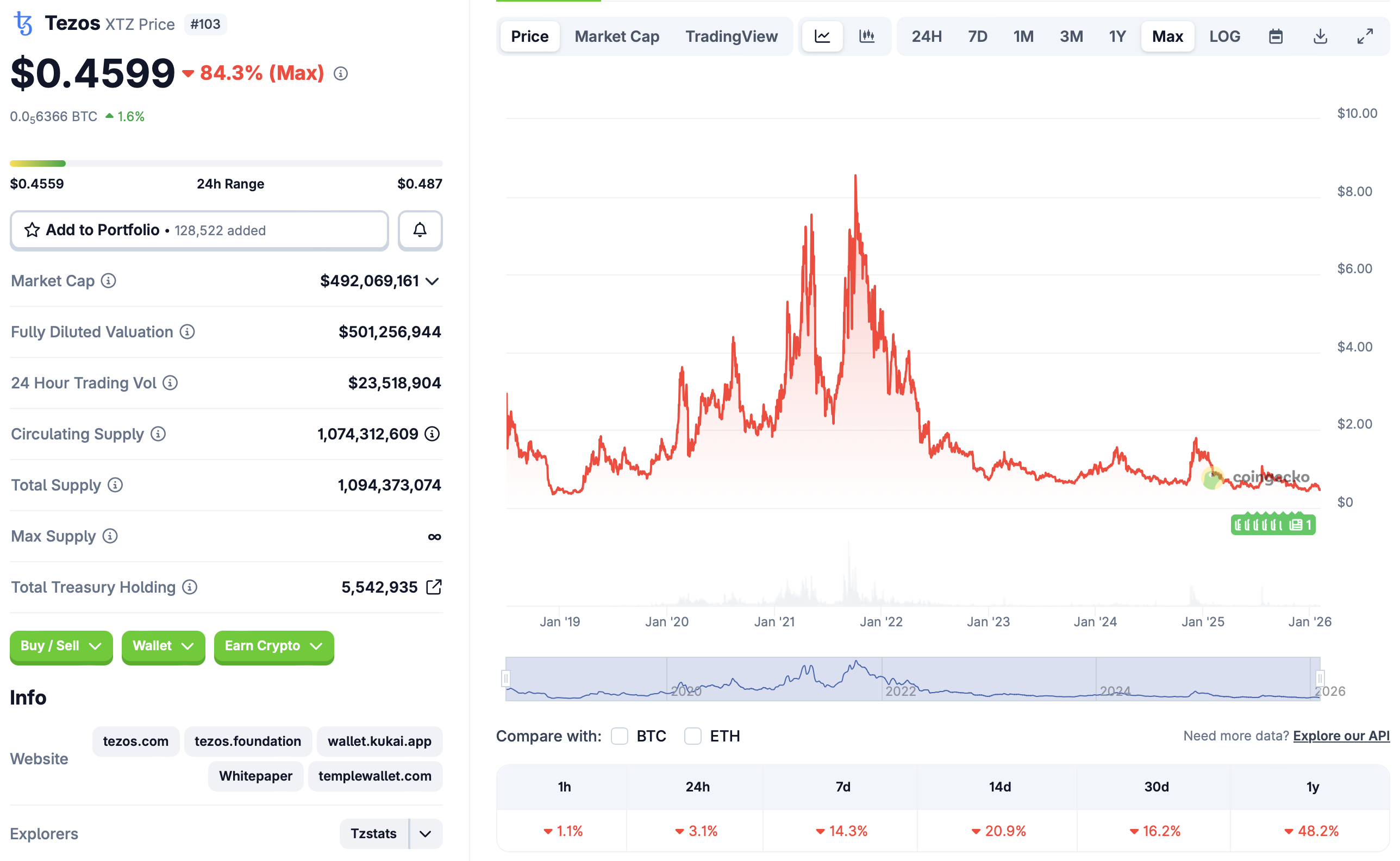
Tezos’ native token, XTZ, hit an all-time high of $9.12 in October 2021, according to CoinGecko data, but has since fallen about 95% and is now trading around $0.46.
On Jan. 25, Tezos implemented its Tallinn protocol upgrade, cutting base-layer block times to six seconds as part of the network’s 20th onchain upgrade.
 Source:
CoinGecko
Source:
CoinGecko
Magazine: Bitcoin is ‘funny internet money’ during a crisis: Tezos co-founder
Disclaimer: The content of this article solely reflects the author's opinion and does not represent the platform in any capacity. This article is not intended to serve as a reference for making investment decisions.
You may also like
FAA halts certification of Boeing 737 MAX 10, shares drop nearly 7%
The FAA has announced the suspension of the Boeing 737 MAX 10 certification due to a new software defect provided by GE Aerospace. This defect could impact the automatic flight guidance function and increase pilot workload during recertification scenarios. There are over 1,500 pending orders for the MAX 10, and certification is crucial for Boeing to improve cash flow and compete against Airbus. The previously expected October certification timeline has been delayed once again. Boeing's share price fell 6.9% on Monday.
Indirect Negotiations Between the US and Iran? Iran Makes Concessions? Major Differences Remain? Saudi Arabia Resumes Exports? Overnight Oil Prices Volatile and Falling Amid Mixed Bullish and Bearish Views
On Monday, after WTI peaked at $96.54 and Brent surged to $108.83, both benchmarks retreated by over $5 within a few hours. The resumption of Saudi Arabia's East-West pipeline constituted the first substantial bearish factor. Meanwhile, US-Iran diplomatic developments escalated: reports claimed Trump was willing to ease sanctions in exchange for nuclear concessions, which he immediately denied in person; Iran was reportedly willing to suspend uranium enrichment, but the US stated that “major differences remain.” Privately, Iran believes the chances of reaching a deal before the US presidential election are slim. Expectations are for potential escalation in conflicts after the election, making it difficult for market risk premiums to dissipate.
$100 Oil Price Spurs 'Cash Flow Revaluation' Logic! BP Plans to Sell Brazilian Biofuel Business to Accelerate Focus on Oil and Gas Assets
BP Plc is considering various options for its Brazil biofuel business, including a sale, as CEO Meg O'Neill accelerates efforts to reshape the energy giant's business portfolio.
Pump.fun: Why PUMP’s 20% surge faces KEY test despite $466M buybacks
Crypto prices
More


