
The real ‘supercycle’ isn’t crypto, it’s AI infrastructure: Analyst

After years of debate in some corners of the crypto industry, Bitcoin and digital assets are on the verge of a long-awaited “supercycle,” typically defined as an extended, structurally driven boom that lasts beyond a normal market cycle.
However, the only development resembling such durable, capital-intensive expansion may be underway in AI infrastructure, according to the latest newsletter from Blockbridge Consulting, which has been rebranded to TheEnergyMag from TheMinerMag.
In the newsletter, analyst Wolfie Zhao described a “trillion-dollar build supercycle” tied to AI data center infrastructure.
While the so-called Magnificent Seven tech giants are projected to spend more than $600 billion combined on AI investments this year, Bitcoin (BTC) mining companies with exposure to AI and high-performance computing are also ramping up capital deployment.
One example is IREN, formerly known as Iris Energy, a Nasdaq-listed Bitcoin miner that has expanded into AI data center infrastructure.
In its most recent quarter, IREN reported about $800 million in net spending on property, plants and equipment. According to TheEnergyMag’s analysis, the company “deployed more capital in a single year, building AI data center infrastructure and procuring GPU hardware than it spent across three years expanding its Bitcoin mining fleet post-IPO.”
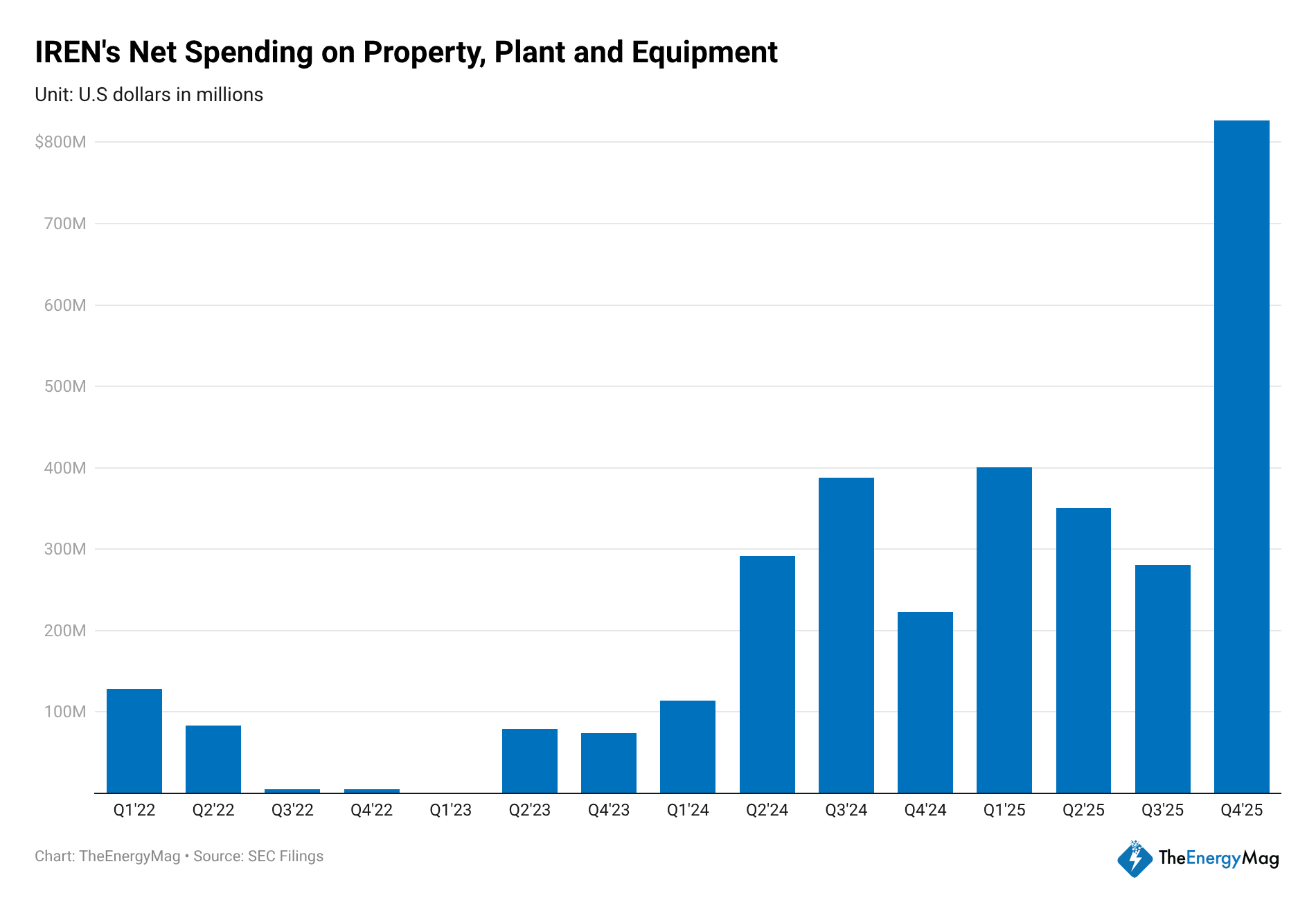 The fourth quarter of 2025 marked record PP&E spending by IREN, reflecting its accelerating pivot toward AI-focused infrastructure. Source:
TheEnergyMag
The fourth quarter of 2025 marked record PP&E spending by IREN, reflecting its accelerating pivot toward AI-focused infrastructure. Source:
TheEnergyMag
Related: Bitcoin mining’s 2026 reckoning: AI pivots, margin pressure and a fight to survive
Bitcoin mining: An industry in transition
IREN is one of several traditional Bitcoin miners that have shifted aggressively into AI and high-performance computing, in part to diversify away from increasingly compressed mining margins. Others pursuing similar strategies include MARA Holdings, Riot Platforms, HIVE Digital Technologies and Bitdeer Technologies.
The past year may have marked one of the most challenging periods for the Bitcoin mining industry, as collapsing revenues collided with rising debt loads. The downturn followed a sharp correction in Bitcoin’s price that began in October 2025. After peaking over $126,000, Bitcoin slid steadily and briefly fell below $60,000 in February.
Bitdeer, which released its fourth quarter 2025 results on Thursday, said the period “marked a strategic inflection point as we accelerated our transition toward high-performance compute infrastructure and colocation services."
Chief business officer Matt Kong said that the company’s power portfolio will be a strategic asset as “We expect the global AI infrastructure supply / demand imbalance to widen,” according to a statement.
Frank Holmes, CEO of HIVE Digital Technologies, recently outlined why this may be a pivotal moment for miners to expand into AI.
“Bitcoin miners are winning the AI data center arms race,” he wrote in a Forbes column, arguing that large-scale AI facilities take years to build, while miners already control power, land and data center infrastructure that can be repurposed for high-performance computing.
 Source:
Frank Holmes
on X
Source:
Frank Holmes
on X
Related: Bitcoin miner production data reveals scale of US winter storm disruption
Disclaimer: The content of this article solely reflects the author's opinion and does not represent the platform in any capacity. This article is not intended to serve as a reference for making investment decisions.
You may also like
Volatility Divergence Between Individual Stocks and Index! Popular US Stock Trading: Go Long on Stock Options, Hedge with Index Options
With the divergence in the AI narrative, drastic fluctuations in oil prices, and U.S. Treasury yields soaring to a 20-year high, the degree of dispersion among S&P 500 constituents has risen to the 95th percentile in 30 years. As single-stock volatility continues to compress, entry costs have become relatively low, and the volatility gap between individual stocks and the index has widened again. This has opened a rare window for dispersed trading strategies such as "long single-stock options + short index options."
US Treasury yield curve approaches inversion! Is the bond market questioning the outlook for the US economy?
The U.S. Treasury yield curve is rapidly approaching the inversion threshold—the spread between the 10-year and 2-year yields has narrowed to historic lows, and bank stocks have responded with a technical correction. This warning signal, regarded as a "hard rule" for recession, is tearing apart market consensus: some are betting the curve will soon invert, while others firmly believe economic resilience will mitigate the risk. Amid ongoing Federal Reserve rate hikes, the outcome of this bond market game may reshape the narrative logic of the entire asset market.
From ICU to KTV! The Polarized "AI Narrative" Leaves Investors "Exhausted"
In just two weeks, the Nasdaq 100 experienced an extreme rollercoaster: first losing $600 billion in market value due to “AI threat” concerns, then rebounding to reclaim $3 trillion thanks to the viral Meta assistant. Analysts believe that market sentiment is swinging violently between fear and greed, detached from fundamentals. The turmoil has driven Nvidia’s valuation to a ten-year low, intensified the bull-bear divide, and the high volatility driven by narratives has become a long-term norm for investors. This week, Micron will release its financial report; regardless of the outcome, the sharp swings in market sentiment are unlikely to subside.
Weekly Preview: Micron (MU.US) earnings test the quality of AI infrastructure, OpenAI and White House AI meeting resonance, PCE and Nonfarm Payrolls set the tone for October interest rates
This week, the market's focus will shift from politics and product launches to financial reports and macroeconomic data.
Crypto prices
More


