
UBS Group to Add 3,000 Jobs in India Amid Credit Suisse Integration

UBS Group AG UBS plans to hire up to 3,000 employees in India in the coming months, according to a Reuters article, which was published in Yahoo Finance. The expansion comes as the Swiss banking giant continues to reduce headcount in Switzerland as part of its ongoing integration of Credit Suisse, which it acquired in a state-backed transaction in 2023.
As part of the integration process, UBS has previously announced plans to cut around 3,000 jobs in Switzerland, with most of the reductions expected to take place later in 2026. The workforce adjustments are likely to be achieved primarily through natural attrition and early retirement measures, aimed at limiting social impact.
Although the number of roles planned in India broadly mirrors the scale of job reductions expected in Switzerland, UBS has not confirmed whether the two developments are directly connected.
As of Dec. 31, 2025, the company reported a total workforce of 119,589 employees. In the fourth quarter of 2025, the bank reduced headcount by 2,793 positions sequentially and by 9,394 roles year over year, reflecting continued progress in eliminating overlapping positions following the merger.
Why UBS Is Expanding Its Operations in India
The company already operates several offices across India and is now opening an additional site in Hyderabad. The bank plans to add between 2,000 and 3,000 roles at the new location over the coming months, effectively doubling its workforce in the city. The recent hiring drive is aimed at strengthening UBS’ technology and operations capabilities.
In recent years, India has become a key hub for global financial firms seeking access to deep technology talent pools and cost-efficient, scalable operating models, particularly as institutions accelerate digital transformation and automation efforts. As such, other major financial firms like BlackRock Inc. BLK and Citigroup Inc. C are pursuing similar strategies.
According to a GlobalData report published on Yahoo Finance, BlackRock plans to add around 1,200 jobs in India to strengthen its artificial intelligence and data analytics capabilities. The hiring is expected to expand the BLK’s iHubs in Mumbai and Gurugram, increasing engineering and data expertise to support investment research, risk management and analytics functions.
Earlier, in September 2025, Citigroup planned to reallocate 1,000 technology jobs to its Indian business support centers following staff reductions in China, according to a Bloomberg article published on MSN. The move highlights the growing importance of India-based global capability centers as these firms streamline operations and respond to regulatory and cost pressures across markets.
UBS Progresses With Credit Suisse Integration Plan
As UBS advances the integration of Credit Suisse, the bank continues to make steady progress across client migrations and operational consolidation. In the fourth quarter of 2025, around 85% of Swiss-booked client accounts had been migrated, while the transition of Personal & Corporate Banking clients was largely completed. The remaining Swiss booking center migrations are expected to be finalized by the end of the first quarter of 2026, keeping UBS on track to substantially complete the integration by year-end.
These operational milestones are increasingly translating into measurable cost efficiencies. During the fourth quarter, UBS delivered an additional $0.7 billion in gross cost savings, taking cumulative gross savings to $10.7 billion at the end of 2025. Reflecting this progress, the bank raised its targeted annualized exit-rate savings to approximately $13.5 billion by the end of 2026, up from the earlier $13 billion goal. Integration-related expenses are expected to total around $15 billion by 2026-end.
UBS’ Zacks Rank & Price Performance
Over the past year, UBS shares have gained 6.9% compared with the industry’s growth of 26.6%.
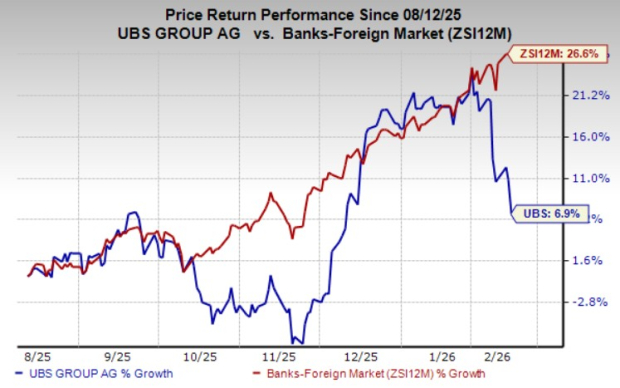
Image Source: Zacks Investment Research
Currently, UBS carries a Zacks Rank #3 (Hold).
Disclaimer: The content of this article solely reflects the author's opinion and does not represent the platform in any capacity. This article is not intended to serve as a reference for making investment decisions.
You may also like
US Treasury yield curve approaches inversion! Is the bond market questioning the outlook for the US economy?
The U.S. Treasury yield curve is rapidly approaching the inversion threshold—the spread between the 10-year and 2-year yields has narrowed to historic lows, and bank stocks have responded with a technical correction. This warning signal, regarded as a "hard rule" for recession, is tearing apart market consensus: some are betting the curve will soon invert, while others firmly believe economic resilience will mitigate the risk. Amid ongoing Federal Reserve rate hikes, the outcome of this bond market game may reshape the narrative logic of the entire asset market.

From ICU to KTV! The Polarized "AI Narrative" Leaves Investors "Exhausted"
In just two weeks, the Nasdaq 100 experienced an extreme rollercoaster: first losing $600 billion in market value due to “AI threat” concerns, then rebounding to reclaim $3 trillion thanks to the viral Meta assistant. Analysts believe that market sentiment is swinging violently between fear and greed, detached from fundamentals. The turmoil has driven Nvidia’s valuation to a ten-year low, intensified the bull-bear divide, and the high volatility driven by narratives has become a long-term norm for investors. This week, Micron will release its financial report; regardless of the outcome, the sharp swings in market sentiment are unlikely to subside.
Weekly Preview: Micron (MU.US) earnings test the quality of AI infrastructure, OpenAI and White House AI meeting resonance, PCE and Nonfarm Payrolls set the tone for October interest rates
This week, the market's focus will shift from politics and product launches to financial reports and macroeconomic data.
"Over 5% 10-Year US Treasury Yield" Fails to Crush AI Investment Frenzy—Is the Real "AI Kill Line" an Inverted Yield Curve?
The bond market is gradually sending warning signals to the economy, indicating that the Federal Reserve's series of interest rate hikes will begin to shift market sentiment, making people increasingly concerned that the US economy may fall into stagnation.

Crypto prices
More


