
Aave Labs seeks $50M grant to redirect product revenue to DAO

Aave Labs has asked tokenholders to approve a funding package worth roughly $50 million in exchange for redirecting all revenue from Aave-branded products to the Aave DAO treasury.
The proposal includes up to $42.5 million in stablecoins — $25 million as a primary grant and $17.5 million tied to product milestones. It also includes 75,000 Aave (AAVE) tokens, worth about $8 million at the time of writing. The stablecoin grants, if approved, will be streamed over time, and milestone payments will be released upon product launches.
In return, Aave Labs would route 100% of product-level revenue to the DAO. That includes fees generated by aave.com, the planned Aave App and Aave Card, Aave Pro, Aave Kit and Aave Horizon. The framework also asks tokenholders to ratify Aave V4 as the protocol’s long-term technical foundation and outlines plans to create a foundation to hold and steward the Aave brand.
The proposal marks a shift in how Aave captures and distributes value. It would consolidate protocol and product revenue at the DAO level while shifting Aave Labs to a DAO-funded operating model after months of governance tension.
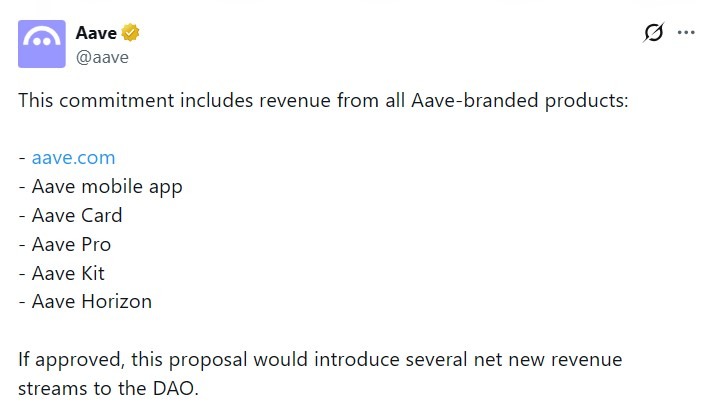 Source:
Aave
Source:
Aave
Governance concerns over voting power
The funding request drew scrutiny from some community members. Marc Zeller, founder of the Aave Chan Initiative, wrote that the package of roughly $50 million represents a significant portion of the DAO treasury.
He called for unbundling the vote into separate proposals covering revenue alignment, V4 ratification, foundation creation and funding.
Zeller also called for clearer definitions of “revenue” and independent verification of product income flowing to the DAO. He raised concerns over the 75,000 Aave token grant, noting that governance tokens carry voting power. He said entities receiving DAO tokens should disclose their wallet holdings.
Meanwhile, crypto commentator DefiIgnas described the proposal as a “big compromise” that AAVE holders “should like,” though he also said clearer disclosures around governance voting power tied to the 75,000 AAVE grant would be appropriate.
Aave Labs framed the proposal as a move toward a “token-centric” model that aligns value accrual with the DAO. Aave founder Stani Kulechov said on X that directing product revenue to the DAO would expand its capacity to fund growth and other initiatives.
“This would position the DAO to fund growth, increase buybacks, and pursue other opportunities as it sees fit,” Kulechov wrote.
Related: Vitalik draws line between ‘real DeFi’ and centralized yield stablecoins
Proposal follows rejected IP vote
The proposal follows another contentious governance episode recently. On Dec. 26, Aave tokenholders rejected a proposal to transfer control of the protocol’s brand assets to an entity under the DAO, with a majority voting against the measure.
On Jan. 3, Kulechov outlined a broader strategy to expand beyond decentralized finance (DeFi) lending and revisit how non-protocol revenue flows to token holders.
The current proposal formalizes elements of that vision, combining revenue consolidation, V4 ratification and a new foundation structure in a single strategic pitch.
The Temp Check is intended to gauge community support before proceeding to a binding vote. If it advances, the proposal would move through additional governance stages before any funds are distributed.
Magazine: Hong Kong stablecoins in Q1, BitConnect kidnapping arrests: Asia Express
Disclaimer: The content of this article solely reflects the author's opinion and does not represent the platform in any capacity. This article is not intended to serve as a reference for making investment decisions.
You may also like
US Treasury yield curve approaches inversion! Is the bond market questioning the outlook for the US economy?
The U.S. Treasury yield curve is rapidly approaching the inversion threshold—the spread between the 10-year and 2-year yields has narrowed to historic lows, and bank stocks have responded with a technical correction. This warning signal, regarded as a "hard rule" for recession, is tearing apart market consensus: some are betting the curve will soon invert, while others firmly believe economic resilience will mitigate the risk. Amid ongoing Federal Reserve rate hikes, the outcome of this bond market game may reshape the narrative logic of the entire asset market.

From ICU to KTV! The Polarized "AI Narrative" Leaves Investors "Exhausted"
In just two weeks, the Nasdaq 100 experienced an extreme rollercoaster: first losing $600 billion in market value due to “AI threat” concerns, then rebounding to reclaim $3 trillion thanks to the viral Meta assistant. Analysts believe that market sentiment is swinging violently between fear and greed, detached from fundamentals. The turmoil has driven Nvidia’s valuation to a ten-year low, intensified the bull-bear divide, and the high volatility driven by narratives has become a long-term norm for investors. This week, Micron will release its financial report; regardless of the outcome, the sharp swings in market sentiment are unlikely to subside.
Weekly Preview: Micron (MU.US) earnings test the quality of AI infrastructure, OpenAI and White House AI meeting resonance, PCE and Nonfarm Payrolls set the tone for October interest rates
This week, the market's focus will shift from politics and product launches to financial reports and macroeconomic data.
"Over 5% 10-Year US Treasury Yield" Fails to Crush AI Investment Frenzy—Is the Real "AI Kill Line" an Inverted Yield Curve?
The bond market is gradually sending warning signals to the economy, indicating that the Federal Reserve's series of interest rate hikes will begin to shift market sentiment, making people increasingly concerned that the US economy may fall into stagnation.

Crypto prices
More


