
Does Rigetti's $600M Cash Runway De-Risk Its 2026 Roadmap Execution?

Rigetti Computing RGTI moves into 2026 with one of the strongest balance sheets in the pure-play quantum universe, a position that materially differentiates it from peers still dependent on frequent capital raises. Liquidity now exceeds $600 million, supported by warrant exercises completed during the second half of 2025, giving the company multi-year financial visibility. This war chest meaningfully lowers near-term dilution risk and allows Rigetti to pursue its roadmap without compromising timelines to preserve cash. Management has reiterated that current resources are sufficient to fund planned system launches, including next-generation 100+ qubit platforms with approximately 99.5% fidelity and a higher-performance 150+ qubit architecture expected as commercialization efforts extend into 2026.
That financial flexibility is particularly important given the inherently uneven nature of Rigetti’s revenue profile, which remains tied largely to government agencies, national labs and research institutions. Recent contract momentum, including expanded international engagement and on-premise system demand, reinforces long-term relevance but does little to smooth quarterly volatility. Against that backdrop, liquidity acts as a strategic buffer, allowing Rigetti to absorb delayed deployments, roadmap recalibration and customer-specific customization without resorting to external financing. In an industry where execution timelines frequently slip, balance sheet strength has become a competitive asset rather than a footnote.
Taken together, Rigetti’s 2026 setup appears financially equipped to sustain elevated R&D intensity, support manufacturing scale-up and weather revenue lumpiness, all without tapping capital markets.
Peers Updates
D-Wave Quantum QBTS recently marked a major technical milestone by demonstrating scalable on-chip cryogenic control for gate-model quantum processors, addressing a core bottleneck in building large-scale systems. The breakthrough sharply reduces wiring complexity without compromising fidelity and, importantly, leverages the same cryogenic control technology already proven in D-Wave’s commercial annealing platforms. This validates the company’s cross-platform engineering strategy and supports its push toward an initial gate-model system, while continued uptake of Advantage-class annealing systems highlights growing commercial relevance alongside technical progress.
IonQ IONQ has deepened its relationship with Korea Institute of Science and Technology Information through plans to install a next-generation 100-qubit IonQ Tempo system at South Korea’s National Quantum Computing Center of Excellence. The system will be integrated with KISTI’s KISTI-6 supercomputer, enabling the country’s first on-premises hybrid quantum–classical computing environment. For investors, the move highlights IonQ’s increasing success with government-backed institutions and its ability to embed quantum hardware within national HPC infrastructure, strengthening its role as a long-term partner as sovereign quantum investments accelerate.
Rigetti’s Price Performance, Valuation and Estimates
Shares of RGTI have plunged 16.6% in the last six-month period compared with the industry’s decline of 20.3%.
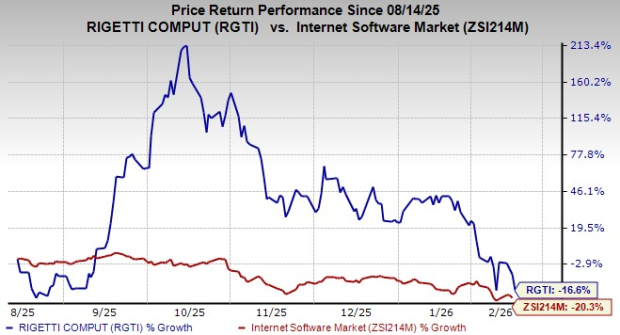
Image Source: Zacks Investment Research
From a valuation standpoint, Rigetti trades at a price-to-book ratio of 13.31, above the industry average. RGTI carries a Value Score of F.
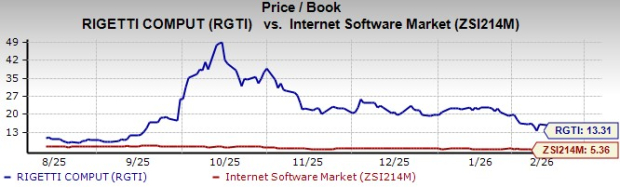
Image Source: Zacks Investment Research
The Zacks Consensus Estimate for Rigetti’s 2026 earnings implies a significant 75.9% improvement from the year-ago period.
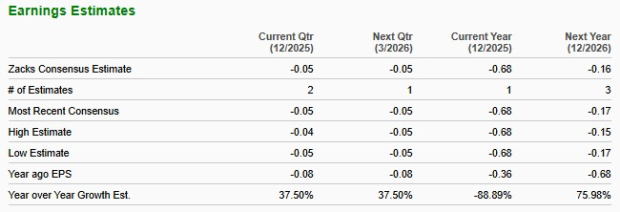
Image Source: Zacks Investment Research
The company currently carries a Zacks Rank #3 (Hold). You can see the complete list of today’s Zacks #1 Rank (Strong Buy) stocks here.
Disclaimer: The content of this article solely reflects the author's opinion and does not represent the platform in any capacity. This article is not intended to serve as a reference for making investment decisions.
You may also like
US Treasury yield curve approaches inversion! Is the bond market questioning the outlook for the US economy?
The U.S. Treasury yield curve is rapidly approaching the inversion threshold—the spread between the 10-year and 2-year yields has narrowed to historic lows, and bank stocks have responded with a technical correction. This warning signal, regarded as a "hard rule" for recession, is tearing apart market consensus: some are betting the curve will soon invert, while others firmly believe economic resilience will mitigate the risk. Amid ongoing Federal Reserve rate hikes, the outcome of this bond market game may reshape the narrative logic of the entire asset market.
From ICU to KTV! The Polarized "AI Narrative" Leaves Investors "Exhausted"
In just two weeks, the Nasdaq 100 experienced an extreme rollercoaster: first losing $600 billion in market value due to “AI threat” concerns, then rebounding to reclaim $3 trillion thanks to the viral Meta assistant. Analysts believe that market sentiment is swinging violently between fear and greed, detached from fundamentals. The turmoil has driven Nvidia’s valuation to a ten-year low, intensified the bull-bear divide, and the high volatility driven by narratives has become a long-term norm for investors. This week, Micron will release its financial report; regardless of the outcome, the sharp swings in market sentiment are unlikely to subside.
Weekly Preview: Micron (MU.US) earnings test the quality of AI infrastructure, OpenAI and White House AI meeting resonance, PCE and Nonfarm Payrolls set the tone for October interest rates
This week, the market's focus will shift from politics and product launches to financial reports and macroeconomic data.
"Over 5% 10-Year US Treasury Yield" Fails to Crush AI Investment Frenzy—Is the Real "AI Kill Line" an Inverted Yield Curve?
The bond market is gradually sending warning signals to the economy, indicating that the Federal Reserve's series of interest rate hikes will begin to shift market sentiment, making people increasingly concerned that the US economy may fall into stagnation.

Crypto prices
More


