
BTC Market Pulse: Week 9

Overview
The broader market environment has seen a minor softening in upward momentum, as well as a pronounced increase in selling pressure. This shift suggests a potential move from a strong buyer's market towards a more balanced playing field, with the emergence of heightened selling activity.
Meanwhile, market activity has slightly declined, as reflected in the decrease in trading volume. This suggests that recent price changes might not be strongly supported by market liquidity, potentially leading to increased volatility. In contrast, the derivatives landscape reflected a balanced approach to risk, with neither strong bullish nor bearish conviction dominating. This was mirrored by a marginal uptick in demand for long positions, hinting at a cautious optimism among traders. Complementing this, the options market exhibited an increase in speculative or hedging activities, suggesting a cautious sentiment among traders and potentially heightened market volatility.
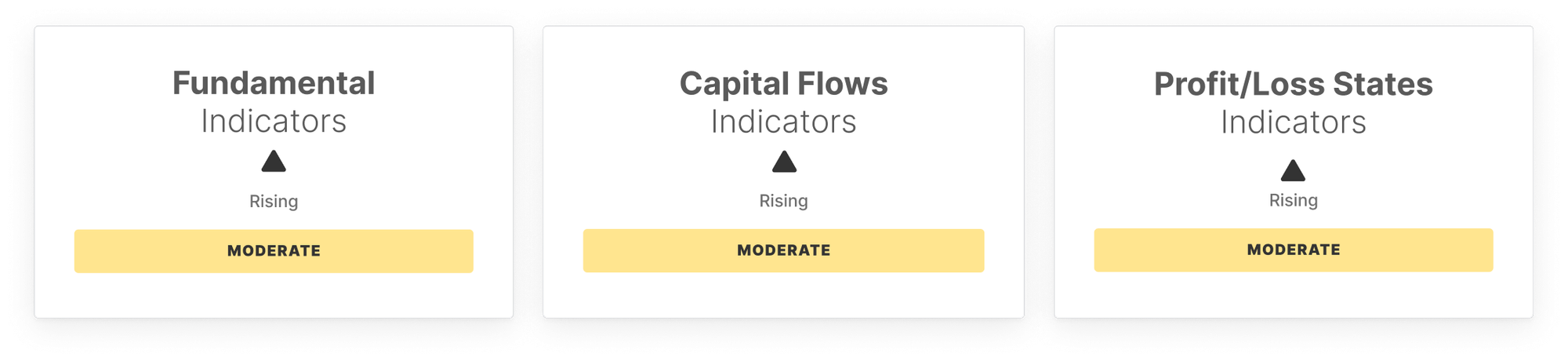
On the fundamental front, an increase in network user engagement was observed, suggesting a healthy user base and growing interest in Bitcoin. However, a decrease in transaction pressure was also noted, possibly reflecting a more cautious market sentiment. In line with this, the ETF market saw a minor reduction in unrealized gains and a notable decline in capital inflows, potentially indicating a cautious stance among institutional investors.
Overall, the market dynamics reflect a balanced market with a shift towards cautious optimism, potentially leading to increased volatility and a more balanced distribution of market power.
Off-Chain Indicators

On-Chain Indicators

Don't miss it!
Smart market intelligence, straight to your inbox.
Disclaimer: The content of this article solely reflects the author's opinion and does not represent the platform in any capacity. This article is not intended to serve as a reference for making investment decisions.
You may also like
Societe Generale’s cost-cut plan targets €1.9B in savings by 2029
The "debt black hole" behind the AI boom: $1.2 trillion external financing may be needed in the next five years
The rapid surge of AI is creating an unprecedented "debt black hole": according to Bank of America estimates, total capital expenditure for building AI data centers between 2025 and 2030 will reach as much as $5 trillion, with external financing needs of core cloud giants alone reaching $1.2 trillion to $1.5 trillion. Free cash flow is already running low for giants such as Amazon and Meta, while Nvidia and Broadcom have quietly taken on the role of "implicit guarantors"—marking the beginning of a capital gamble that is set to reshape global credit markets.
Analyst Makes Bold Prediction: Micron (MU.US) Expected to Surpass Microsoft (MSFT.US) in Fiscal Year 2027 Profit; Memory Prices Are the Key Factor
Is Micron (MU.US) expected to earn a net profit of $35 billion in a quarter, surpassing Microsoft's (MSFT.US) profits?
Warning Signs of US Stock Market Crash Reappear as in 2018 and 2022? Fed Tightening and US Treasury Supply Hit Amid Worsening Market Breadth, Liquidity Crisis May Be Approaching
Liquidity pressures may not yet be apparent on the surface of the market, but as market breadth in both stock and bond markets continues to deteriorate, these pressures are steadily accumulating internally.
Crypto prices
More


