
Based on the self-charging robot technology jointly developed by OpenMind and Circle, the FABRIC Foundation will further promote the large-scale deployment of the machine economy and agents in two major directions.

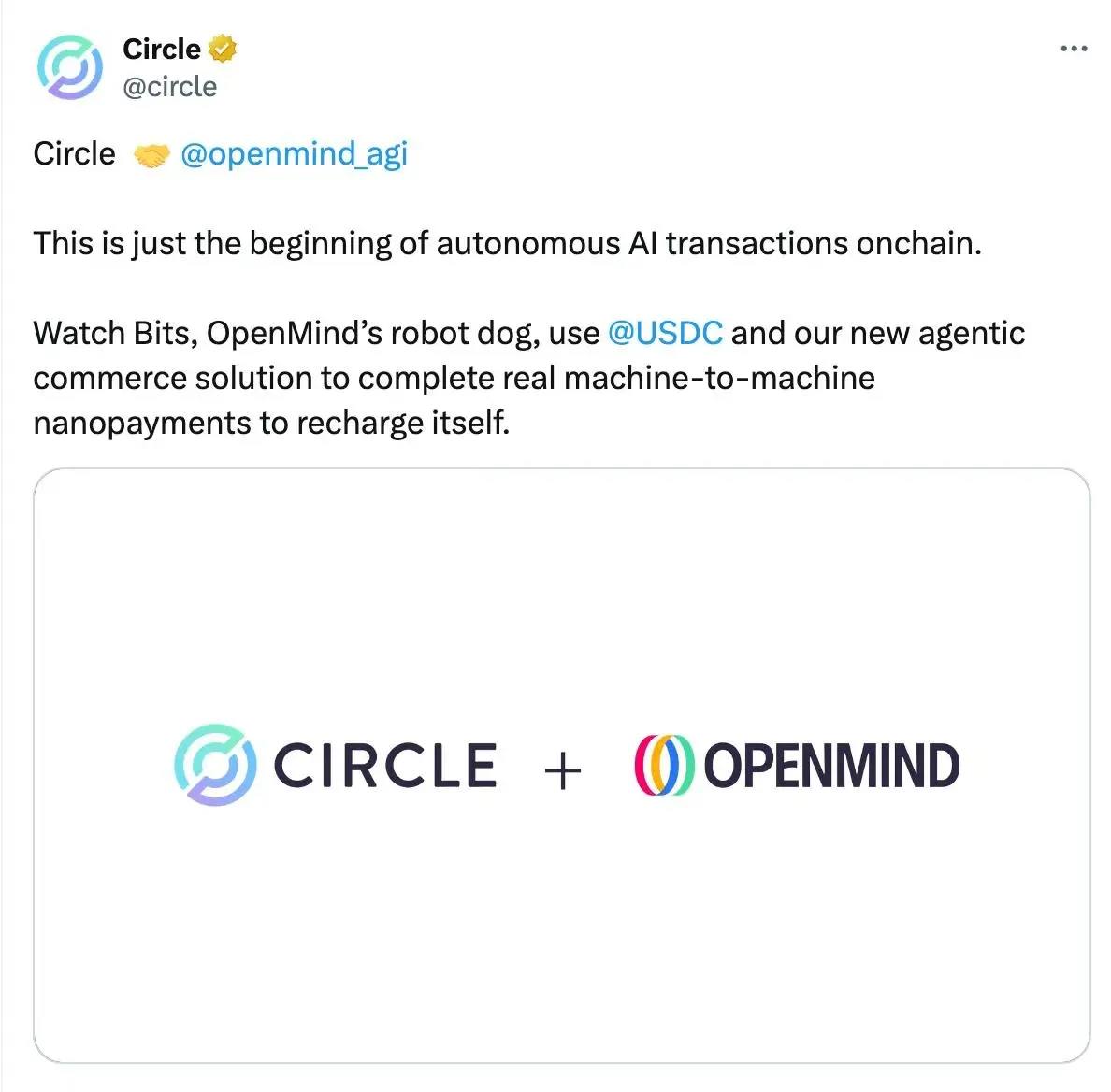
OpenMind and Circle have officially announced a strategic partnership to jointly launch the world's first payment infrastructure specifically designed for autonomous agents and real-world embodied AI. Through the deep integration of Circle's USDC stablecoin and OpenMind's x402 protocol module, this collaboration enables robots and AI agents to directly and autonomously pay for energy, services, and data in the physical world.
Based on the joint foundation of OpenMind and Circle, the FABRIC Foundation will accelerate implementation and large-scale deployment from two main directions: Robot Birthplace and Acceleration of Adoption.
The payment infrastructure of OpenMind + Circle provides machines with an "economic brain," while the FABRIC Foundation is responsible for the full-chain closed loop of "birth, production, operation, and evolution." The synergy of these three will jointly give rise to the true era of the machine economy—robots will no longer be mere tools, but independent economic entities with autonomous perception, decision-making, action, and payment capabilities. In the coming months, more real-world deployment cases (such as automated charging stations) are worth continuous attention.
Disclaimer: The content of this article solely reflects the author's opinion and does not represent the platform in any capacity. This article is not intended to serve as a reference for making investment decisions.
You may also like
Is the Federal Reserve repeating the 2022-style rate hikes? Bank of America warns: Rates may return above 5%, suggests shorting two-year U.S. Treasuries.
Bank of America warns: With Waller at the helm, the Federal Reserve may raise interest rates above 5%, potentially repeating the events of 2022.
OpenAI is expected to burn over $278 billion in cash by 2030, with a revenue target of $350 billion over the same period.
OpenAI is expected to generate up to $278 billion in negative free cash flow over the next five years, driven solely by computing power and infrastructure, with cumulative spending projected to reach approximately $856 billion by 2030. The company anticipates revenue of $350 billion in 2030 and $36 billion in 2026, with total revenue from 2026 to 2030 amounting to around $840 billion.
Garrett Jin's ZEC short position has an unrealized loss of $33.422 million.
Crypto prices
More


