
Vitalik sells 17K ETH in one month after earmarking $45M to privacy

Ethereum co-founder Vitalik Buterin has reduced his Ether balance by roughly 17,000 ETH in one month after announcing plans to earmark $45 million worth of tokens for privacy projects.
Buterin’s wallets tracked by Arkham held about 241,000 Ether (ETH) in early February, before a series of outflows reduced the combined balance to 224,000 ETH today.
The reduction comes amid continued selling from Buterin, including selling about 2,961 Ether worth $6.6 million over a three-day period earlier in the month. Onchain analysts reported that the selling accelerated recently as he sold $7 million worth of tokens in the past three days.
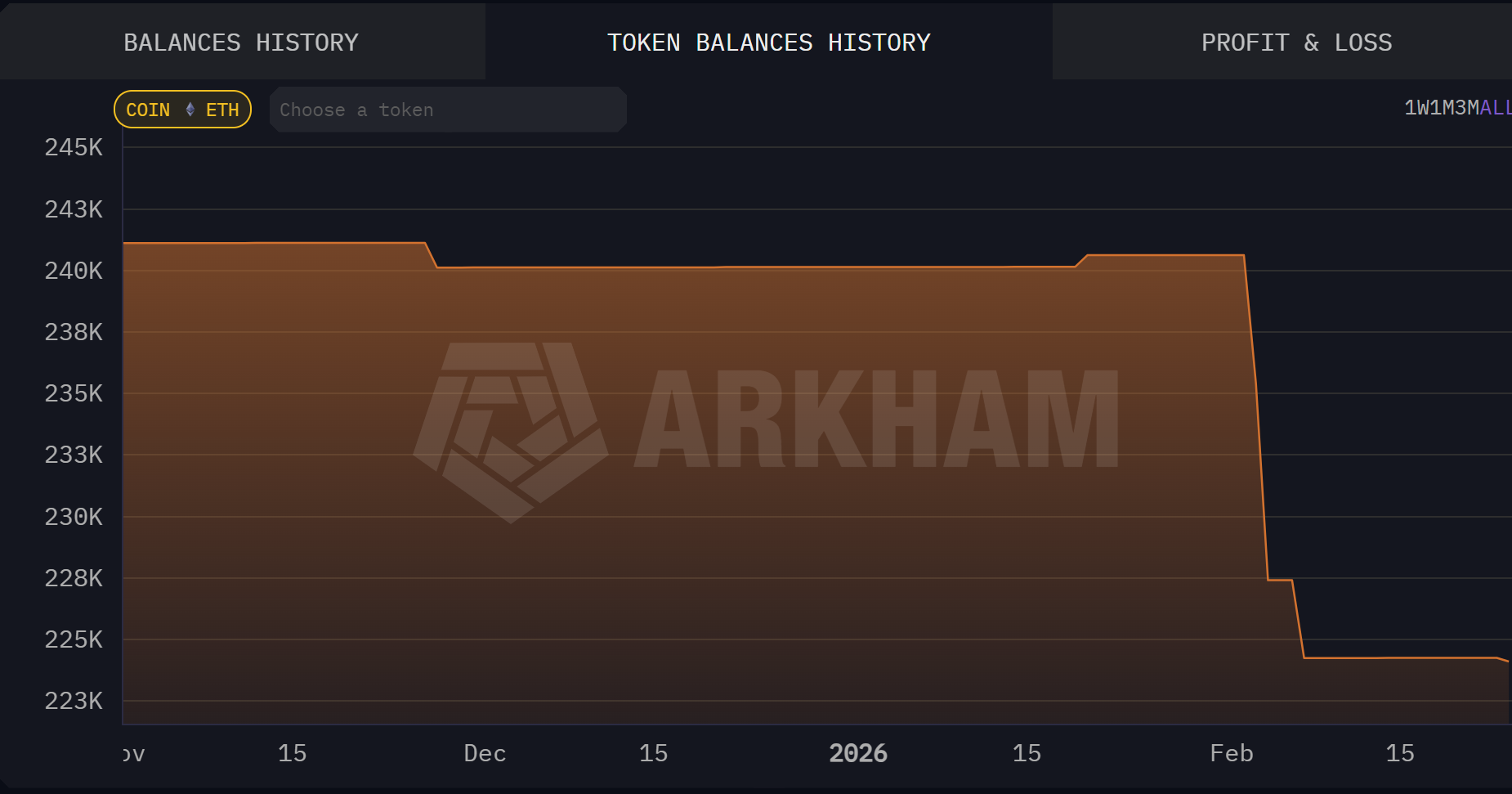 Buterin’s ETH balance declines since February. Source: Arkham
Arkham Intelligence data shows the ETH sales were routed via decentralized exchange (DEX) aggregator CoW Protocol using numerous smaller swaps instead of one large transaction, a method typically employed to minimize market impact.
Related:
Buterin commits $45 million to privacy initiatives
The ETH sell-off came after Buterin revealed in January that he had set aside 16,384 Ether, about $45 million, from his personal holdings to fund privacy-preserving technologies, open hardware, and secure, verifiable software systems. He said the capital will be deployed gradually over the coming years as part of a broader push for open-source and self-sovereign tools.
Buterin described the effort as aligned with the Ethereum Foundation entering a period of “mild austerity,” while maintaining its technical roadmap. He added he would personally take on initiatives that might otherwise be handled by the foundation, focusing on building a full open-source software and hardware stack to protect both digital and real-world environments.
“Specifically, we are seeking the existence of an open-source, secure and verifiable full stack of software and hardware that can protect both our personal lives and our public environments,” he wrote.
Related:
ETH drops 37% in one month
Buterin’s ETH selling coincided with a sharp drop in the price of Ether, which has lost over 37% of its value over the past month, according to data from CoinMarketCap. The token is currently trading at $1,825.39, down by nearly 5% over the past day.
The weak price performance comes even as more than 30% of Ether’s supply remains locked in staking. While staking yields have declined to about 2.8%, validator demand is still strong, with a near-record entry queue and minimal exits, according to data from DropsTab.
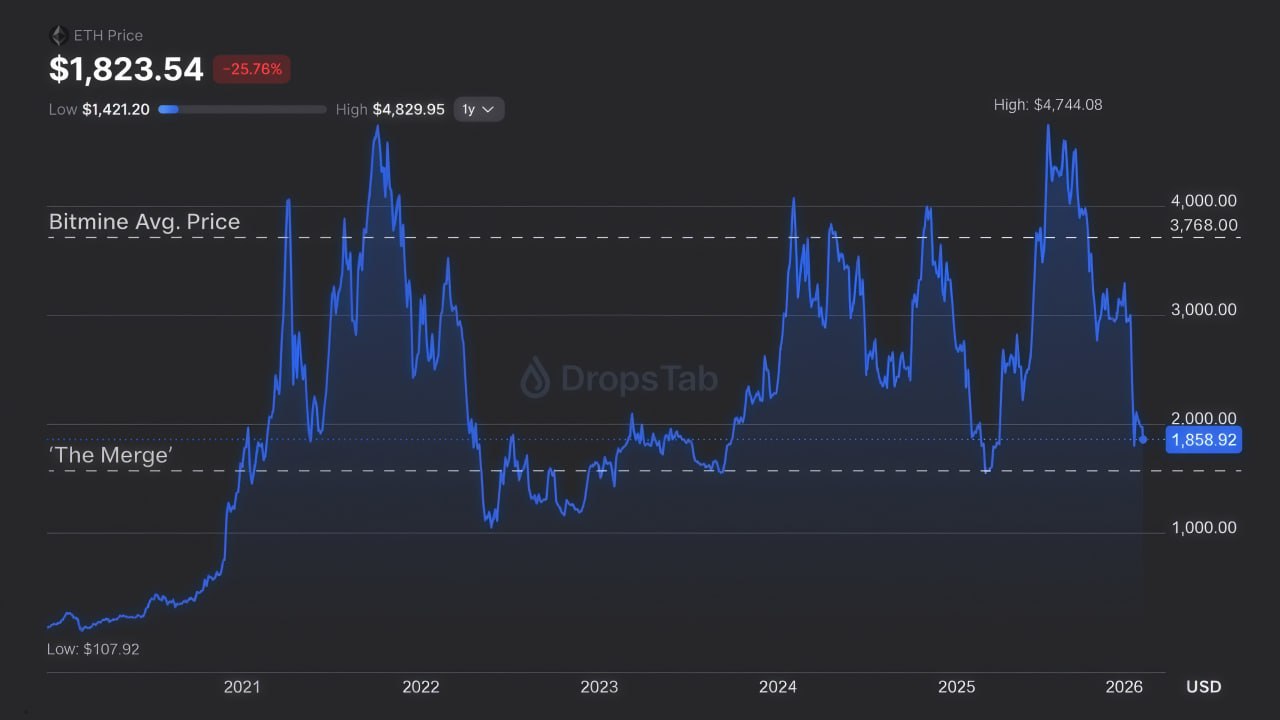 EHT price. Source: DropsTab
The decline has also hit corporate Ether treasuries hard. Bitmine Immersion Technologies, one of the largest corporate ETH holders, is estimated to be carrying billions in unrealized losses after the token fell about 60% in six months and dropped far below its average purchase price.
Magazine:
Disclaimer: The content of this article solely reflects the author's opinion and does not represent the platform in any capacity. This article is not intended to serve as a reference for making investment decisions.
You may also like
Elon Musk sleeps at construction site! Going all out for AI infrastructure

AI investment frenzy ready for another surge? With the Fed rate hike decision settled, reverse buying appears as US Treasury bonds face their "most painful moment"
Bob Michele from JPMorgan Asset Management stated that his team has started buying long-term bonds from the United States, Japan, and Australia, saying that current prices are "simply too cheap." Michele believes that a series of central bank actions and potential stabilization trends in the Middle East are key driving factors supporting the debt market.

"The New Bond King": The moment of reckoning is inevitable; a fully defensive stance should be adopted in the next 6 to 9 months
Gundlach believes the market has entered a "difficult phase." The excessive expansion of AI capital expenditures intertwined with the rapidly growing private credit market is bound to lead to a reckoning; credit spreads related to AI have already widened significantly, and the complex risk exposures between private credit and the insurance industry will trigger severe consequences in the next downturn. He has reduced his portfolio's AI exposure to zero and shifted toward equal-weight equities, high-quality bonds, local currency emerging market debt, and gold commodities.
Crypto prices
More


