
Cardano Whales Stack 819M ADA Amid Market Weakness

Cardano’s native token, ADA, has been under pressure for months. Despite this, deep-pocketed holders have continued to build their positions. Their steady buying suggests confidence has not faded behind the scenes, even as the broader market trend remains weak.
In brief
- Large holders have quietly added 819 million ADA over six months and now control nearly 70% of circulating supply.
- ADA’s price has dropped more than 71% from 0.90 to 0.26 dollars during the same period.
Whale Activity Intensifies Amid ADA Price Drop
Data shared on February 24 by blockchain analytics firm Santiment shows that large ADA holders have been quietly expanding their stacks for half a year. Addresses holding between 100,000 and 100 million ADA accumulated an additional 819.4 million tokens during that period. At current valuations, that equals roughly $213.9 million and represents a 1.6% rise in total supply held by this cohort.
As a result, these major wallets now hold about 25.36 billion ADA. That equals nearly 70% of the circulating supply, showing that most of the available ADA sits with large investors.
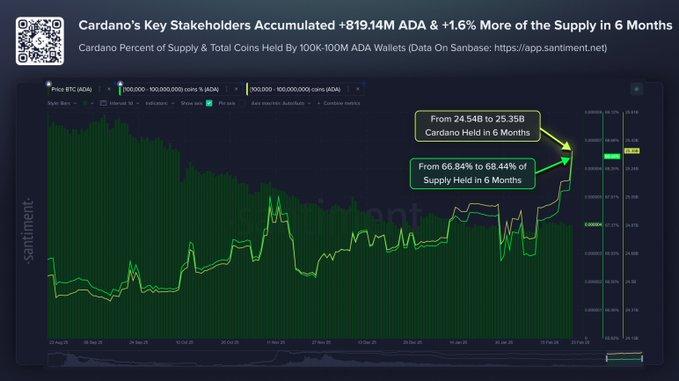 Cardano Whales Increase ADA Holdings Over 6 Months
This accumulation unfolded while ADA’s market value declined sharply. Over the same six-month window, the price fell more than 71%, sliding from $0.90 to $0.26. Such divergence between price action and whale behavior often draws attention. Large investors tend to increase exposure during downturns, treating weaker prices as entry points. By pulling tokens out of active circulation, whales tighten the available supply, which can amplify upside pressure if demand stabilizes or improves.
Grayscale Lifts ADA Allocation
Alongside whale activity, another institutional signal has emerged. Grayscale Investments adjusted the composition of its Smart Contract Fund, increasing ADA’s share to 20.12% from 19.50%. The update means Cardano now represents more than one-fifth of the fund’s portfolio.
Portfolio reallocations by established asset managers are closely watched in the digital asset space. An increased allocation does not guarantee price appreciation, yet it reflects a degree of conviction at the institutional level. Combined with on-chain accumulation, it adds another layer to the broader narrative surrounding ADA’s positioning.
Technical Structure Still Points Lower
Despite these supportive factors, ADA’s daily chart continues to show a broader downtrend. The market has consistently printed lower highs and lower lows, reinforcing the bearish structure. A recent rebound from around $0.25 provided short-term relief but has not altered the overall pattern.
Currently, price hovers near the middle Bollinger Band, corresponding to the 20-day moving average, which acts as near-term resistance. The narrowing of the Bollinger Bands signals declining volatility—a pattern that often precedes a strong price move. However, the indicator does not reveal the breakout’s direction, only that a move may be approaching.
Momentum remains slightly negative as ADA trades below both the middle band and the $0.30 threshold. A decisive close above $0.30 could trigger a push toward the $0.33–$0.36 range, forming a potential relief rally. Conversely, failure to hold the $0.25 support level could extend the downtrend, exposing $0.23 and possibly $0.20 as the next targets.
For now, ADA appears locked in consolidation within a broader bearish framework. Whale accumulation and institutional portfolio adjustments indicate underlying confidence, yet the chart continues to demand confirmation. A breakout, in either direction, will determine whether the quiet buildup by major holders lays the groundwork for a recovery or unfolds within an ongoing downtrend.
Maximize your Cointribune experience with our "Read to Earn" program! For every article you read, earn points and access exclusive rewards. Sign up now and start earning benefits.
Disclaimer: The content of this article solely reflects the author's opinion and does not represent the platform in any capacity. This article is not intended to serve as a reference for making investment decisions.
You may also like
The "debt black hole" behind the AI boom: $1.2 trillion external financing may be needed in the next five years
The rapid surge of AI is creating an unprecedented "debt black hole": according to Bank of America estimates, total capital expenditure for building AI data centers between 2025 and 2030 will reach as much as $5 trillion, with external financing needs of core cloud giants alone reaching $1.2 trillion to $1.5 trillion. Free cash flow is already running low for giants such as Amazon and Meta, while Nvidia and Broadcom have quietly taken on the role of "implicit guarantors"—marking the beginning of a capital gamble that is set to reshape global credit markets.
Analyst Makes Bold Prediction: Micron (MU.US) Expected to Surpass Microsoft (MSFT.US) in Fiscal Year 2027 Profit; Memory Prices Are the Key Factor
Is Micron (MU.US) expected to earn a net profit of $35 billion in a quarter, surpassing Microsoft's (MSFT.US) profits?
Warning Signs of US Stock Market Crash Reappear as in 2018 and 2022? Fed Tightening and US Treasury Supply Hit Amid Worsening Market Breadth, Liquidity Crisis May Be Approaching
Liquidity pressures may not yet be apparent on the surface of the market, but as market breadth in both stock and bond markets continues to deteriorate, these pressures are steadily accumulating internally.
X Finance Bull highlights $3,300 XRP price model filed with SEC
Crypto prices
More


