
TEM vs. ILMN: Which MedTech Stock Offers Greater Upside?

In 2026, MedTech players' success will hinge on their ability to balance near-term pressure with long-term transformation. Per a report by ZS, these players must address immediate operational, financial, and regulatory challenges without losing sight of broader industry shifts. A key priority will be proactively adapting to the migration of care toward outpatient centers and ambulatory surgery settings, ensuring that products and services are tailored to these evolving care environments. MedTech firms will also need to take a strategic approach to surgical robotics — either integrating the technology to strengthen their competitive positioning or differentiating themselves in segments where robotics is not essential.
At the same time, these companies must take a pragmatic approach to artificial intelligence (AI), focusing on applications that genuinely enhance efficiency, decision-making and patient outcomes rather than adding AI features solely for marketing appeal. Market players need to actively plan for multiple future scenarios and be ready to pivot as conditions evolve. Companies that combine agility with a clear strategic direction will be best positioned to thrive in 2026.
MedTech players like Tempus AI TEM and Illumina ILMN are likely to be on investors’ radars in 2026.
Stock Performance: TEM vs. ILMN
Shares of Tempus and ILMN have declined 9.1% and 7.1%, respectively, year to date.
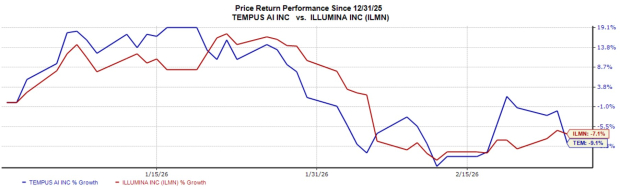
Image Source: Zacks Investment Research
The Case for Tempus
Oncology remains the primary growth driver within Tempus’ diagnostics business. In 2026, Tempus launched Paige Predict, an AI-powered digital pathology suite that analyzes standard H&E slides to predict 123 biomarkers across 16 cancer types.
In 2025, Tempus extended Tempus Next care pathway intelligence platform into breast cancer, furthering AI-driven decision support across oncology. The company introduced Tempus xM for treatment and response monitoring (TRM), a liquid biopsy assay designed to monitor immunotherapy response in patients with advanced solid tumors. Tempus also expanded its exclusive collaboration with Personalis to include colorectal cancer as the fourth indication under the NeXT Personal MRD commercial partnership.
Tempus’ fourth-quarter revenues increased 83.0% year over year to $367.2 million. The growth was driven by the Diagnostics and Data and Applications arms’ huge growth of 121.6% and 25.1%, respectively.
In the fourth quarter of 2025, Tempus delivered significant improvement in profitability metrics compared to prior periods. The company reported positive adjusted EBITDA of $12.9 million, reflecting operating leverage as revenues scaled and cost discipline improved. Gross profit increased 109.4% year over year, driven by higher oncology testing volumes, increased data and services revenues, and continued automation within its lab operations.
The quality of profitability remains a key consideration for Tempus. Despite achieving positive adjusted EBITDA, GAAP losses persisted, reflecting substantial stock-based compensation, higher amortization of acquired intangibles related to the Ambry transaction, and a one-time loss associated with debt extinguishment. Net loss was $54.2 million, which included $48.7 million of stock compensation expense and related employer payroll taxes in the fourth quarter.
The Case for Illumina
An expanding NGS oncology portfolio is helping Illumina drive the revolution in cancer genomics. In 2025, Illumina introduced TSO 500 v2, the next-generation version that offers a streamlined sample-to-analysis workflow.
Illumina is partnering with several global pharmaceutical companies to develop companion diagnostics (CDx) enabled on the TSO Comprehensive genomic profiling test, focusing on KRAS alterations, which are known to cause uncontrolled cell growth, leading to cancer. The company introduced DRAGEN v4.4 with ready-to-use oncology applications for clinical research and obtained regulatory clearance in Japan.
Revenues of $1.16 billion were up 5% year over year. The figure was also surpassed the company’s expectations, driven by robust clinical consumable revenues, better-than-expected NovaSeq X placements, and outperformance in China.
In the fourth quarter of 2025, Illumina reported improved profitability metrics, supported by cost-reduction actions and stabilizing demand in clinical sequencing markets. Adjusted operating margin expanded 64 bps to 63.7% in the quarter.
In recent years, Illumina’s operations have been impacted by macroeconomic headwinds, including inflation, currency fluctuations and concerns about a potential economic slowdown. In the fourth quarter of 2025, non-GAAP gross margin declined 40 basis points year over year to 67%, primarily reflecting a 205-basis-point impact from tariffs.
Valuation: TEM vs. ILMN
Tempus is trading at a forward 12-month price-to-sales (P/S) ratio of 5.92, below its median of 7.81 over the past year. Illumina’s forward 12-month P/S ratio of 4.08 is higher than its median of 3.53. However, ILMN is trading cheaper than TEM.
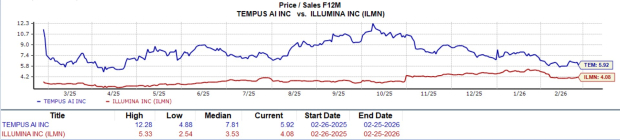
Image Source: Zacks Investment Research
Price Targets for TEM and ILMN
Based on short-term price targets by 14 analysts, the average price target for Tempus is $86.71, implying a 49.6% upside from the latest closing price.
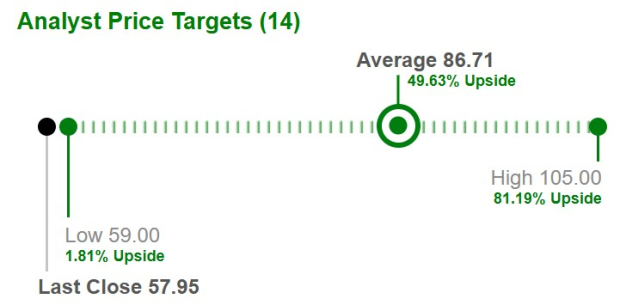
Image Source: Zacks Investment Research
Based on short-term price targets by 19 analysts, Illumina’s average target of $133.74 implies an 8.8% upside from the most recent close.
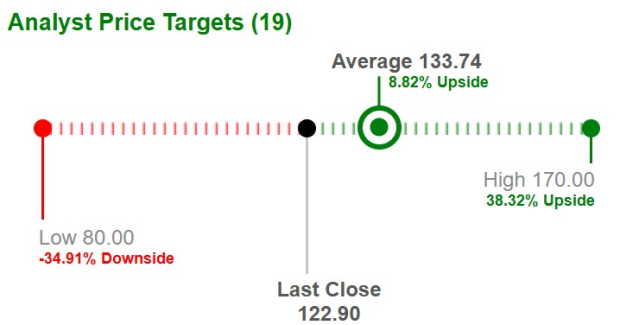
Image Source: Zacks Investment Research
Conclusion
Both Tempus and Illumina presently carry a Zacks Rank #3 (Hold). Overall, Tempus’ accelerating oncology innovation, expanding AI-powered diagnostics portfolio, and strong growth across its Diagnostics and Data and Applications segments reinforce its position as a leader in precision medicine. Illumina’s expanding NGS oncology portfolio, companion diagnostic partnerships and software advancements strengthen its central role in enabling cancer genomics globally.
Both companies demonstrated improved profitability in the fourth quarter, though Illumina operates from a more mature, cash-generative base, while Tempus is transitioning from growth-stage investment toward scaled profitability.
Based on 12-month price performance and valuation metrics, Illumina appears to be the stronger investment option at this time compared with Tempus. You can see the complete list of today’s Zacks #1 Rank (Strong Buy) stocks here.
Disclaimer: The content of this article solely reflects the author's opinion and does not represent the platform in any capacity. This article is not intended to serve as a reference for making investment decisions.
You may also like
XRP Pundit: First Thing You Should Do When You Become a Crypto Millionaire
 VIPTradFi Focus: Where Does the RWA Market Stand Today?
1. Crypto outperformed traditional equity indexes following the rate hike, but elevated interest rates remain a key constraint on cross-asset allocation. From September 12 to 18, BTC, ETH, and SOL gained 4.83%, 3.84%, and 9.96%, respectively, while the S&P 500 edged down 0.08%. The U.S. Dollar Index rose 1.11%, and the 10-year U.S. Treasury yield closed at approximately 4.998%. Improving risk appetite is therefore coexisting with elevated discount rates, raising the bar for RWA allocation: investors need to compare not only returns on the underlying assets, but also on-chain liquidity and collateral efficiency. 2. Growth in tokenized equities is occurring even as the overall RWA market remains under pressure. As of September 18, Distributed Asset Value across RWAs stood at $38.503 billion, down 1.13% week over week, while tokenized equities reached $3.056 billion, up 6.03%. This week's data are better explained by capital reallocating across different RWA segments than by a broad-based expansion of the entire RWA market. 3. For exchanges, the opportunity lies in connecting spot holdings, collateral, and derivatives. Reality's distributed asset value stands at approximately $155 million, while eligible rTokens can already be used within Bitget's UTA margin framework. Across CoinGlass's verifiable sample of 177 TradFi instruments, open interest reached approximately $11.498 billion, up 2.06% week over week, even as weekly trading volume declined 7.60%. The medium-term opportunity remains intact, but deeper utilization will depend on liquidity, collateral use, and sustained trading activity. 4.Assets to watch: BTC, ETH, SOL, NEAR, ZEC, gold, tokenized U.S. equities, COST. 5.Key metrics to watch: rToken collateral utilization, the durability of TradFi open interest and trading volume, and next week's employment and consumer data.

Gold prices fall Rs 1,331/10 gram, silver dips Rs 1,600/kg as Mideast tensions outweigh oil fall: Key levels to track
Strategists Say Market's ‘Wall of Worry' Is Healthy, Not a Warning Sign

Crypto prices
More


