
WLFC Rallies 35% in 6 Months: Should You Buy the Stock?

Willis Lease Finance Corporation WLFC shares have climbed 35.3% in the past six months compared with the industry’s 21.8% growth. The company has outperformed other industry players, including Air Lease Corporation AL and Ryder System, Inc. R. Shares of AL and R have gained 7.2% and 18%, respectively, in the same time frame. Sustained aviation supply-demand imbalances, firm lease rates, institutional capital partnerships, in-house technical capabilities and long-term service agreements drive recurring cash flows and earnings visibility for WLFC.
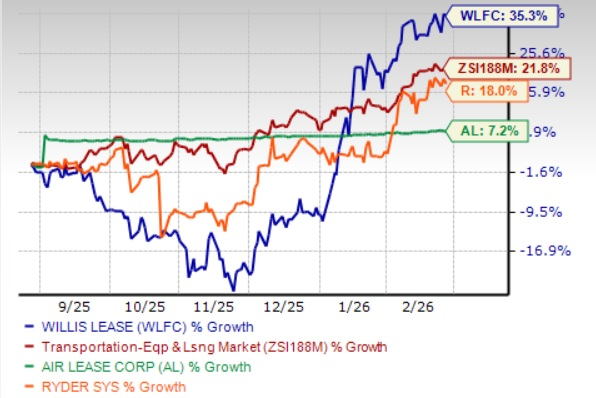
Image Source: Zacks Investment Research
A Key Look Into WLFC’s Business Operations
WLFC is a leading lessor and servicer of commercial aircraft and engines, focused on generating shareholder value through leasing, asset management, and spare parts sales. As of Sept. 30, 2025, its portfolio included 354 engines, 20 aircraft, one marine vessel and other equipment leased to 69 lessees in 37 countries, with most revenues derived from Leasing and Related Operations. WLFC primarily provides triple-net operating leases, retaining residual value risk while lessees cover maintenance and related costs. The company also earns maintenance reserves and management fees, and manages additional assets for third parties. Through subsidiaries Willis Aero and Willis Asset Management, WLFC sells engine parts and provides engine management and consulting services.
WLFC’s Key Tailwinds
WLFC is benefiting from sustained strength in the aviation market, as airlines continue to face tight aircraft and engine supply. In the third quarter of 2025, lease rent revenues rose to $76.6 million, while maintenance reserve revenues reached $76.1 million, reflecting strong utilization and demand for spare engines. Management noted that lease rates remain firm and that the portfolio is positioned to capture ongoing supply-demand imbalances, supporting recurring cash flows and earnings visibility.
The company’s expanding asset management and credit strategies represent another meaningful tailwind. In December 2025, WLFC announced a partnership with Liberty Mutual Investments to deploy up to $600 million into engine loans and loan-like financings. In January 2026, it also formed a strategic aircraft engine leasing partnership with Blackstone Credit & Insurance, targeting over $1 billion of deployments over two years. These alliances diversify funding, accelerate growth and scale fee-based income streams.
Operational integration and in-house technical capabilities are further strengthening margins and asset control. In February 2026, WLFC launched Willis Module Shop, successfully completing its first core engine restoration with strong EGT margin recovery. In parallel, it partnered with CFM International on a program to extend the operational life of CFM56 engines. These initiatives enhance lifecycle management, reduce maintenance costs and improve long-term asset returns.
Finally, WLFC’s vertically integrated service offerings and long-term programs such as ConstantThrust support durable customer relationships and recurring revenues. In February 2026, the company signed a multi-year ConstantThrust agreement with Nauru Airlines covering seven CFM56-7B engines. Combined with consistent capital returns, including a recently declared 40 cents per share quarterly dividend, these factors underscore financial strength and confidence in sustained growth.
Challenges Persist for WLFC’s Business
The company faces pressure from rising financing costs and balance sheet leverage. Net finance costs increased meaningfully due to a higher overall debt balance and new securitizations, lifting quarterly interest expense. At the same time, it recorded $10.2 million of equipment write-downs in the third quarter as several engines were impaired and moved to held for sale.
Depreciation also climbed with portfolio growth and accelerated charges on older models, while technical expenses rose on higher engine repair activity, weighing on margins. Macro and policy dynamics add further strain. In addition, spare parts revenues can be lumpy and timing-dependent, and maintenance services revenue declined following the sale of the fleet management business.
WLFC’s Valuation
The company is cheaply priced compared with the industry average. Currently, WLFC is trading at 5.02X trailing 12-month EV/sales value, below the industry’s average of 7.4X. The metric also remains lower than one of the company’s peers, Air Lease (8.79X), but remains higher than that of Ryder (1.23X).
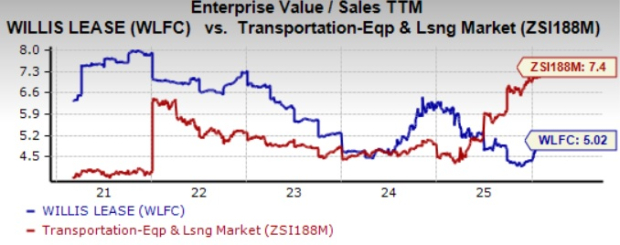
Image Source: Zacks Investment Research
Conclusion
Despite rising financing costs, higher leverage, equipment write-downs and margin pressure from elevated depreciation and technical expenses, WLFC remains supported by sustained aviation supply-demand imbalances, firm lease rates, expanding institutional partnerships, enhanced in-house technical capabilities and long-term service agreements that underpin recurring cash flows, earnings visibility and long-term shareholder returns.
Strong fundamentals, coupled with WLFC’s undervaluation, present a lucrative opportunity for investors to add the stock to their portfolio.
Disclaimer: The content of this article solely reflects the author's opinion and does not represent the platform in any capacity. This article is not intended to serve as a reference for making investment decisions.
You may also like
XRP Pundit: First Thing You Should Do When You Become a Crypto Millionaire
 VIPTradFi Focus: Where Does the RWA Market Stand Today?
1. Crypto outperformed traditional equity indexes following the rate hike, but elevated interest rates remain a key constraint on cross-asset allocation. From September 12 to 18, BTC, ETH, and SOL gained 4.83%, 3.84%, and 9.96%, respectively, while the S&P 500 edged down 0.08%. The U.S. Dollar Index rose 1.11%, and the 10-year U.S. Treasury yield closed at approximately 4.998%. Improving risk appetite is therefore coexisting with elevated discount rates, raising the bar for RWA allocation: investors need to compare not only returns on the underlying assets, but also on-chain liquidity and collateral efficiency. 2. Growth in tokenized equities is occurring even as the overall RWA market remains under pressure. As of September 18, Distributed Asset Value across RWAs stood at $38.503 billion, down 1.13% week over week, while tokenized equities reached $3.056 billion, up 6.03%. This week's data are better explained by capital reallocating across different RWA segments than by a broad-based expansion of the entire RWA market. 3. For exchanges, the opportunity lies in connecting spot holdings, collateral, and derivatives. Reality's distributed asset value stands at approximately $155 million, while eligible rTokens can already be used within Bitget's UTA margin framework. Across CoinGlass's verifiable sample of 177 TradFi instruments, open interest reached approximately $11.498 billion, up 2.06% week over week, even as weekly trading volume declined 7.60%. The medium-term opportunity remains intact, but deeper utilization will depend on liquidity, collateral use, and sustained trading activity. 4.Assets to watch: BTC, ETH, SOL, NEAR, ZEC, gold, tokenized U.S. equities, COST. 5.Key metrics to watch: rToken collateral utilization, the durability of TradFi open interest and trading volume, and next week's employment and consumer data.

Gold prices fall Rs 1,331/10 gram, silver dips Rs 1,600/kg as Mideast tensions outweigh oil fall: Key levels to track
Strategists Say Market's ‘Wall of Worry' Is Healthy, Not a Warning Sign

Crypto prices
More


