
Profit-taking pressure pushes gold and silver prices lower

FX678, February 26—— On Thursday (February 26) during early US trading hours, both gold and silver prices fell, with silver once again leading the decline. Previously, both commodities had gained, starting a short-term upward trend. Currently, profit-taking by short-term futures traders has become the dominant factor in the market. April gold futures fell by $42.20 during trading, quoted at $5184.40 per ounce; March silver futures fell by $4.878, quoted at $86.245 per ounce.
On Thursday (February 26) during early US trading hours, both gold and silver prices fell, with silver once again leading the decline. Previously, both commodities had gained, starting a short-term upward trend. Currently, profit-taking by short-term futures traders has become the dominant factor in the market. April gold futures fell by $42.20 during trading, quoted at $5184.40 per ounce; March silver futures fell by $4.878, quoted at $86.245 per ounce.
Today, the United States and Iran launched the third round of nuclear negotiations in Geneva, Switzerland, with only a few days left before the deadline set by President Trump. The tense standoff over Iran's nuclear activities has lasted for months, and this round of talks is being mediated by Oman at its embassy in Geneva. Ismail Baghaei, spokesperson for the Iranian Foreign Ministry, said in an interview with Iranian state television during the talks in Switzerland: "Iran has come to the talks with sufficient pragmatic flexibility, and the peaceful use of nuclear energy is our legitimate right recognized by the international community." Trump has set a window for reaching an agreement with Iran from March 1 to 6 and threatened that if Iran fails to comply, the US will take military action. This has sparked market concerns about a new conflict in the Middle East, which could affect Israel and the oil-producing Gulf Arab countries.
Ukrainian President Zelensky and President Trump had just discussed possible next steps for peace talks, and hours later, Russia launched a large-scale drone and missile attack on Ukraine. Zelensky posted on Telegram today, with Bloomberg reprinting the message, stating that Russian forces attacked eight regions in Ukraine, deploying 420 drones and 39 missiles, injuring dozens including children, and targeting energy infrastructure in Kyiv, Dnipro, and Poltava regions. Other reports indicate that senior US and Ukrainian negotiators are also meeting in Geneva today to discuss economic issues, including the so-called "Prosperity Plan" to provide funding support for Ukraine's post-war reconstruction.
Earlier this week, Citron Research published a blog post titled "The Global Intelligence Crisis of 2028," causing a slight dip in the stock market. Investors are digesting the negative outlook that artificial intelligence could replace white-collar jobs and trigger a deflationary spiral. The report points out that the blog post described a scenario where powerful AI agents replace large numbers of white-collar jobs, severely hitting consumer spending and pushing the global economy into a deflationary spiral; stocks of companies such as Uber and Mastercard also plunged as a result. The report notes that the market's reaction to this blog post once again shows that Wall Street still struggles to grasp the direction of artificial intelligence, with investors worried that the technology may lack commercial value or could cause too great an economic impact. This viewpoint aligns with the bullish stance of safe-haven buying in precious metals.
Today, in key external markets, the US dollar index edged higher, oil prices declined, currently trading around $64.25 per barrel; the benchmark 10-year US Treasury yield is at 4.05%.
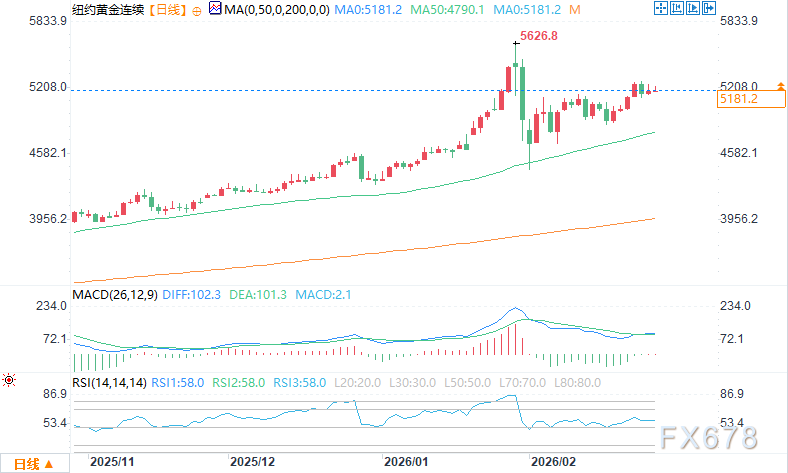
(COMEX Gold Daily Chart Source: Easy FX678)
The next short-term upside target for gold bulls is to push futures prices to close above the key resistance at $5400.00; the next short-term downside target for bears is to push prices below the key technical support of $4854.20. The first resistance for gold futures is the week's high at $5269.40, with further resistance at $5300.00; the first support is the week's low at $5109.50, with further support at $5100.00.
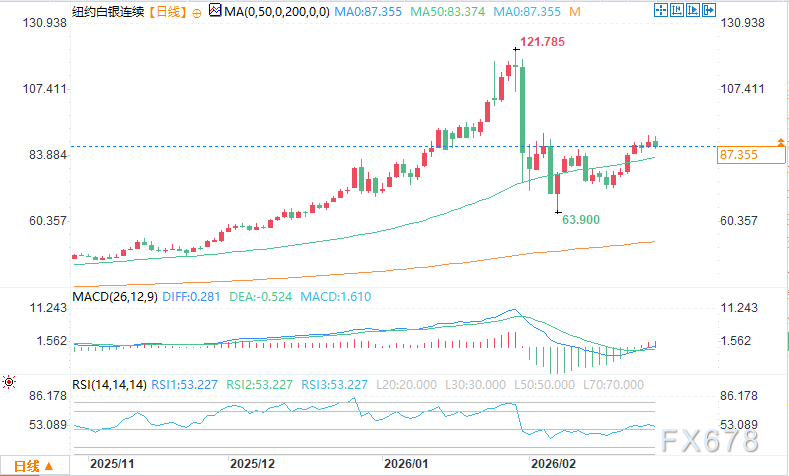
(COMEX Silver Daily Chart Source: Easy FX678)
The next short-term upside target for silver bulls is to push futures prices to close above the key technical resistance at $100.00; the next short-term downside target for bears is to push prices below the February low and key support of $71.815. The first resistance for silver futures is $88.00, with further resistance at last night's high of $90.255; the next support is this week's low at $84.56, with further support at $82.50.
Note: The gold market mainly operates through two pricing mechanisms: the spot market, which quotes immediate buy/sell prices for instant delivery; and the futures market, which determines the delivery price for a future date. Affected by year-end positions and market liquidity, the most actively traded gold futures contract on the Chicago Mercantile Exchange is currently the December contract.
Disclaimer: The content of this article solely reflects the author's opinion and does not represent the platform in any capacity. This article is not intended to serve as a reference for making investment decisions.
You may also like
AI memory demand continues to surge: Micron (MU.US) surpasses expectations in Q4, with quarterly data center core business revenue increasing by over 10 times year-over-year
Storage chip giant Micron Technology released its financial results for the fourth quarter of fiscal year 2026 after the market closed on Wednesday. Both revenue and profit exceeded Wall Street expectations, and the company provided stronger-than-expected guidance for the next quarter.
Federal Reserve approves stress test reform by a 6-1 vote: Capital requirement volatility halved, sole dissenting vote warns of reduced resilience
The Federal Reserve has officially approved two final rules aimed at increasing transparency and reducing capital requirement volatility by approximately 50%. The new regulations will seek public comments on stress test scenarios and will calculate the capital buffer based on the average of the results from two consecutive years of testing. This averaging mechanism will take effect in 2028. The reforms are the result of years of negotiation within the banking sector and have been welcomed by industry groups. However, critics such as Governor Barr warn that the reforms will weaken the constraints of stress testing and reduce the overall resilience of the banking system.

Metals fade as long yields offset cooler inflation, lower Fed odds - Kitco PM Report
Bitwise brings NEAR to Wall Street – But the chart isn’t impressed
Crypto prices
More


