
AI Anxiety Persists as Long-term U.S. Treasuries Attract Investors, Yields Fall to Multi-month Lows

Recently, the US bond market has continued to strengthen, with significant buying inflows into key maturities within the $30 trillion US Treasury market. Lawrence Gillum, chief fixed income strategist at LPL Financial, pointed out that this surge in long-term US Treasuries is partly driven by market concerns over the potential impact of artificial intelligence (AI) on the US labor market.
Gillum believes that the recent decline in long-term Treasury yields at least partially reflects investors' anxiety over the potential "disruptiveness" of AI. In other words, worries surrounding AI are driving yields lower in the bond market.
Data shows that on Thursday, the yield on the US benchmark 10-year Treasury closed below 4.02%, at 4.015%, hitting its lowest level since November 26 of last year. The 10-year Treasury yield is typically regarded as the benchmark for pricing 30-year fixed-rate mortgages. On the same day, the yield on the 30-year Treasury fell below 4.7%, closing at 4.665%, marking the lowest level in the past three months. It is worth noting that this round of yield declines was not accompanied by the release of major economic data or other significant non-AI-related events.
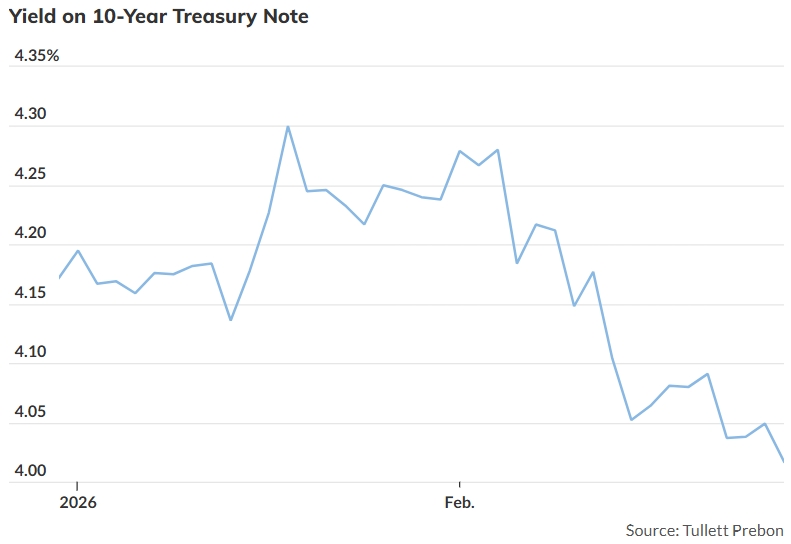
Since January, the sustained downward trend in long-term yields has extended into the housing finance sector. According to data from Freddie Mac, newly issued 30-year fixed mortgage rates have fallen below 6% for the first time in three and a half years. Generally, US Treasury yields are influenced by multiple factors, including economic growth and inflation outlook, expectations for Federal Reserve interest rate paths, as well as rising geopolitical risks in regions like the Middle East.
However, the current market environment is quite unique. On one hand, the overall US economy remains resilient; on the other hand, expectations for the next Fed rate cut have been pushed back to July. In addition, the US and Iran are holding talks on nuclear issues in Geneva, with reports suggesting that an agreement may be reached. Against this backdrop, the continued decline in long-term yields is particularly noteworthy.
Despite mixed recent economic data, most US companies have yet to see large-scale layoffs, with the labor market maintaining a "low hiring, low layoffs" pattern. As long as employment remains stable, lower mortgage rates help ease home affordability pressures. However, concerns about AI potentially replacing jobs continue to simmer beneath the surface.
In a phoneinterview, Gillum stated that there is "ongoing buying in the bond market related to AI-driven job replacement," and the decline in yields over the past few weeks is closely related to this. He pointed out that Thursday's bond market performance "seems like a continuation of this trading logic." In addition, traders appear to be more focused on the possible deflationary effects brought by AI rather than potential inflationary risks in the coming years.
In contrast to the bond market, on Thursday investors continued to weigh the winners and losers of the AI theme in the stock market. The three major US stock indices showed mixed performance: the Dow Jones Industrial Average edged up 0.03%, the S&P 500 Index fell 0.54%, and the Nasdaq Composite Index dropped nearly 1.2%. The decline in market risk appetite has also, to some extent, reinforced the trend of funds flowing into relatively safe assets.
Disclaimer: The content of this article solely reflects the author's opinion and does not represent the platform in any capacity. This article is not intended to serve as a reference for making investment decisions.
You may also like
AI agents drive shift from XRP to stablecoins on XRP Ledger, BlackRock says
Why suspend RMPs? Explanation from New York Fed SOMA Manager Perli
"Agent vs US Treasury" — Who Will Dominate the US Stock Market?
The wave of AI Agents and US Treasury yields are splitting the US stock market into two worlds: Meta's release of the Muse model boosted its market value by $220 billion in a single week, propelling the Nasdaq's standout performance; however, excluding AI stocks, the S&P 500 actually fell 1% this week, with the number of new lows on the New York Stock Exchange surpassing new highs for nine consecutive days, signaling the near end of "breadth trading." Goldman Sachs bluntly stated that this is a "frustrating cat-and-mouse game" between the stock market and interest rates—any breakout can be snuffed out by the bond market at any time, so equity holders must short US Treasury bonds to hedge simultaneously.
Hopes for a ceasefire between the US and Iran encounter obstacles again! Trump rejects Iran's seven-day proposal; inflation pressure under $100 oil prices remains difficult to ease
Trump rejects a ceasefire with Iran, and it is expected that bombings will occur again after the midterm elections. The president doubts whether Tehran will meet his demands.
Crypto prices
More


