
The Federal Reserve's balance sheet can only be rebalanced when the gold price reaches $8,000.

FX678, February 27—— Daniel Oliver, founder of Myrmikan Capital, stated that historically, central banks, under market pressure, held gold reserves roughly equivalent to one-third of their balance sheets. According to his analysis, applying this historical ratio to the current Federal Reserve balance sheet would yield a much higher implied gold price. He said: "Gold prices must reach a level that rebalances the Federal Reserve’s balance sheet, and currently $8,000 can reach about one-third."
Daniel Oliver, founder of Myrmikan Capital, stated that the international accumulation phase of the current gold bull market has officially ended, giving way to a turbulent second phase driven by pressures in the US credit system.
Oliver said that the combination of excessively leveraged private equity and the ever-expanding US Treasury debt is trapping the Federal Reserve. He outlined the mechanisms driving up the prices of physical gold and silver, pointing out the fundamental vulnerabilities that exist in the broader financial system.
US Treasury debt now exceeds $38.5 trillion. Meanwhile, the Congressional Budget Office (CBO) projects that by 2036, net interest payments on national debt will more than double to $2.1 trillion. Oliver noted that if you take into account the net present value of unfunded liabilities such as Medicare and Social Security, the real debt burden is much higher. He believes that,
He said: "Every major credit bubble ends with a price collapse. In contrast,
This systemic pressure is becoming increasingly closely related to the private credit market. Analysts at UBS recently warned that, due to the rapid disruption of corporate borrowers by artificial intelligence, private credit default rates could soar to 15% in a worst-case scenario.
Oliver explained that, unlike the 2008 financial crisis when the Federal Reserve could stimulate the housing market by printing money, saving the private equity industry presents different challenges. He pointed out that due to lack of consumer demand, highly leveraged businesses face bankruptcy and cannot be saved simply by injecting liquidity into the banking system.
Oliver said: "I
Due to these macroeconomic pressures and weakening confidence in paper financial instruments, the physical metals market is undergoing structural changes. He observed that industrial demand for silver is tightening as manufacturers abandon the standard inventory model. Out of concern for supply chain disruptions, he noted that companies are directly stockpiling physical silver at factories, depleting available inventories in the market.
Meanwhile, Oliver emphasized that stressed banks are tightening margin requirements for smelters and refiners. He said this is forcing these entities to process less physical metal, becoming a bottleneck that limits the flow of gold into retail and institutional markets.
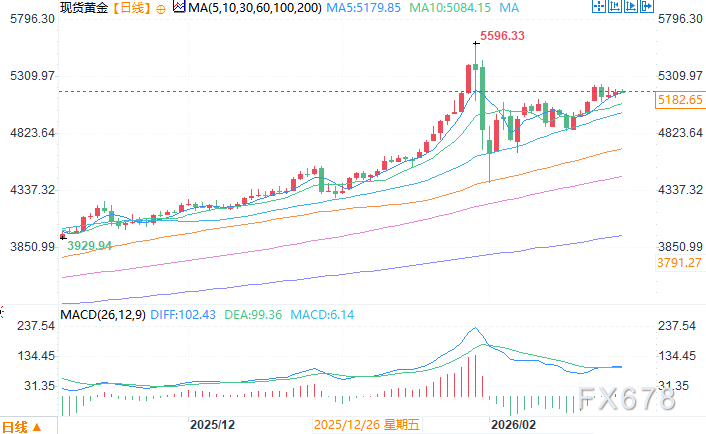
Spot gold daily chart Source: FXeasy
GMT+8, February 27, 13:24 – Spot gold quoted at $5,187.65/oz
Disclaimer: The content of this article solely reflects the author's opinion and does not represent the platform in any capacity. This article is not intended to serve as a reference for making investment decisions.
You may also like
Why suspend RMPs? Explanation from New York Fed SOMA Manager Perli
"Agent vs US Treasury" — Who Will Dominate the US Stock Market?
The wave of AI Agents and US Treasury yields are splitting the US stock market into two worlds: Meta's release of the Muse model boosted its market value by $220 billion in a single week, propelling the Nasdaq's standout performance; however, excluding AI stocks, the S&P 500 actually fell 1% this week, with the number of new lows on the New York Stock Exchange surpassing new highs for nine consecutive days, signaling the near end of "breadth trading." Goldman Sachs bluntly stated that this is a "frustrating cat-and-mouse game" between the stock market and interest rates—any breakout can be snuffed out by the bond market at any time, so equity holders must short US Treasury bonds to hedge simultaneously.
Hopes for a ceasefire between the US and Iran encounter obstacles again! Trump rejects Iran's seven-day proposal; inflation pressure under $100 oil prices remains difficult to ease
Trump rejects a ceasefire with Iran, and it is expected that bombings will occur again after the midterm elections. The president doubts whether Tehran will meet his demands.
Tesla ramps Optimus production 10-fold but robot hands are holding Elon back
Crypto prices
More


