
Blockchains may need 1B TPS to support AI agent future: Stripe

Financial technology firm Stripe says blockchains may need to process up to 1 billion transactions per second to support the future of artificial intelligence agents.
In an annual letter to X on Tuesday, Stripe CEO and co-founder Patrick Collison and co-founder John Collison gave a rundown of the firm’s performance over 2025, while also making some predictions for the near future.
One of the key talking points was the adoption of AI agents and what widespread use could look like in the future. The duo argued that blockchain transaction activity could increase significantly as AI agents gradually become the primary conductors of online transactions.
However, the Stripe co-founders said there is a significant infrastructure gap in blockchain and said significant scaling improvements would be required to meet this incoming demand.
“Last year, a memecoin trading frenzy on one of the major blockchains delayed payouts for one Bridge user by over 12 hours and spiked per-transaction prices 35x. While such operational issues are already significant, they will only intensify, for we expect the appetite for transactions to grow a great deal,” they wrote, adding:
“In our view, agents will most likely soon be responsible for most internet transactions, and we will likely need blockchains that support more than one million — or even one billion — transactions per second.”
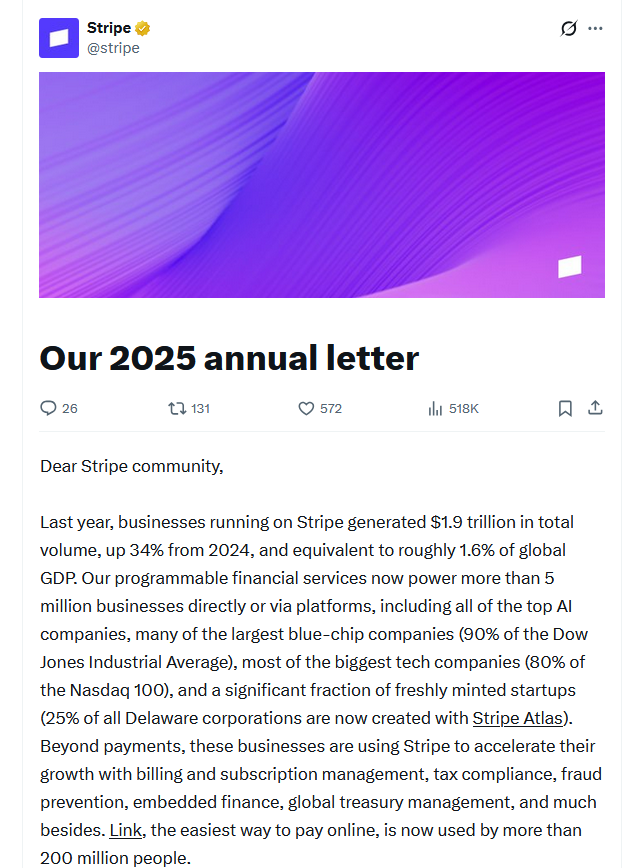 Source: Stripe
According to data from Chainspect, Internet Computer Protocol and Solana are currently the top two blockchains by transaction speed, with roughly 1,196 and 1,140 transactions per second (TPS), respectively.
They are the only two on the market currently processing more than 1,000 TPS, and at their peak, they have processed 25,621 TPS and 5,289 TPS, respectively.
As it stands, both networks have a theoretical maximum of only 209,708 TPS and 65,000 TPS, respectively.
AI commerce is past the “hype phase”
Alongside their predictions on the incoming demand, the Stripe execs also outlined what the main kinds of use cases AI agents will be serving online. Currently, they said that AI agents have moved beyond a phase of “pure hype” into a time of building and “real-world experimentation.”
They outlined five levels of AI agent capabilities. The first two levels include: completing web forms and descriptive search — being able to find results for users based on descriptions of situations rather than specific attributes.
According to the Stripe execs, AI agents are “hovering on the edge” of levels one and two.
The next three levels include: persistence — remembering user information, requirements, and preferences; delegation — handling tasks like grocery shopping on your behalf; and anticipation — being able to provide solutions to problems or schedules without being prompted.
“As with the early internet, the future success of agentic commerce is contingent on universal interoperability. Our ascent through the five levels depends on our ability to work together,” they wrote, adding:
“If all goes well, the little critters won’t be cooped up in walled gardens, but will be zooming down the wide-open protocol highways.”
Disclaimer: The content of this article solely reflects the author's opinion and does not represent the platform in any capacity. This article is not intended to serve as a reference for making investment decisions.
You may also like
AI agents drive shift from XRP to stablecoins on XRP Ledger, BlackRock says
Why suspend RMPs? Explanation from New York Fed SOMA Manager Perli
"Agent vs US Treasury" — Who Will Dominate the US Stock Market?
The wave of AI Agents and US Treasury yields are splitting the US stock market into two worlds: Meta's release of the Muse model boosted its market value by $220 billion in a single week, propelling the Nasdaq's standout performance; however, excluding AI stocks, the S&P 500 actually fell 1% this week, with the number of new lows on the New York Stock Exchange surpassing new highs for nine consecutive days, signaling the near end of "breadth trading." Goldman Sachs bluntly stated that this is a "frustrating cat-and-mouse game" between the stock market and interest rates—any breakout can be snuffed out by the bond market at any time, so equity holders must short US Treasury bonds to hedge simultaneously.
Hopes for a ceasefire between the US and Iran encounter obstacles again! Trump rejects Iran's seven-day proposal; inflation pressure under $100 oil prices remains difficult to ease
Trump rejects a ceasefire with Iran, and it is expected that bombings will occur again after the midterm elections. The president doubts whether Tehran will meet his demands.
Crypto prices
More


