
Market Impact of Cancelling Forward Foreign Exchange Risk Reserve Ratio

Morning FX
After the Chinese New Year, the RMB exchange rate has experienced a continuous and rapid appreciation. In response to rising expectations of one-sided RMB appreciation, the central bank announced last Friday morning that, starting from March 2, 2026, the foreign exchange risk reserve ratio for forward FX sales will be reduced from 20% to 0.
I. Market Reaction
After the announcement, USDCNH immediately rebounded 200 pips from the 6.84 level to 6.86. When the onshore market opened, under selling pressure at higher levels, it consolidated around 6.85. However, later in the evening, affected by tensions in the Middle East and increased risk aversion sentiment, USDCNH surged above 6.87. On the swaps side, the market expects an increase in forward FX buying, and combined with the decline in SOFR, 1Y USDCNY swap points rose by 30 pips to -1255. Regarding option volatility, as the market's expectation of rapid one-sided RMB appreciation was broken, implied volatility in options declined.
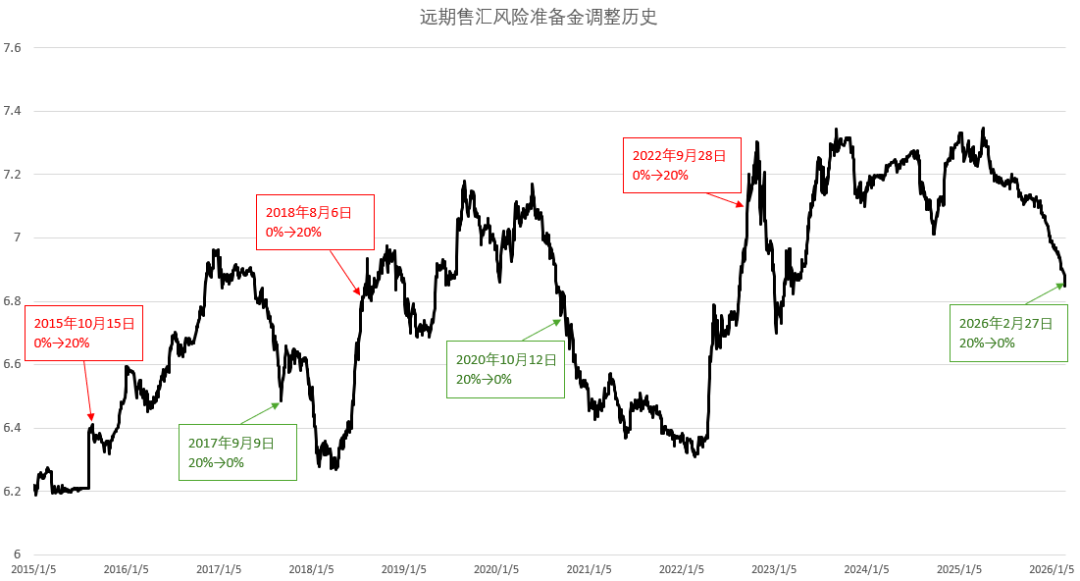 II. Lessons from History Comparing the two previous reductions in the FX purchase risk reserve ratio (in 2017 and 2020), the author believes the current market environment is more similar to 2020.
 - Macroeconomic cycle differences. 2017 was during a US dollar rate hike cycle, while both 2020 and the current period are in a US dollar rate cut cycle.
- Supply, demand, and sentiment. In 2017, market confidence in RMB was still fragile, and appreciation was mainly due to passive appreciation driven by a weaker US dollar index; in 2020, after the pandemic, China was the first to resume work and production, and companies held large amounts of accumulated US dollars; this year, the situation is similar, as companies are holding a large amount of US dollars to be settled, as reflected in the massive net FX settlement surplus in the past two months.
- Differences: Cost impact differences. In the past, US dollar interest rates were low, so the risk reserve had little impact on the cost of purchasing FX. Now, although the Federal Reserve has entered a rate cut cycle, based on the current one-year USD FTP cost of around 3.5% for banks, this translates to about 480 pips for forward USDCNY purchases (3.5%*20%*6.85). Removing the reserve requirement will significantly lower the forward hedging costs for importing companies and help to promote a balance between supply and demand in the FX market.
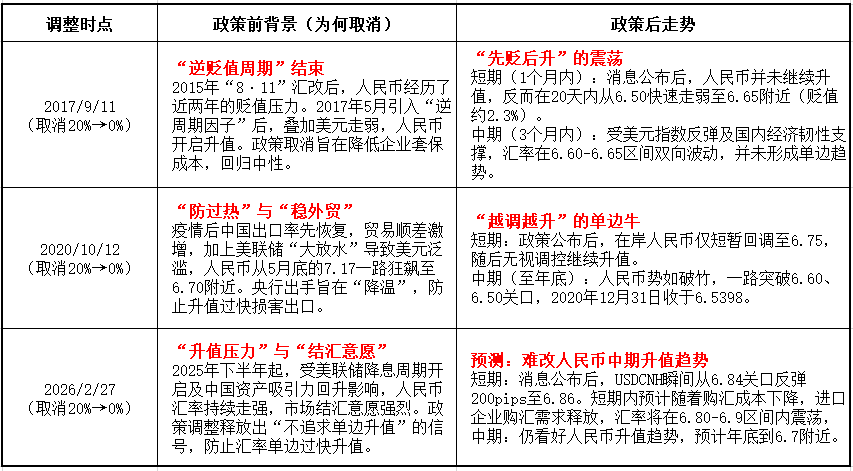
III. Outlook on Subsequent Market Trends
1. Spot:Historically, the removal of the risk reserve generally means that RMB depreciation expectations have faded. In the medium to long term, policy is unlikely to reverse the appreciation trend of the RMB, but in the short term, with the added risk aversion sentiment due to the Middle East situation, USDCNY may fluctuate and consolidate in the short term; if there is an opportunity for it to reach above 6.90, it would be an excellent opportunity for FX settlement.
2. Swaps: One of the main reasons for the pressure on swap points this year is the excessive volume of forward FX settlement. Releasing forward FX purchases will make market supply and demand more balanced, driving swap points higher.
3. Option volatility: Previously, clients needed to pay half the risk reserve for both buying calls and selling puts domestically. This client demand caused USDCNY RR to be relatively low; after the cancellation, it is expected that USDCNY RR will tend to rise.
For clients seeking to hedge, this adjustment is highly beneficial for all types of hedging clients: it not only reduces the forward FX purchase cost for buyers, but also allows FX settlement clients to employ more flexible option strategies domestically (such as USD/CNY put spread or seagull options for settlement), enriching the corporate toolbox for exchange rate risk management.
Disclaimer: The content of this article solely reflects the author's opinion and does not represent the platform in any capacity. This article is not intended to serve as a reference for making investment decisions.
You may also like
Why suspend RMPs? Explanation from New York Fed SOMA Manager Perli
"Agent vs US Treasury" — Who Will Dominate the US Stock Market?
The wave of AI Agents and US Treasury yields are splitting the US stock market into two worlds: Meta's release of the Muse model boosted its market value by $220 billion in a single week, propelling the Nasdaq's standout performance; however, excluding AI stocks, the S&P 500 actually fell 1% this week, with the number of new lows on the New York Stock Exchange surpassing new highs for nine consecutive days, signaling the near end of "breadth trading." Goldman Sachs bluntly stated that this is a "frustrating cat-and-mouse game" between the stock market and interest rates—any breakout can be snuffed out by the bond market at any time, so equity holders must short US Treasury bonds to hedge simultaneously.
Hopes for a ceasefire between the US and Iran encounter obstacles again! Trump rejects Iran's seven-day proposal; inflation pressure under $100 oil prices remains difficult to ease
Trump rejects a ceasefire with Iran, and it is expected that bombings will occur again after the midterm elections. The president doubts whether Tehran will meet his demands.
Tesla ramps Optimus production 10-fold but robot hands are holding Elon back
Crypto prices
More


