
Fed could print money to support US conflict with Iran, says Hayes

The US Federal Reserve could ease its hawkish monetary policy to help finance the country’s conflict with Iran, which would boost crypto markets, says BitMEX co-founder Arthur Hayes.
Hayes said in a blog post on Monday that every US president since 1985 has launched military action in the Middle East, and each time, the Federal Reserve has responded by cutting rates and expanding the money supply to finance the conflict.
“The longer Trump engages in the extremely costly activity of Iranian nation-building, the higher the likelihood that the Fed lowers the price and increases the quantity of money to support Pax Americana’s latest bout of Middle Eastern adventurism,” he added.
Hayes said that the Gulf War in 1990, the Global War on Terrorism after the Sept. 11 attacks in 2001, and the so-called “surge” in Afghanistan in 2009 had all resulted in Fed rate cuts or monetary easing.
Over the weekend, Israel and the US initiated a series of airstrikes on Iran that killed the country's supreme leader, Ali Khamenei, which President Donald Trump has pledged to continue.
Hayes advises a wait-and-see approach
“We do not know how long Trump will remain interested in spending billions, if not trillions, of dollars reshaping Iran’s politics to his liking, nor how much geopolitical and financial markets pain he can politically tolerate before he cuts and runs,” said Hayes. “The prudent action is to wait and see.”
“The time to back up the truck and buy Bitcoin and high-quality shitcoins [...] is immediately after the Fed cuts rates and or prints money to support the government’s goals in Iran,” he added.
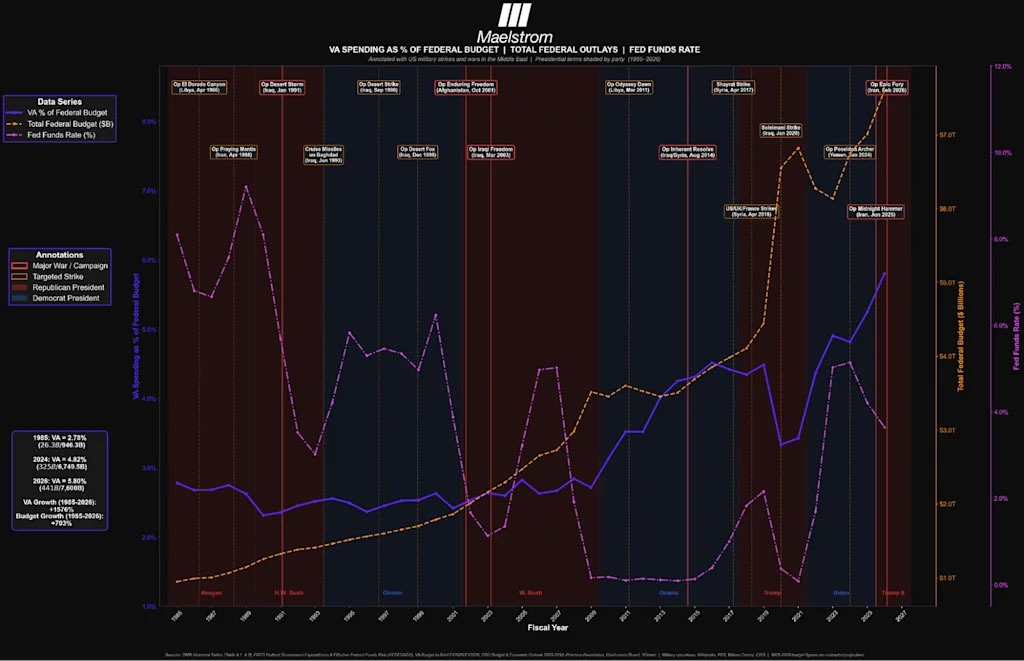 Fed funds rate increased during times of conflict. Source:
Maelstrom
Fed funds rate increased during times of conflict. Source:
Maelstrom
Hayes has recently shared other theories on how the Fed may approach monetary policy, and in the past three months has said the Fed would start quantitative easing due to a new liquidity tool called Reserve Management Purchases, or to alleviate the Japanese bond crisis, or because artificial intelligence will take jobs, leading to a credit crisis.
Related: Bitcoin traders eye Iran reactions as oil sparks US 5% inflation forecast
Futures show only marginal drop
After the Israel-US strikes on Iran, crypto social media saw a spike in mentions of “World War 3” over the weekend, according to Santiment.
However, the mentions remain much lower than in June 2025 when Israel launched strikes on Iran’s nuclear and military sites, which escalated into a 12-day conflict.
Macro newsletter The Kobeissi Letter said, “This is not a futures open that is anywhere near WW3,” a reference to US stock futures, which opened down marginally in early trading on Monday.
Oil prices have already erased nearly half of their opening gap higher, and the S&P 500 is down less than 1%, it added.
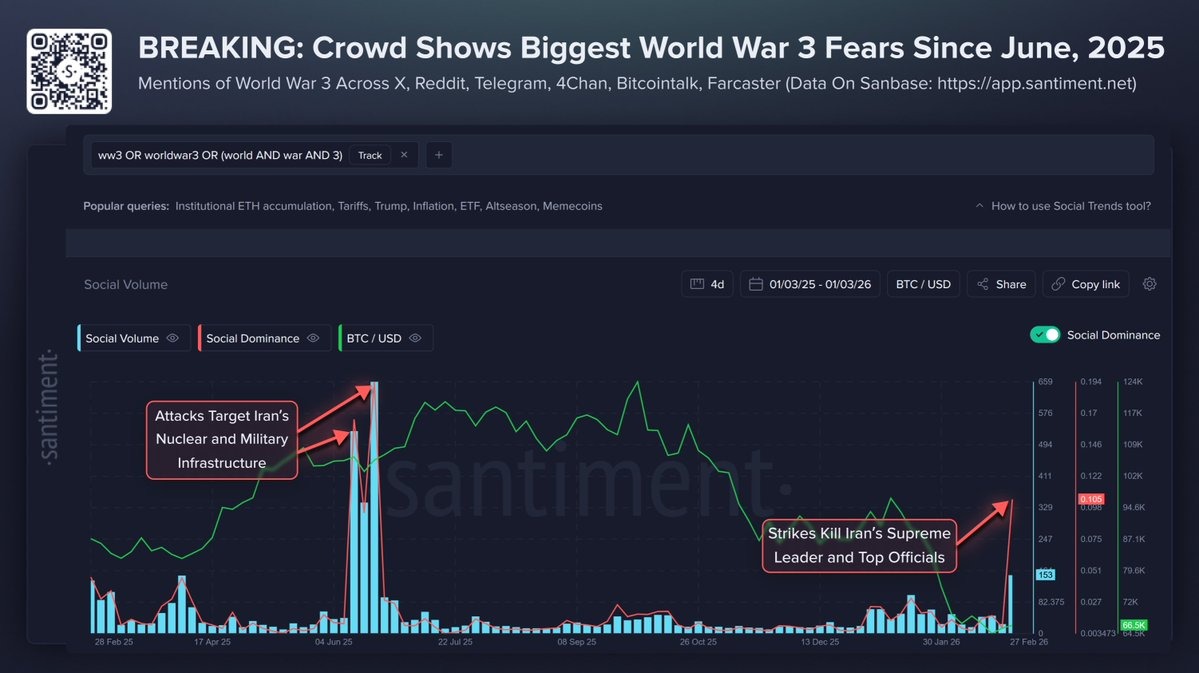 Crypto social media mentions of WWIII spiked. Source:
Santiment
Crypto social media mentions of WWIII spiked. Source:
Santiment
Magazine: Would Bitcoin really be at $200K if not for Jane Street? Trade Secrets
Disclaimer: The content of this article solely reflects the author's opinion and does not represent the platform in any capacity. This article is not intended to serve as a reference for making investment decisions.
You may also like
Why suspend RMPs? Explanation from New York Fed SOMA Manager Perli
"Agent vs US Treasury" — Who Will Dominate the US Stock Market?
The wave of AI Agents and US Treasury yields are splitting the US stock market into two worlds: Meta's release of the Muse model boosted its market value by $220 billion in a single week, propelling the Nasdaq's standout performance; however, excluding AI stocks, the S&P 500 actually fell 1% this week, with the number of new lows on the New York Stock Exchange surpassing new highs for nine consecutive days, signaling the near end of "breadth trading." Goldman Sachs bluntly stated that this is a "frustrating cat-and-mouse game" between the stock market and interest rates—any breakout can be snuffed out by the bond market at any time, so equity holders must short US Treasury bonds to hedge simultaneously.
Hopes for a ceasefire between the US and Iran encounter obstacles again! Trump rejects Iran's seven-day proposal; inflation pressure under $100 oil prices remains difficult to ease
Trump rejects a ceasefire with Iran, and it is expected that bombings will occur again after the midterm elections. The president doubts whether Tehran will meet his demands.
Tesla ramps Optimus production 10-fold but robot hands are holding Elon back
Crypto prices
More


