
Jefferies latest research report: The implementation of the HALO framework in the transportation sector—In the AI era, the real “moat” is not code, but railways


Hello everyone, this is You Dou.
On March 2, 2026, Jefferies released the Transportation & Logistics industry report:
“Physical Networks at the Heart of the HALO Trade; Raising PTs Across Transports”
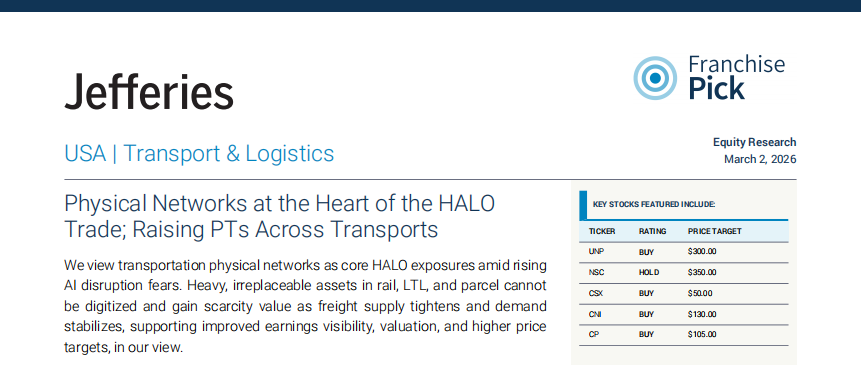
The core viewpoints of the report are clear:
In an environment where the risks of AI substitution are increasingly magnified, transportation assets possessing irreplicable physical networks are becoming typical representatives of the HALO framework (Heavy Assets, Low Obsolescence).
Jefferies emphasizes that while AI can optimize efficiency, it cannot digitize physical infrastructure. Long-term, capital-intensive assets such as rail networks, port systems, and airline fleets are being repriced due to their scarcity.
In the current market context of widespread discussions on the logic of AI disruption, this perspective is structurally meaningful.
I. Distinguishing ‘Automatable Tasks’ from ‘Irreplicable Assets’
The first main thread of the report is to distinguish between tasks and assets.
AI can optimize:
Routing efficiency
Pricing models
Asset utilization rate
But it cannot replicate:
Railway right-of-way
Terminal network density
Routes and fleet systems
Large-scale operational data tied to physical networks
Jefferies points out that the core value of railway companies such as UNP, NSC, CSX, CNI, and CPKC lies in the networks themselves.
These assets have three characteristics:
Extremely long construction cycles
Very high regulatory thresholds
Almost impossible to duplicate construction
AI enhances efficiency but does not weaken network barriers.
Amid rising "replacement anxiety," the scarcity premium of such assets is instead reinforced.
II. Fundamental Improvement: Simultaneous Supply Contraction and Demand Recovery
The second logic comes from industry fundamentals.
Jefferies notes:
Capacity exit is accelerating
Load-to-truck ratio is rebounding
Spot rates outperform seasonality
ISM Manufacturing PMI above 50 for the second consecutive month in February 2026
After inventory destocking, manufacturing activity is marginally stable.
Historical experience shows:
New orders rebound → Lagged transmission to freight volume → Improved pricing power
Against the backdrop of supply constraints, marginal demand uptick means improved earnings visibility.
The logic of the transportation sector is shifting from “cyclical pressure” to “profit recovery.”
III. Target Price Upgrades: Valuation Anchors Shift Upward
Based on the above judgments, Jefferies raises the target price for several companies:
UNP: $300 (was $285)
NSC: $350 (was $300)
CSX: $50 (was $42)
CNI: $130 (was $115)
CP: $105 (was $85)
Target prices for companies such as XPO, UPS, and FedEx are also raised.
The logic framework is clear:
Capacity tightness improves price structure
Increased stability of cash flow
AI strengthens the perceived scarcity of physical network assets
The focus of the valuation system is tilting towards "predictability of cash flow."
My Understanding:
The value of this report is not in the specific target prices.
What is truly noteworthy is the application of the HALO framework in real sectors.
What the market has been discussing over the past two years is whether AI would compress the profit margins of traditional industries.
But the answer Jefferies gives is:
When substitutability rises, the premium for irreplaceable assets also rises.
If placed in a broader asset allocation logic:
The premium of software comes from growth imagination.
The premium of heavy assets comes from irreplicability.
When the market shifts from a “growth narrative” to “cash flow certainty,”
the valuation structure naturally undergoes change.
The transportation sector is just one sample.
What is truly being repriced is the certainty of “low obsolescence risk assets.”
Disclaimer: The content of this article solely reflects the author's opinion and does not represent the platform in any capacity. This article is not intended to serve as a reference for making investment decisions.
You may also like
AI agents drive shift from XRP to stablecoins on XRP Ledger, BlackRock says
Why suspend RMPs? Explanation from New York Fed SOMA Manager Perli
"Agent vs US Treasury" — Who Will Dominate the US Stock Market?
The wave of AI Agents and US Treasury yields are splitting the US stock market into two worlds: Meta's release of the Muse model boosted its market value by $220 billion in a single week, propelling the Nasdaq's standout performance; however, excluding AI stocks, the S&P 500 actually fell 1% this week, with the number of new lows on the New York Stock Exchange surpassing new highs for nine consecutive days, signaling the near end of "breadth trading." Goldman Sachs bluntly stated that this is a "frustrating cat-and-mouse game" between the stock market and interest rates—any breakout can be snuffed out by the bond market at any time, so equity holders must short US Treasury bonds to hedge simultaneously.
Hopes for a ceasefire between the US and Iran encounter obstacles again! Trump rejects Iran's seven-day proposal; inflation pressure under $100 oil prices remains difficult to ease
Trump rejects a ceasefire with Iran, and it is expected that bombings will occur again after the midterm elections. The president doubts whether Tehran will meet his demands.
Crypto prices
More


