
Oracle Q3 Earnings Preview: Limited Performance Boost, Market Seeks Long-Term Optimistic Outlook
 Bitget2026/03/09 08:28
1.Investment Highlights Overview
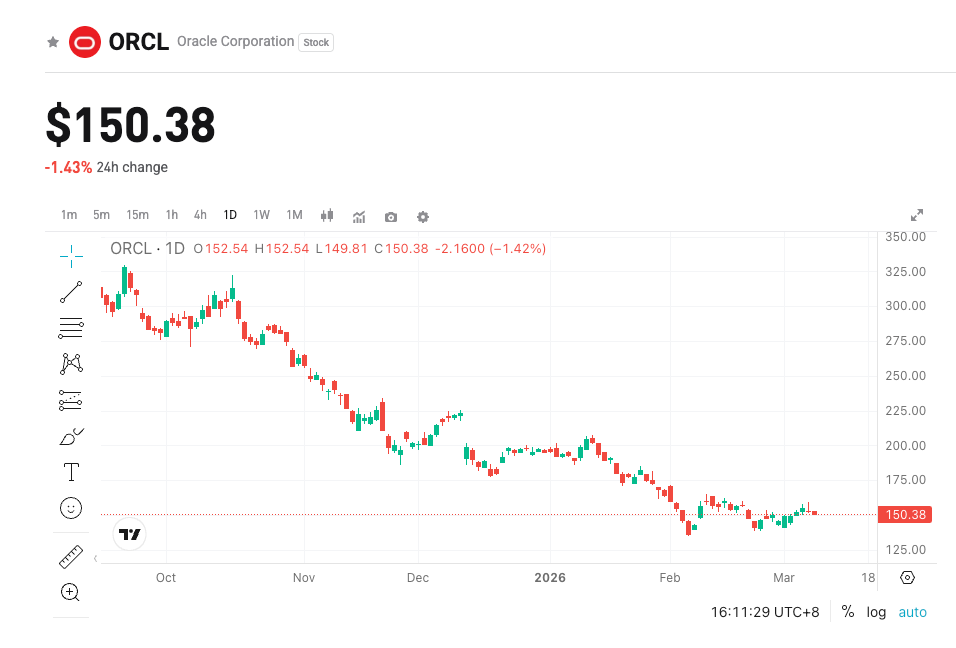
Oracle will release its FY2026 third-quarter earnings after the US market close on March 10, with market consensus expecting revenue of about $16.9 billion (+20% YoY) and adjusted EPS of around $1.70-1.71 (+15% YoY). Investors are focusing on the speed of converting orders into revenue and the long-term return potential from high capital expenditures, which will directly impact stock volatility and trading opportunities. Driven by AI demand, the market anticipates the company to demonstrate a sustainable growth path rather than short-term performance fluctuations.
Bitget now supports ORCLUSD with 20x leverage contract trading—head over to seize volatility opportunities.
Current Bitget limited-time promotion: "Stock Newbie Gift, Zero-Fee Trading with 10 USDT"—trade more efficiently and cost-effectively!
2. Three Key Focus Areas Focus
1: Cloud Infrastructure Business Momentum
Cloud operations serve as Oracle's core growth driver, and their performance will shape market confidence in the company's AI positioning. Strong growth could uplift investor sentiment and drive short-term stock rebounds. Last quarter, total cloud revenue reached $8.0 billion (+34% YoY), with Oracle Cloud Infrastructure (OCI) at $4.08 billion (+68% YoY). If Q3 OCI growth exceeds expectations, it may signal robust demand and expand upside potential for the stock; conversely, a slowdown could intensify valuation pressures.
Focus 2: Remaining Performance Obligation Conversion Efficiency
RPO indicates future revenue potential, but conversion speed directly affects cash flow and earnings visibility, making it crucial for traders assessing long-term value. Last quarter, total RPO was $523 billion, with the next 12-month portion up +40% YoY. Accelerated conversion would show effective capacity expansion and help stabilize the stock; delays could raise doubts about execution and heighten volatility risks.
Focus 3: Capital Expenditure and Financing Balance
High Capex supports AI expansion but must align with cash flows to avoid diluting shareholder value and shifting the valuation framework. Over the past 12 months, operating cash flow was $22.3 billion, with Capex at $35.48 billion, resulting in negative free cash flow of $13.2 billion; FY2026 first-half Capex was $20.5 billion, with full-year expected to rise further. The company plans to raise $45-50 billion (half equity-related, half debt) to support client needs. If guidance shows a shortened return cycle, it will boost bullish confidence; otherwise, increased debt could continue to weigh on the stock.
3. Risks and Opportunities Coexist Upside Catalysts
- OCI and RPO metrics significantly beat expectations, indicating accelerated AI demand conversion and potentially sparking a stock surge.
- Management provides a clear Capex return timeline, strengthening the long-term growth narrative and attracting value investors.
- Contributions from clients (e.g., AMD, Meta, NVIDIA) translate into visible revenue, proving investment efficiency.
Downside Risks:
- Ongoing Capex overruns intensify cash flow pressures, dilute EPS, and spark financing concerns.
- Delayed order conversions expose supply bottlenecks, prompting the market to revise growth expectations downward.
- One-time items (e.g., last quarter's $2.7 billion pre-tax gain from Ampere stake sale) distort profit comparisons, reducing guidance credibility.
4. Trading Strategy Suggestions Bullish Logic
If OCI growth and RPO conversion surpass consensus, paired with positive capacity guidance, the company could regain favor in the AI theme, driving an upward stock breakout. Bearish Risks: If Capex return cycles extend or financing details fall short, the valuation shifts to a heavy-asset model, potentially leading to pullbacks, especially in rate-sensitive environments. Key Data Points:
- Cloud revenue and OCI sub-items (watch for growth above +34% YoY).
- Total RPO and next 12-month portion (+40% YoY as benchmark).
- Capex guidance and free cash flow (avoid expanding negatives).
- Adjusted EPS (evaluate after stripping one-time effects).
Operational Suggestions: In the short term, Oracle's turnaround via earnings alone is unlikely; the market craves a long-term optimistic vision. For retail investors, focus on the earnings call, prioritizing management's comments on client payments, return cycles, and guidance to build long/short positions.
Bitget now supports ORCLUSD with 20x leverage contract trading—head over to seize volatility opportunities! Current Bitget limited-time promotion: "Stock Newbie Gift, Zero-Fee Trading with 10 USDT"—trade more efficiently and cost-effectively!
Disclaimer: The above content is for reference only and does not constitute investment advice.
Disclaimer: The content of this article solely reflects the author's opinion and does not represent the platform in any capacity. This article is not intended to serve as a reference for making investment decisions.
You may also like
US Treasury volatility surges, triggering alarms! BofA’s Hartnett warns of rising deleveraging risks as higher yields become main threat to the market
Bank of America strategist Michael Hartnett warns that the recent sharp rise in volatility in the US bond market is increasing the risk of broader deleveraging in financial markets.
U.S. diesel prices surge 83% this year! Apollo Chief Economist warns: Cost pass-through may make core inflation more stubborn, Federal Reserve can't ignore it
Torsten Slok, Chief Economist at Apollo Global Management, has warned that the inflation threat posed by the surge in U.S. diesel prices to historic highs may be more serious than the Federal Reserve currently realizes.
Goldman Sachs Estimates AI Compute Power Gamble: Six Tech Giants Need to Earn an Extra $1.42 Trillion from 2028 to 2030 to Sustain 15% ROIC
Goldman Sachs recently released a research report on the US technology industry, estimating the necessary scale of the AI economy required to justify the ROIC of hyperscale cloud providers' AI capital expenditures.
Crypto prices
More


