
Energy ignites a debt market "liquidation" storm: 99.70 becomes the US dollar ceiling? Gold's 5050 defensive line in jeopardy

Huitong Network, March 9—On Monday (March 09), the global financial market was at the center of a liquidity rebalancing storm triggered by dramatic volatility in energy prices. The core driver of the current market is no longer simply inflation expectations, but rather a complex web interwoven by US Treasury liquidity premium, spillover of risk aversion, and global central bank policy divergence.
On Monday (March 09), the global financial market was at the center of a
Bond Market Liquidity Stress and the Underlying Logic of Dollar Pricing
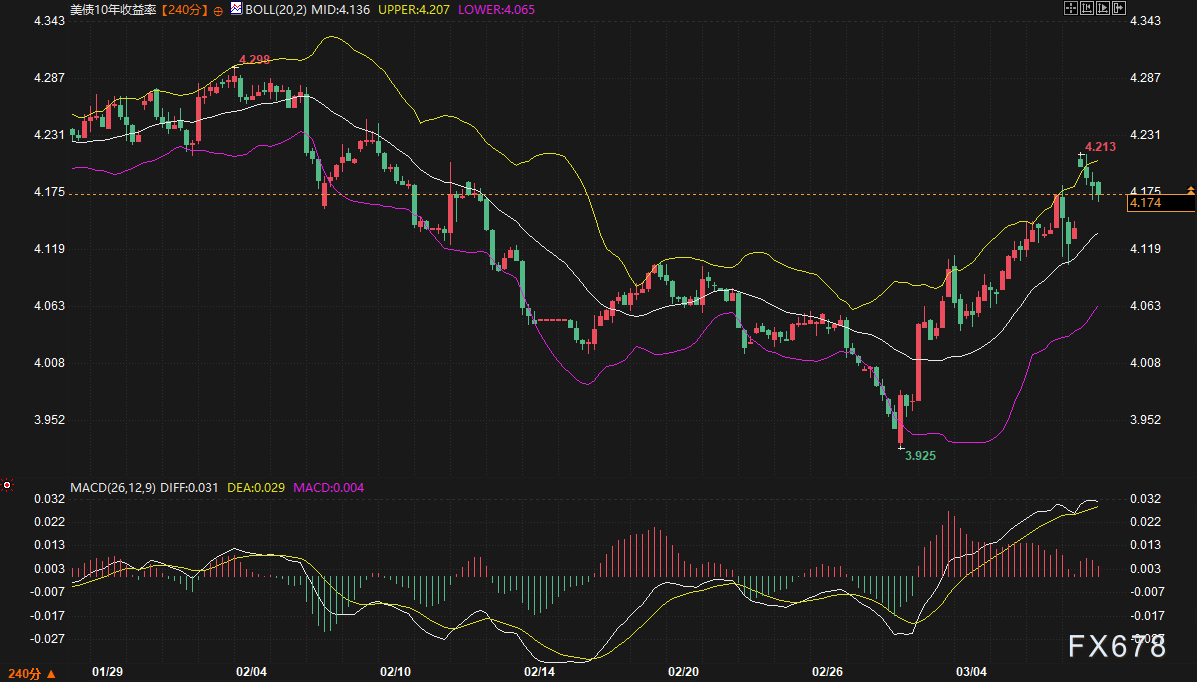
Under the current macro environment, the dollar’s trend is highly anchored to the supply and liquidity structure of the US Treasury market. According to the latest market quotes,
From a fundamental perspective, the rise in Treasury yields is not simply the result of optimism over economic growth, but rather
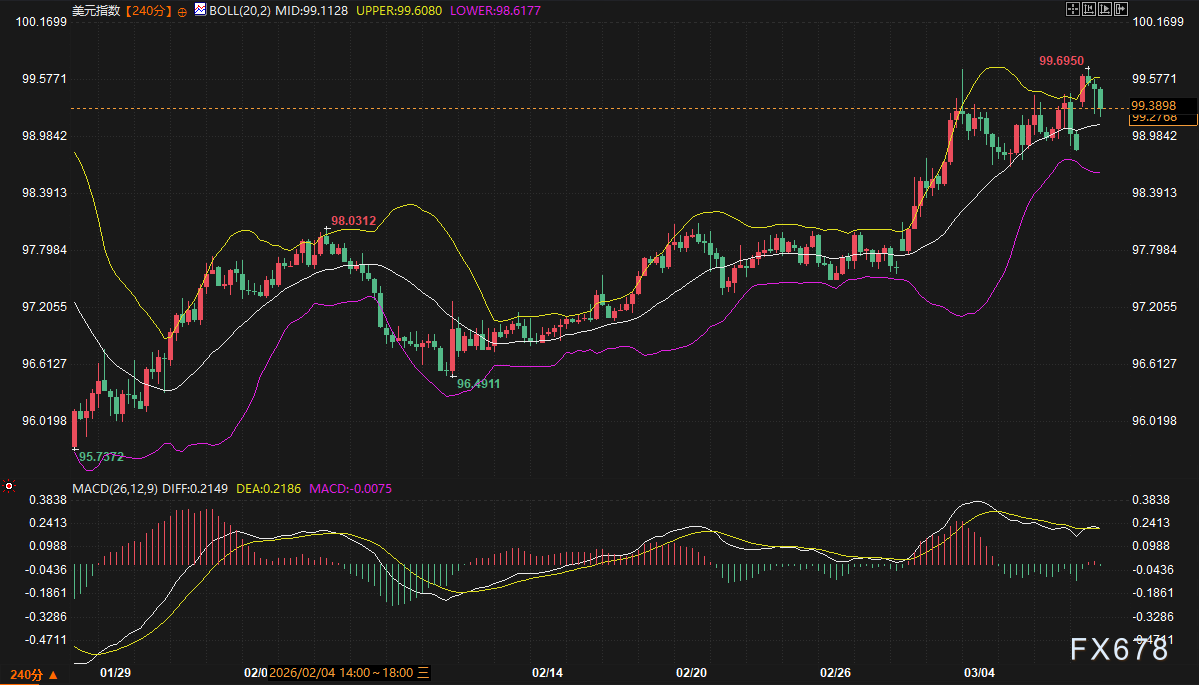
From a technical perspective, the US Dollar Index (DXY) currently stands at 99.3898. Although in a pullback phase from the highs, it is still trading above the middle Bollinger Band. Notably, the 240-minute
The Hedging Logic for Gold Amidst Bond Market Transmission: From Inflation Hedge to Liquidity Defense
Traditionally, rising Treasury yields would suppress gold, but in the current context of “clouds of war,” gold’s pricing logic is undergoing a profound shift from
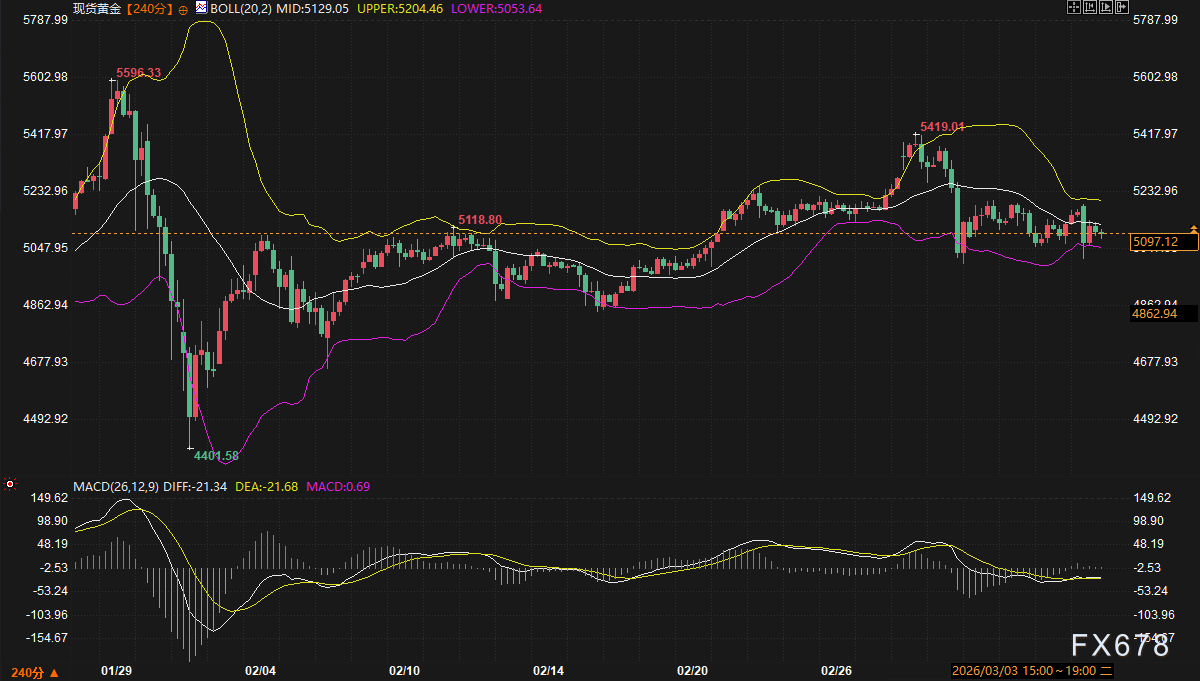
Currently, spot gold is quoted around $5,097.12 per ounce. Although slightly off the peak from early March, its strong support near $5,050 essentially stems from safe-haven demand triggered by bond market turbulence. When 10-year Treasury yields rise rapidly, global investor worries over the stability of European and emerging market sovereign debt mean not all funds flow into safe-haven currencies; some stay in gold, a classic
Forecast for the Next 2–3 Days and Key Technical Levels
In the coming 2–3 trading days, the market will enter a “post-impulse normalization” period, but volatility will remain elevated.
Summary & Outlook
The current market game is in a highly sensitive vacuum phase. On one hand,
FAQ
Answer: The transmission occurs along two paths. First, the “inflation expectation” channel—crude oil as the mother of commodities, sees price surges push forward inflation compensation (Break-even Inflation) higher, lifting nominal treasury yields and increasing dollar appeal. Second, the “safe-haven liquidity” channel—when the energy landscape deteriorates, and investors turn pessimistic on non-US economies (especially Europe, heavily dependent on imports), capital flows into US Treasuries for safety. Should oversupply spark a bond selloff, rising yields increase the dollar’s funding cost and reinforce its strong stance.
Answer: In normal cycles, Treasury yields and gold are inversely correlated. But in crisis modes, both can climb together. The core logic now driving gold is “hedging systemic risk.” When the Treasury market itself is volatile due to liquidity shortages (e.g., GC rates climbing) or elevated credit risk premiums (such as UK and French bonds), investors no longer see bonds as absolutely safe. At that point, gold’s “ultimate safe-haven asset” attribute is triggered. As long as risk premium from geopolitics outweighs the holding cost from higher real rates, gold can remain resilient or even strengthen.
Answer: A 240-minute MACD death cross usually signals a temporary exhaustion in a medium-term uptrend. This means the one-sided rally fuelled by geopolitical panic of recent weeks may be pausing, shifting to a phase of consolidation near the highs. Given support from the middle Bollinger at 99.11, this death cross is more about “time for space”—a minor pullback, not a genuine trend reversal. It sends a message: absent fresh extreme news, the 99.70 level is now a commonly agreed short-term top.
Answer:
Answer: The crucial signal is
Disclaimer: The content of this article solely reflects the author's opinion and does not represent the platform in any capacity. This article is not intended to serve as a reference for making investment decisions.
You may also like
AI boom reshapes the wafer foundry landscape! UBS: Explosive demand accelerates advanced process expansion, mature process enters upward cycle
UBS stated in a recent research report that within the foundry market, the Total Addressable Market (TAM) for the N2 (2nm) node far exceeds expectations, A14 (1.4nm) production expansion is accelerating, and the upcycle for mature process nodes has already begun.
$1,999 Foldable iPhone Is Ready, but Apple (AAPL.US) Faces Over $5.7 Billion Patent Penalty
As Apple intensifies its efforts in foldable displays and AI business, it faces a haptic technology patent compensation ruling exceeding $5.7 billion. On September 25, a federal jury in California found that Apple's Taptic Engine, used in certain iPhone and Apple Watch models, infringed on two patents held by Taction Technology.
Prospects for the opening of the Hormuz Strait are overshadowed, Asian bonds under pressure: 2Y Japanese bond yield approaches 2%, 3Y Korean bond yield rises to highest level since 2022
With high oil prices, short-term bond yields in South Korea and Japan have risen.
5% US Treasury pressure weighs on global assets, while Australian government bonds open up a window for allocation? Fixed income giant Pimco calls the rate hike expectations too aggressive
Pacific Investment Management Company (Pimco) holds a constructive view on Australian bonds, believing that market expectations for rate hikes are too high. Pimco stated that the rate hike cycle in Australia has been "fully priced in," and cracks are beginning to appear in the economy, making Australian bonds look attractive, especially in the 5- to 10-year segment of the yield curve.
Crypto prices
More


