
Institutions Are Moving Out Of XRP After One Month Of Inflows, Is It Time To Sell?

By:Newsbtc
Bitget offers one-stop trading for cryptocurrencies, stocks, and gold. Trade now!
A welcome pack worth 6200 USDT for new users! Sign up now!
Institutional investors are beginning to pull capital out of XRP aftera month of steady inflows, raising new questions about whether confidence in the digital asset is weakening. Lately, XRP has experienced significant volatility, sending its price crashing below $1.4. If thisdowntrend continues alongside capital outflows, it would not be surprising if market participants begin to wonder whether now may be the right time to sell their bags to avoid deeper losses.
XRP Records Outflows As Other Digital Assets Attract Capital
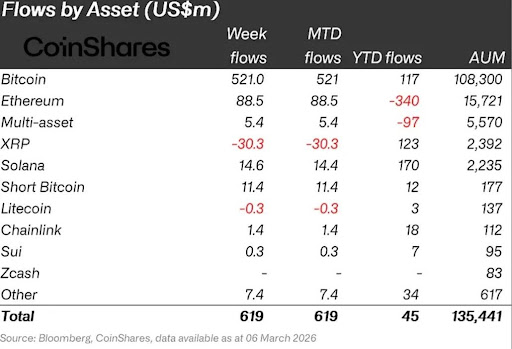
XRP currently stands apart from the rest of the crypto market, and not in a good way. According to a CoinShares digital asset fund flows weekly report, XRP recorded substantial outflows of $30.3 million last week. The decline stands in contrast to the broader digital asset investment market, whichcontinued to attract new money during the same period.
Across all digital asset investment products, CoinShares reports that total inflows had jumped to $619 million. Early in the week,the market also showed strong demand, with $1.44 billion flowing into crypto funds during the first three days. However, the trend reversed toward the end of the week, with investors withdrawing $829 million on Thursday and Friday.
var rnd = window.rnd || Math.floor(Math.random()*10e6); var pid607465 = window.pid607465 || rnd; var plc607465 = window.plc607465 || 0; var abkw = window.abkw || ''; var absrc = 'https://servedbyadbutler.com/adserve/;ID=172179;size=0x0;setID=607465;type=js;sw='+screen.width+';sh='+screen.height+';spr='+window.devicePixelRatio+';kw='+abkw+';pid='+pid607465+';place='+(plc607465++)+';rnd='+rnd+';click=CLICK_MACRO_PLACEHOLDER'; document.write('
');
if (!window.AdButler){(function(){var s = document.createElement("script"); s.async = true; s.type = "text/javascript";s.src = "https://servedbyadbutler.com/app.js";var n = document.getElementsByTagName("script")[0]; n.parentNode.insertBefore(s, n);}());}
var AdButler = AdButler || {}; AdButler.ads = AdButler.ads || []; var abkw = window.abkw || ""; var plc366606 = window.plc366606 || 0; (function(){ var divs = document.querySelectorAll(".plc366606:not([id])"); var div = divs[divs.length-1]; div.id = "placement_366606_"+plc366606; AdButler.ads.push({handler: function(opt){ AdButler.register(172179, 366606, [728,90], "placement_366606_"+opt.place, opt); }, opt: { place: plc366606++, keywords: abkw, domain: "servedbyadbutler.com", click:"CLICK_MACRO_PLACEHOLDER" }}); })();
 Source:
Chart from CoinShares
Source:
Chart from CoinShares
According to CoinShares analysts, the negative shift in sentiment came as oil prices rose, complicating inflation expectations. This occurred even though US payroll data came in weaker than expected, a development that would normally support risk assets like cryptocurrencies, but failed to do so.
Investors Become More Selective About Crypto
Despite the late-week reversal, the total inflows show thatinstitutional interest in digital assets has remained relatively strong, especially amidongoing geopolitical tensions involving the US, Israel, and Iran. Still, the distribution of those flows shows that investors are becoming more selective about capital allocation, with XRP notably absent from the list of assets attracting new institutional money.

XRP Starts New Week With Bullish Confirmation, But This Level Is A Problem
Instead, funds are concentrated on larger assets such as Bitcoin, Ethereum, and Solana, leaving XRP outside the current focus of institutional demand. CoinShares reports that Bitcoin attracted the vast majority of new capital, with $521 million flowing into related investment products. At the same time, $11.4 million moved into short Bitcoin products, reflecting a divided outlook among investors.
var rnd = window.rnd || Math.floor(Math.random()*10e6); var pid607472 = window.pid607472 || rnd; var plc607472 = window.plc607472 || 0; var abkw = window.abkw || ''; var absrc = 'https://servedbyadbutler.com/adserve/;ID=172179;size=0x0;setID=607472;type=js;sw='+screen.width+';sh='+screen.height+';spr='+window.devicePixelRatio+';kw='+abkw+';pid='+pid607472+';place='+(plc607472++)+';rnd='+rnd+';click=CLICK_MACRO_PLACEHOLDER'; document.write('
');
if (!window.AdButler){(function(){var s = document.createElement("script"); s.async = true; s.type = "text/javascript";s.src = "https://servedbyadbutler.com/app.js";var n = document.getElementsByTagName("script")[0]; n.parentNode.insertBefore(s, n);}());}
var AdButler = AdButler || {}; AdButler.ads = AdButler.ads || []; var abkw = window.abkw || ""; var plc452518 = window.plc452518 || 0; (function(){ var divs = document.querySelectorAll(".plc452518:not([id])"); var div = divs[divs.length-1]; div.id = "placement_452518_"+plc452518; AdButler.ads.push({handler: function(opt){ AdButler.register(172179, 452518, [728,90], "placement_452518_"+opt.place, opt); }, opt: { place: plc452518++, keywords: abkw, domain: "servedbyadbutler.com", click:"CLICK_MACRO_PLACEHOLDER" }}); })();
Notably, Ethereum recorded $88.5 million in inflows, while Solana brought in $14.6 million. Smaller allocations were also directed toward Uniswap and Chainlink. Against this backdrop, XRP was the only major digital asset to experience significant outflows.
The recent withdrawals could signal that institutions are rotating capital from XRP into assets with stronger narratives or higher expected returns. For investors, this shift could raise questions about whether it is time to sell. Although institutional outflows do not automatically signal a price decline, they can indicateweakening confidence among large investors. If these outflows continue in the coming weeks, it could be a sign of caution ahead.
 XRP trading at $1.37 on the 1D chart | Source: XRPUSDT on
Tradingview.com
XRP trading at $1.37 on the 1D chart | Source: XRPUSDT on
Tradingview.com
Featured image from Pxfuel, chart from Tradingview.com
var rnd = window.rnd || Math.floor(Math.random()*10e6); var pid607473 = window.pid607473 || rnd; var plc607473 = window.plc607473 || 0; var abkw = window.abkw || ''; var absrc = 'https://servedbyadbutler.com/adserve/;ID=172179;size=0x0;setID=607473;type=js;sw='+screen.width+';sh='+screen.height+';spr='+window.devicePixelRatio+';kw='+abkw+';pid='+pid607473+';place='+(plc607473++)+';rnd='+rnd+';click=CLICK_MACRO_PLACEHOLDER'; document.write('
');
if (!window.AdButler){(function(){var s = document.createElement("script"); s.async = true; s.type = "text/javascript";s.src = 'https://servedbyadbutler.com/app.js';var n = document.getElementsByTagName("script")[0]; n.parentNode.insertBefore(s, n);}());}
var AdButler = AdButler || {}; AdButler.ads = AdButler.ads || []; var abkw = window.abkw || ''; var plc452519 = window.plc452519 || 0; (function(){ var divs = document.querySelectorAll(".plc452519:not([id])"); var div = divs[divs.length-1]; div.id = "placement_452519_"+plc452519; AdButler.ads.push({handler: function(opt){ AdButler.register(172179, 452519, [728,90], 'placement_452519_'+opt.place, opt); }, opt: { place: plc452519++, keywords: abkw, domain: 'servedbyadbutler.com', click:'CLICK_MACRO_PLACEHOLDER' }}); })();
0
0
Disclaimer: The content of this article solely reflects the author's opinion and does not represent the platform in any capacity. This article is not intended to serve as a reference for making investment decisions.
Understand the market, then trade.
Bitget offers one-stop trading for cryptocurrencies, stocks, and gold.
Trade now!
You may also like
 VIPTradFi Focus: Where Does the RWA Market Stand Today?
1. Crypto outperformed traditional equity indexes following the rate hike, but elevated interest rates remain a key constraint on cross-asset allocation. From September 12 to 18, BTC, ETH, and SOL gained 4.83%, 3.84%, and 9.96%, respectively, while the S&P 500 edged down 0.08%. The U.S. Dollar Index rose 1.11%, and the 10-year U.S. Treasury yield closed at approximately 4.998%. Improving risk appetite is therefore coexisting with elevated discount rates, raising the bar for RWA allocation: investors need to compare not only returns on the underlying assets, but also on-chain liquidity and collateral efficiency. 2. Growth in tokenized equities is occurring even as the overall RWA market remains under pressure. As of September 18, Distributed Asset Value across RWAs stood at $38.503 billion, down 1.13% week over week, while tokenized equities reached $3.056 billion, up 6.03%. This week's data are better explained by capital reallocating across different RWA segments than by a broad-based expansion of the entire RWA market. 3. For exchanges, the opportunity lies in connecting spot holdings, collateral, and derivatives. Reality's distributed asset value stands at approximately $155 million, while eligible rTokens can already be used within Bitget's UTA margin framework. Across CoinGlass's verifiable sample of 177 TradFi instruments, open interest reached approximately $11.498 billion, up 2.06% week over week, even as weekly trading volume declined 7.60%. The medium-term opportunity remains intact, but deeper utilization will depend on liquidity, collateral use, and sustained trading activity. 4.Assets to watch: BTC, ETH, SOL, NEAR, ZEC, gold, tokenized U.S. equities, COST. 5.Key metrics to watch: rToken collateral utilization, the durability of TradFi open interest and trading volume, and next week's employment and consumer data.
Bitget•2026/09/21 06:38

Gold prices fall Rs 1,331/10 gram, silver dips Rs 1,600/kg as Mideast tensions outweigh oil fall: Key levels to track
EconomicTimes•2026/09/21 04:33
Strategists Say Market's ‘Wall of Worry' Is Healthy, Not a Warning Sign
BeInCrypto•2026/09/21 03:12

Canadian Dollar seems vulnerable near August 7 low amid sliding oil prices, trade tensions
FXStreet•2026/09/21 03:09
Crypto prices
More
Bitcoin
BTC
$81,821.34
+1.73%

Ethereum
ETH
$2,671.47
+3.58%

Tether USDt
USDT
$0.9997
+0.01%

BNB
BNB
$773.42
+2.77%

XRP
XRP
$1.44
+4.05%

USDC
USDC
$0.9999
+0.01%

Solana
SOL
$112.4
+3.57%

TRON
TRX
$0.3434
+0.98%

Zcash
ZEC
$1,510.04
+4.24%

Hyperliquid
HYPE
$94.29
+3.56%
How to buy BTC
Bitget lists BTC – Buy or sell BTC quickly on Bitget!
Trade now
Become a trader now?A welcome pack worth 6200 USDT for new users!
Sign up now