
DAT: Truckload spot rates post seventh straight monthly gain

Spot Market Volume & Rates: Van
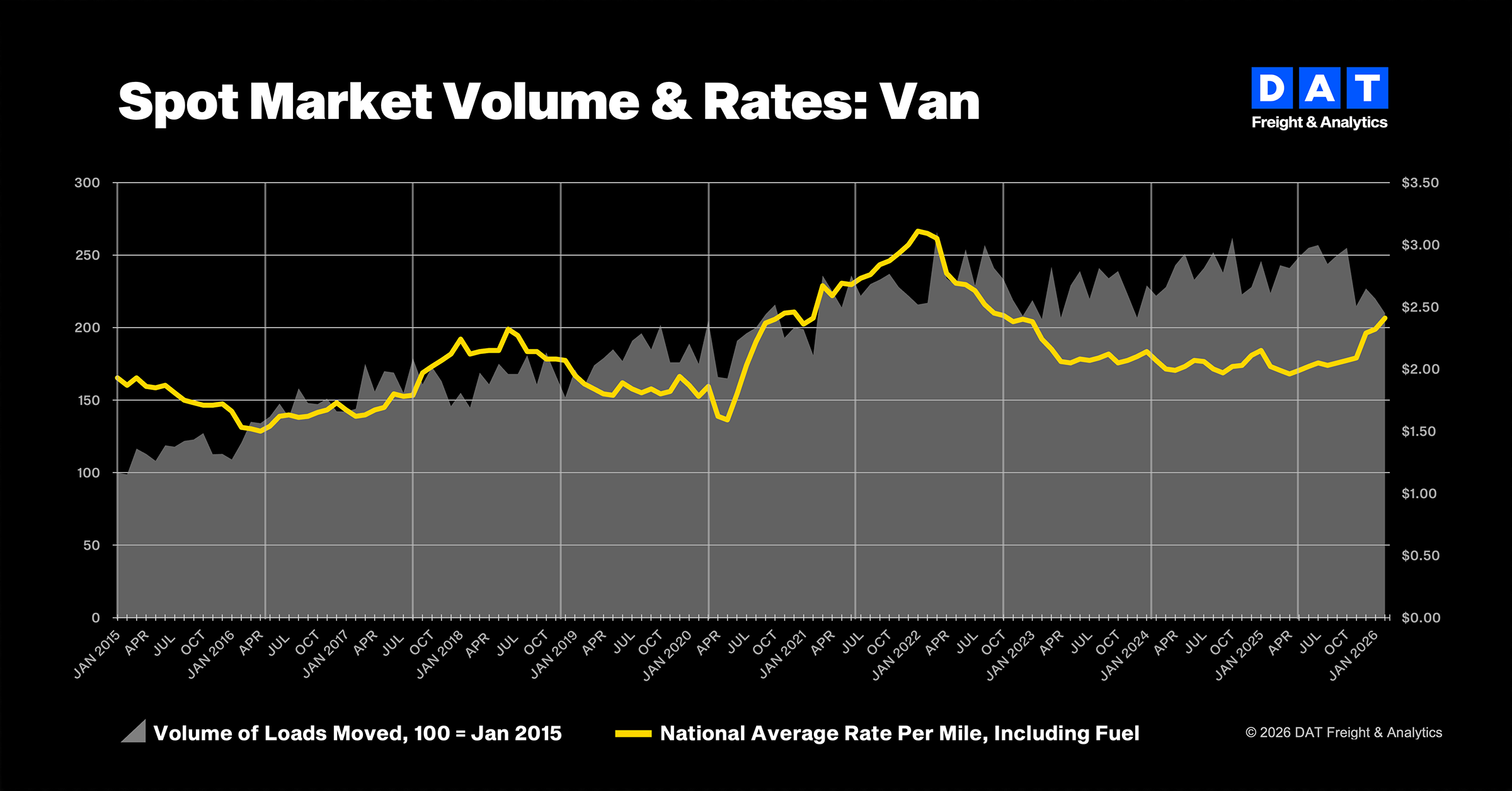
PORTLAND, Ore., March 17, 2026 -- Truckload freight volumes eased slightly in February but remained firm on a daily basis, while spot market van and refrigerated (“reefer”) rates increased for the seventh straight month, said DAT Freight & Analytics, provider of the industry’s leading load boards and freight analytics.
The DAT Truckload Volume Index (TVI), an indicator of trucking industry trends and demand for truckload services, was lower across all three freight segments:
- Van TVI: 210, down 5% compared to January
- Reefer TVI: 173, down 7%
- Flatbed TVI: 256, down 1%
The declines in van and reefer TVI were less than the expected drop due to the shorter month, suggesting the daily average freight volume actually rose in February compared to January for those two equipment segments. The negligible drop in flatbed TVI also indicates a stable or slightly higher average daily volume.
Volumes were lower year over year, however. Compared with February 2025, the TVI was down approximately 6% across all three freight categories.
Rates: Gaining since August
National average spot and contract rates increased month over month as truckload capacity tightened:
- Spot van rate: $2.41 per mile, up 9 cents from January
- Spot reefer rate: $2.88 per mile, up 7 cents
- Spot flatbed rate: $2.72 per mile, up 14 cents
Three winter storms—Fern, Gianna, and Ezra—disrupted freight networks across the eastern U.S. in February, tightening available truckload capacity and amplifying spot-rate gains. The storms accelerated a trend that was already underway: spot van and reefer rates had been climbing steadily since August, when the van rate averaged $2.03 per mile and the reefer rate was $2.41 per mile.
- Contract van rate: $2.52 per mile, up 4 cents month over month
- Contract reefer rate: $2.89 per mile, up 8 cents
- Contract flatbed rate: $3.13 per mile, up 12 cents
The spread between spot and contract van rates narrowed to its smallest gap since March 2022, signaling that freight demand and available truck capacity are moving toward balance.
Fuel: Spiking costs add to uncertainty
Diesel prices added a wrinkle to February’s rate story. The national average price for on-highway diesel rose to $3.71 per gallon in February, up roughly 6% from January and about 1% above February 2025. That uptick is reflected in fuel surcharges: the average van fuel surcharge climbed to 41 cents per mile in February, up from 38 cents in January.
Unlike most loads moving under contract, spot rates are negotiated as an “all-in rate” between the freight broker and carrier. There is no separate fuel surcharge to adjust for fluctuations in diesel prices. Because spot loads are one-time transactions booked close to the pickup date, the rate should already reflect current fuel prices.
Driven by escalating conflict in the Middle East, retail diesel prices have surged since the end of February, compounding an already tightening cost environment for carriers.
“Without fuel hedging, contract pricing, or surcharges, carriers will need to negotiate higher spot rates now to compensate for higher pump prices,” said Ken Adamo, DAT Chief of Analytics. “Otherwise, more carrier exits are likely—which, paradoxically, could accelerate the supply-side market recovery.”
About the Truckload Volume Index
The DAT Truckload Volume Index measures monthly changes in loads with a pickup date during that month. A baseline of 100 equals the number of loads moved in January 2015, based on data from DAT RateView, part of the DAT iQ freight analytics platform, which tracks rates paid on approximately 3 million loads per month. Benchmark spot rates reflect invoice data for hauls of 250 miles or more, offering a consistent view of truckload demand and trucking spot rate trends across the United States and Canada.
About DAT Freight & Analytics
DAT Freight & Analytics operates the DAT One truckload freight marketplace; Convoy Platform, an automated freight-matching technology; DAT iQ analytics service; Trucker Tools load-visibility platform; and Outgo factoring and financial services for truckers. Shippers, transportation brokers, carriers, news organizations, and industry analysts rely on DAT for market trends and data insights, informed by nearly 700,000 daily load posts and a database exceeding $1 trillion in freight market transactions.
Founded in 1978, DAT is a business unit of Roper Technologies (Nasdaq: ROP), a constituent of the Nasdaq 100, S&P 500, and Fortune 1000. Headquartered in Portland, Oregon, DAT continues to set the standard for innovation in the trucking and logistics industry. Visit dat.com for more information.

Disclaimer: The content of this article solely reflects the author's opinion and does not represent the platform in any capacity. This article is not intended to serve as a reference for making investment decisions.
You may also like
South Korea's AI Mania Spills Into Crypto, With Worldcoin as Top Pick
Our Pinterest Stock Pick Hasn't Worked. We're Dropping It. -- Barrons.com
By Jacob Sonenshine Pinterest is down about 42% since Barron's recommended the stock in June 2025. During that time the S&P 500 has gained 29%. Time to move on. The problem isn't that Pinterest doesn't have long-term growth potential. It's that it has repeatedly failed to sustain a super high growth rate, creating uncertainty. Our thesis was that revenue growth would hold strong and the company's artificial intelligence usage would enable it to match the right products and advertisements with users. The hope was that Pinterest, with its hundreds of millions of users and more than $4 billion of annual sales, would grow within a global digital ad market worth hundreds of billions, as it would increasingly monetize its users. It has grown -- but not consistently at a high rate. Pinterest will continue to grow, but the market's concern doesn't appear likely to subside soon; revenue growth often decelerates by several percentage points, which causes large selloffs in the shares. The root of the problem is that whenever growth slows, the market is left to wonder if the platform is beginning to lose its relevance. Users now have a crowded field of options for finding personal and household trinkets to buy. Maybe the growth story isn't as beautiful as investors had hoped years ago, when the stock was at record highs of close to $90. Consider second quarter earnings, which management released Aug. 4, and caused the stock to drop. Yes, sales of $1.18 billion beat analyst's expectations and grew about 18% year over year, and yes, adjusted earnings per share of 43 cents beat estimates and grew 30%, as profit margins expanded. But the guidance signaled slowing growth yet again. Management guided for third quarter revenue of $1.2 billion at the midpoint of the range. That implies 14% year over year growth. Chief Financial Officer Julia Donnelly said on the earnings call that second quarter growth was strong partly due to the combination of brands increasing their ad spend around Amazon Prime Day and "World Cup-related spend th
Gold steady as firm dollar counters softer US rate-hike bets
CFTC Clears Path for US Exchanges to Launch Perpetual Futures

Crypto prices
More


