
Iran War: Will the “Black Swan” in Chips Materialize?

The greatest concern for the global semiconductor industry is not the raw price of oil, but the limited energy supply buffer that would remain in the few short weeks after a blockade of the Strait of Hormuz.
According to Chaser Trading Desk, on March 18, the Barclays Macro Research Team released a deep-dive report showing that ongoing unrest in the Strait of Hormuz is transmitting substantial "tail risks" to the North Asian semiconductor supply chain through energy and key raw material pathways.
Macro researcher Bum Ki Son stated bluntly in the report: "The Middle East conflict has now reached its third week, which coincides exactly with the typical shipping cycle from the Middle East to North Asian ports. Starting this week, energy import disruptions for South Korea and Taiwan will become increasingly apparent."
At present, the market’s focus is no longer just whether crude oil prices will break $100, but rather whether the stable electricity and specialty gases crucial for the survival of semiconductor giants will be exhausted due to the blockade.

Energy Reserves: The “Mismatch” Between Nominal Days and Actual Buffer Zones
On the surface, South Korea and Taiwan appear to possess significant strategic petroleum reserves, seemingly sufficient to withstand short-term shocks. However, Barclays breaks down the underlying worries behind these numbers in its research report.
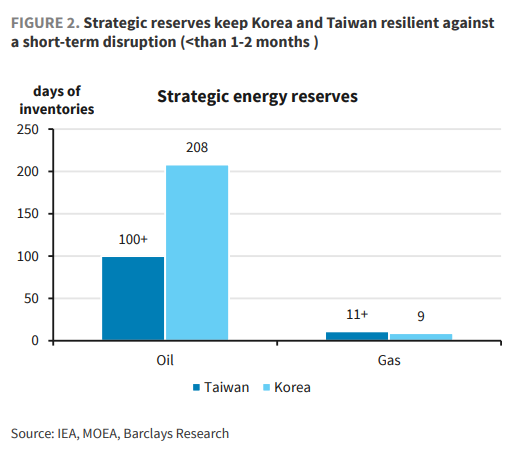
Although the South Korean president previously claimed to have 208 days of oil reserves, and Taiwan also stated it holds more than 100 days’ worth, Barclays points out these figures include non-energy demands from the refining and petrochemical industries, resulting in considerable overstatement.
Analyst Dave Dai highlights: “Considering the substantial consumption by petrochemical and refining industries, South Korea’s actual crude oil reserves are around four months, while Taiwan’s reserves may already be approaching a critical two-month threshold.”
Even more pressing is liquefied natural gas (LNG). Due to storage technology limitations, the buffer for LNG is much narrower compared to crude oil. Taiwan’s nominal LNG reserves are only enough for 11 days, while South Korea’s cover about 9 days.
According to Barclays' calculations, even accounting for diversified sources, both regions rely on Middle Eastern LNG for 15%-25% of their needs. In an extreme scenario of complete blockade, their LNG reserves could only keep their power systems running for up to a month and a half.
Electricity Resilience: Nuclear Power Reserves vs. the “No-Nuclear” Dilemma
Barclays’ report finds that when it comes to filling the LNG gap, the power systems of South Korea and Taiwan show starkly different levels of resilience.
South Korea's energy mix is relatively balanced. In the face of a 16% shortage in Middle Eastern natural gas, the South Korean government plans to raise its nuclear power utilization rate from the current 60%+ to 85%-87% (returning to 2015’s high levels), supplemented by a small increase in coal power, which should largely offset the energy supply disruption.
In contrast, Taiwan faces a structural “fragility.” With its last nuclear reactor set to retire in May 2025, Taiwan's power system will lose all nuclear flexibility. Currently, natural gas generates 48% of its total electricity output (2025 data).
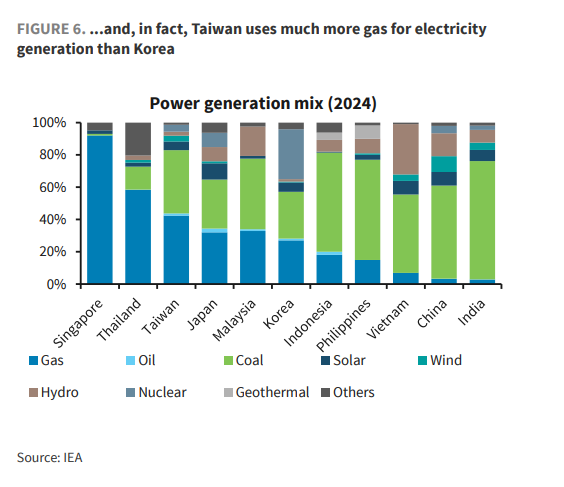
"In our scenario assumptions, if Middle Eastern LNG supplies are cut by 24%, Taiwan will need to raise coal-fired electricity generation by 36% to fill the gap."
Dave Dai notes in the report, “Although this is technically feasible, given already thin reserve capacity, the risk of system collapse during the summer peak is extremely high.” Currently, the tech industry in Taiwan accounts for 25% of total electricity use, with TSMC alone occupying 10%.
The “Precision Pain” of Chip Manufacturing: Power Fluctuations as a Hidden Red Line
For semiconductor manufacturing at the nanometer scale, the stability of power supply is not just an issue of cost—it is a matter of survival.
Barclays points out that semiconductor production must run continuously for 24 hours in a vacuum environment. Bum Ki Son emphasizes: “Even momentary power outages or voltage fluctuations can render an entire batch of wafers worthless.”
If an energy blockade results in electricity rationing, policymakers would face a dilemma:
-
Prioritize civil use: This would force factories to cut production, causing a sharp drop in semiconductor output;
-
Maintain unstable supply: This would directly damage yield rates, significantly reducing added value per unit product.
This risk is not confined locally but is highly transregional in its “contagion.” For example, Taiwan’s GPU packaging is highly dependent on South Korea’s high-bandwidth memory (HBM) chips. If power fluctuations in Taiwan halt packaging lines, it will in turn erode South Korean HBM market demand, creating a domino effect.
Specialty Gases: The Overlooked Raw Materials Crisis
Beyond electricity, the Strait of Hormuz is also the sole passage for key chemical raw materials used in semiconductors.
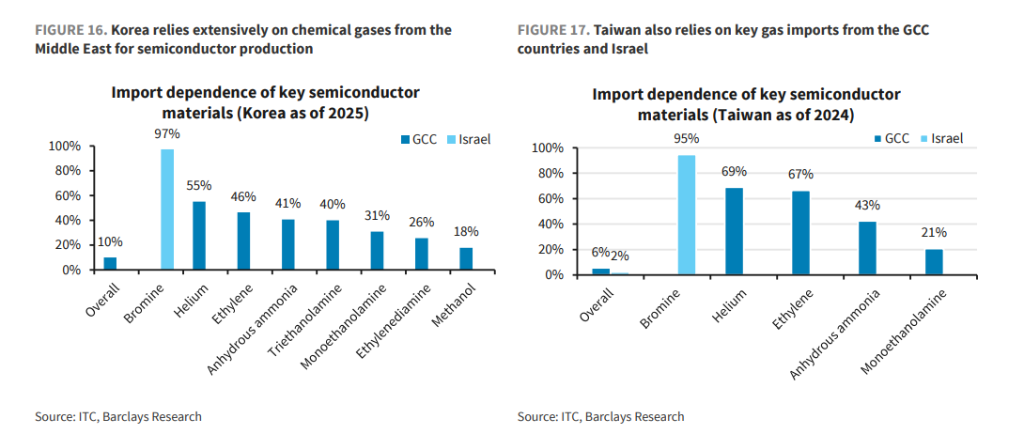
Barclays data show that South Korea and Taiwan’s dependence on the Middle East and Israel for specialty gases essentials for chip etching and cleaning is staggering:
-
Bromine: 97% of South Korea’s demand comes from Israel, Taiwan accounts for 95%;
-
Helium: 55% of South Korea’s demand comes from Gulf nations, Taiwan accounts for 69%;
-
Ethylene: The dependency ratio is also between 40%-60%.
Although major producers stock several months’ worth of raw materials, Barclays warns that if the blockade lasts more than three months, once these highly concentrated supply chains break, global semiconductor supply will enter a real “vacuum phase.”
Market Consequences: A Drastic Reshaping of Output and Prices
Researcher Brian Tan warns that the market is underestimating the destructive power this conflict could have on global tech valuations.
He states: “What Asian policymakers fear most is not just the inflation driven by rising oil prices, but the ‘Outsized Growth Shock’ to semiconductor output. If global semiconductor demand remains robust, this supply-side shock will directly push up nominal chip prices, even as output contracts.”
Currently, the Monetary Authority of Singapore (MAS) and Bank Negara Malaysia have already shown heightened caution towards geopolitical risks. Brian Tan believes that, as economies deeply tied to the tech sector, these regions’ central banks will treat rate hikes or policy tightening more cautiously, to avoid chain collapses in domestic financial systems if external energy risks materialize.
For global investors, the Iran war is not only a regional conflict—it is also a stress test for the fundamental logic underpinning global computing power. If the Strait’s blockade is not substantially eased in the coming weeks, the “black swan” in the chip industry could move from rumor to reality.
~~~~~~~~~~~~~~~~~~~~~~~~
Disclaimer: The content of this article solely reflects the author's opinion and does not represent the platform in any capacity. This article is not intended to serve as a reference for making investment decisions.
You may also like
$1,999 Foldable iPhone Is Ready, but Apple (AAPL.US) Faces Over $5.7 Billion Patent Penalty
As Apple intensifies its efforts in foldable displays and AI business, it faces a haptic technology patent compensation ruling exceeding $5.7 billion. On September 25, a federal jury in California found that Apple's Taptic Engine, used in certain iPhone and Apple Watch models, infringed on two patents held by Taction Technology.
Prospects for the opening of the Hormuz Strait are overshadowed, Asian bonds under pressure: 2Y Japanese bond yield approaches 2%, 3Y Korean bond yield rises to highest level since 2022
With high oil prices, short-term bond yields in South Korea and Japan have risen.
5% US Treasury pressure weighs on global assets, while Australian government bonds open up a window for allocation? Fixed income giant Pimco calls the rate hike expectations too aggressive
Pacific Investment Management Company (Pimco) holds a constructive view on Australian bonds, believing that market expectations for rate hikes are too high. Pimco stated that the rate hike cycle in Australia has been "fully priced in," and cracks are beginning to appear in the economy, making Australian bonds look attractive, especially in the 5- to 10-year segment of the yield curve.
Only a few stocks are rising! Goldman Sachs warns: US stock market breadth hits the worst level since the 2000 internet bubble, with rare divergence in bond volatility
Flood, a Goldman Sachs partner, believes that leading AI companies are propping up the market indexes, while median stocks have fallen 16% from their highs. More unusually, Garrett, the head of derivatives trading at Goldman Sachs, warns that the bond volatility MOVE index is at an extremely high percentile, yet the VIX remains subdued. Jonathan Krinsky, a strategist at BTIG, points out that while total hedge fund leverage is rising, net leverage is falling, indicating a contradiction of "increasing exposure without increasing direction," and warns: "Something has to give."
Crypto prices
More


