
Bitcoin options signal fear even as BTC ETF outflows remain relatively low

Key takeaways:
Bitcoin traders are turning cautious as high oil prices and Middle East tensions fuel inflation and stall US interest rate cuts.
The $254 million in spot Bitcoin ETF outflows is too small to confirm a bearish flip, yet options markets show heavy hedging.
Bitcoin (BTC) price stagnated near $70,000 during the Friday trading session after failing to reclaim the $75,000 level on Tuesday. The decline marked two days of net outflows from US-listed Bitcoin spot exchange-traded funds (ETFs), reversing the trend from the prior seven days. Traders are now wondering if institutional investors are turning bearish, especially as the US stock market showed signs of weakness.
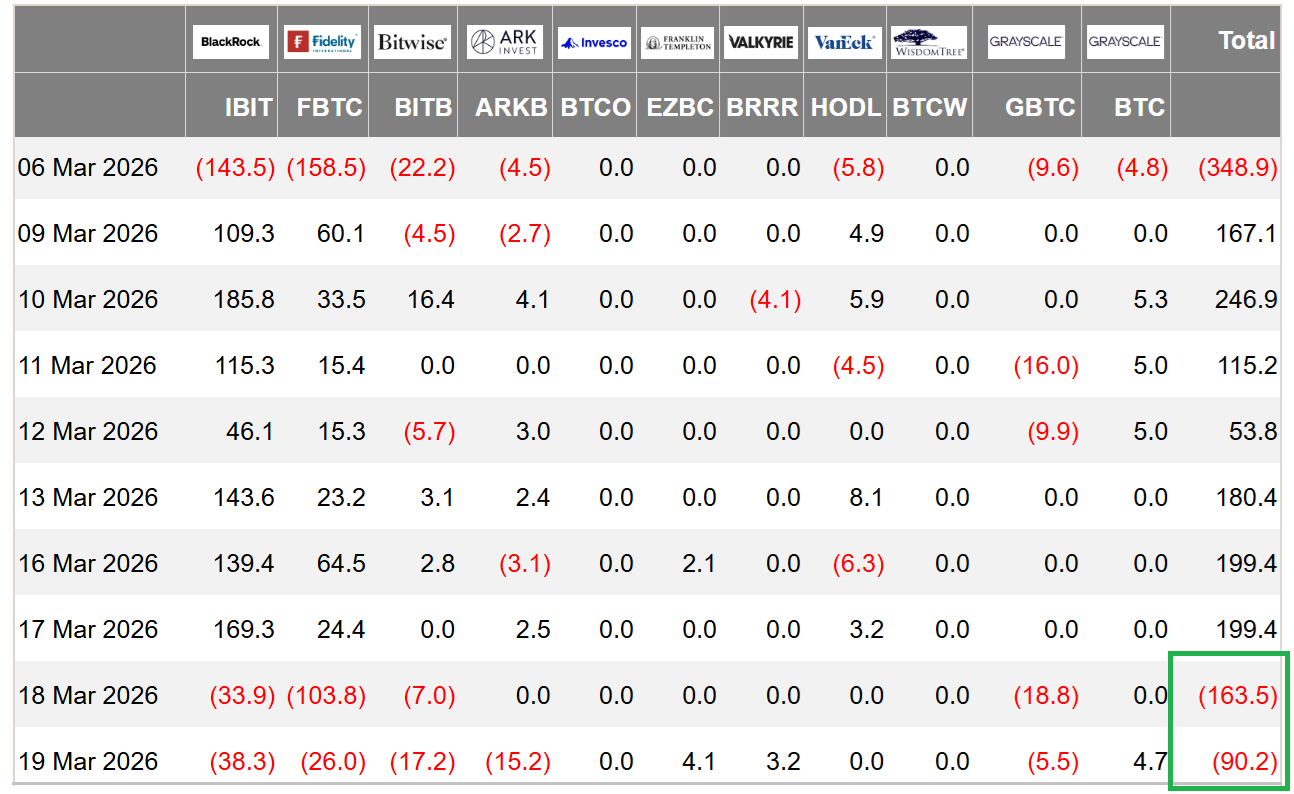 US-listed spot Bitcoin ETFs daily net flows, USD million. Source: Farside Investors
The bearish sentiment across global markets is weighing on Bitcoin as the S&P 500 plummeted to its lowest level in six months. Even gold, which typically acts as a hedge, faced a 10% sell-off over three days. As the US and Israel-Iran war triggers a broad move toward risk aversion, Bitcoin derivatives data now reflect increasing fear among traders.
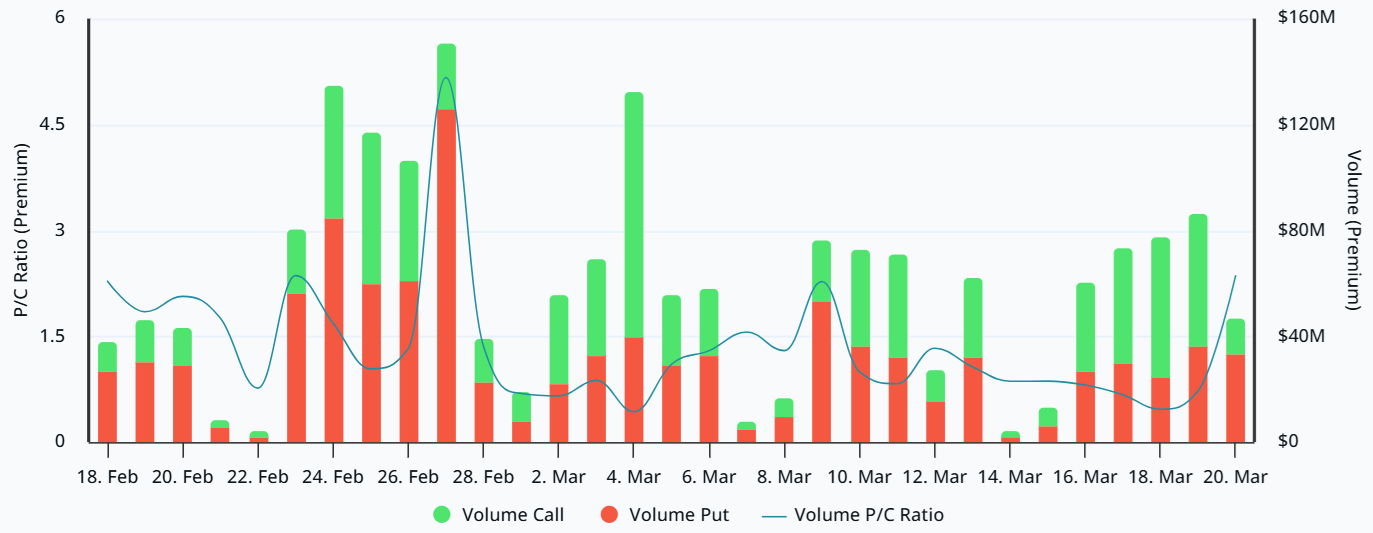 Bitcoin options put-to-call premium volumes at Deribit, USD. Source:
Demand for put (sell) Bitcoin options premiums at Deribit was nearly 2.5 times larger than equivalent call (buy) instruments on Friday, indicating increased demand for neutral-to-bearish strategies. The prior surge in the metric occurred on Feb. 27 after Iran rejected negotiations to dismantle its key nuclear facilities and export its enriched uranium.
Traders frustrated by Bitcoin's 17% lag behind the S&P 500
To confirm if the increased demand for put options has effectively been used for downside protection, one should assess the delta skew metric. When market makers fear imminent Bitcoin price correction risks, the put options tend to trade at a 6% or higher premium relative to equivalent call instruments. Conversely, periods of bullishness push the indicator below -6%.
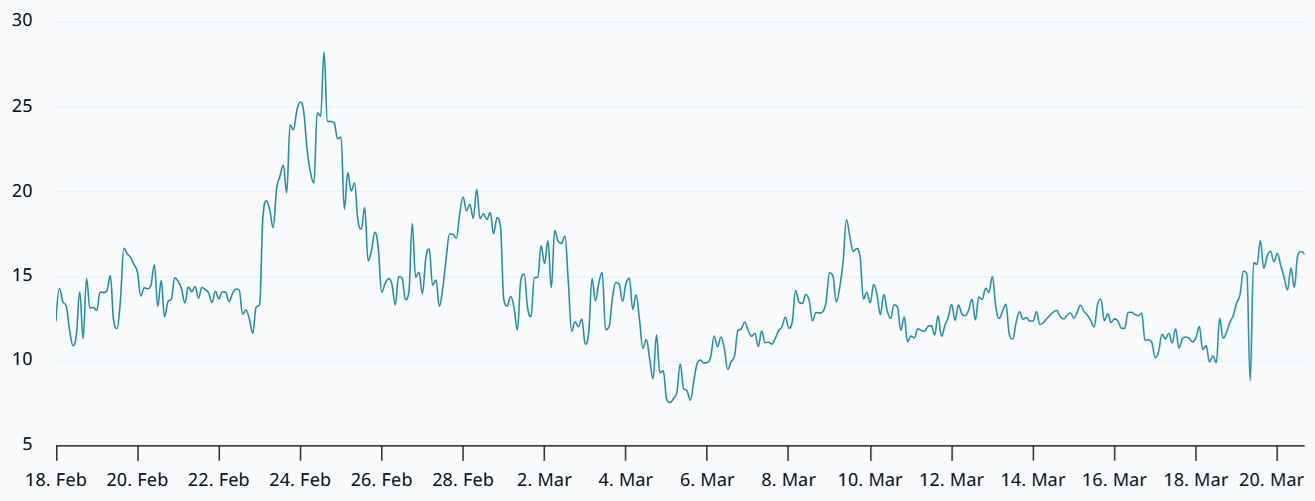 Bitcoin 30-day options delta skew (put-call) at Deribit. Source: Laevitas.ch
The Bitcoin options delta skew (put-call) stood at 16% on Friday, meaning professional traders were not comfortable that the $69,000 level will hold. While distant from the extreme panic levels seen in late February, the current conditions reflect the stress caused by the 21% price drop in three months, while gold and the US stock market held relatively steady.
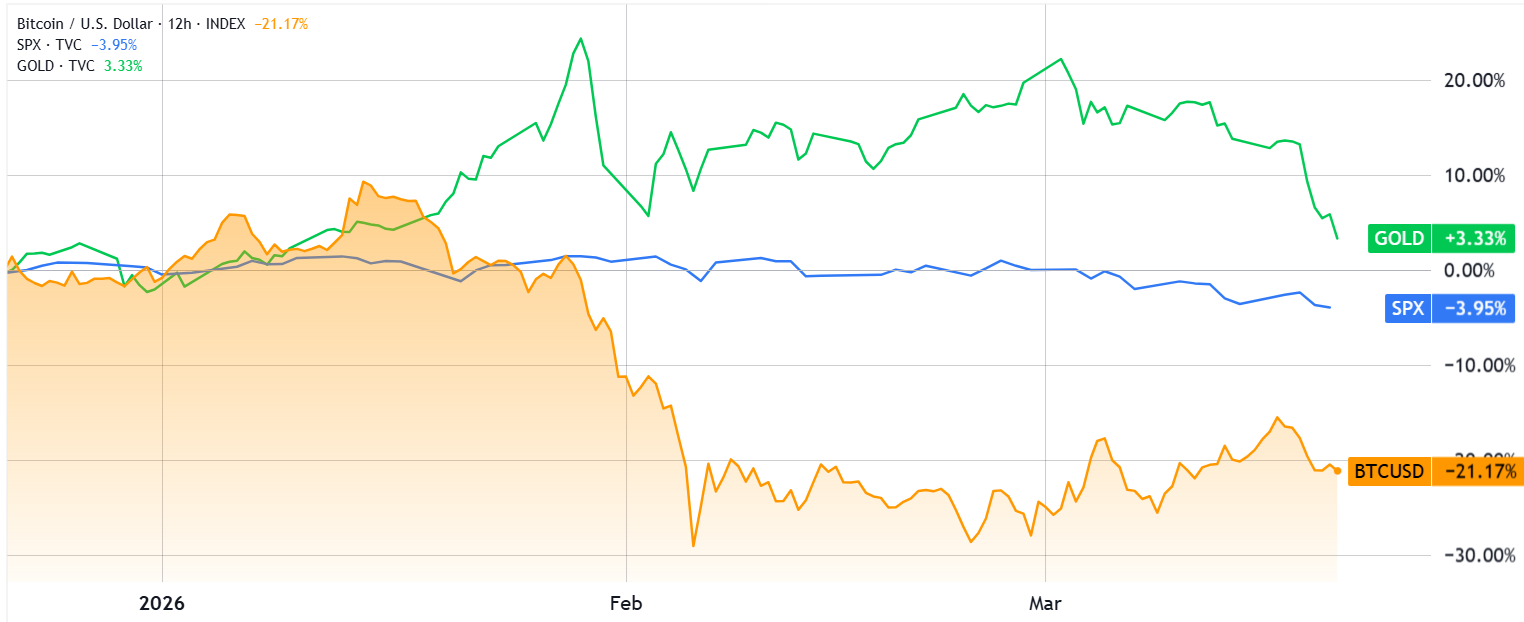 Bitcoin/USD vs. S&P 500 Index & gold/USD. Source: TradingView
Regardless of whether Bitcoin successfully defends the $70,000 level, traders are not pleased with the 17% underperformance relative to the S&P 500 over three months. More importantly, the recent rally to $75,000 on Tuesday was unable to move the needle in Bitcoin options markets, a strong indicator that traders are acting overly cautious.
Part of the pessimism can be attributed to the surge in energy prices. WTI oil prices have sustained levels above $94 since March 12, a 50% increase versus the prior month. The disruption of oil and gas production and logistics in the Middle East negatively impacts economic growth expectations and limits the ability of the US Federal Reserve to slash interest rates due to inflationary pressure.
The fuel price surge is expected to cause consumers to pull back on spending, according to a new Oxford Economics analysis. Analysts warned that US manufacturers who rely on imports will also be impacted, causing further price increases and potential "outright shortages of some products," according to Yahoo Finance.
The mere $254 million net outflows in two days are unlikely to be a sign of institutional investors flipping bearish, but traders are not confident that Bitcoin will hold above the $68,000 level. Traders’ sentiment has been largely driven by worsening macroeconomic conditions and uncertainty caused by the prolonged war, driving increased demand for downside protection using derivatives.
Disclaimer: The content of this article solely reflects the author's opinion and does not represent the platform in any capacity. This article is not intended to serve as a reference for making investment decisions.
You may also like
Silver’s tight supply creates yield opportunity as Theo launches new tokenized product

U.S. Treasury sell-off intensifies! 7-year Treasury auction sees weak demand, Treasury buyback falls short of the cap again, municipal bond yields hit highest in 15 years
On Thursday, the yield on the U.S. Treasury Department's $44 billion 7-year note auction soared to 5.085%, marking a historical high for this maturity. The allocation ratio to overseas investors dropped to a near two-year low. The Treasury's expanded repurchase operations only reached 68% of the cap, lower than the previous 86%, indicating less liquidity support than expected. The pressure spread to the U.S. municipal bond market, with the 30-year yield breaking above 5%, the highest since 2011, and the scale of sell-off reaching levels unseen since the early days of the pandemic. On Thursday, the yield on the 10-year U.S. Treasury exceeded 5.2% for the first time since 2007.
Macron: France will provide military aid to Saudi Arabia to protect the Red Sea Yanbu oil facilities
Macron stated that France will deploy troops to Yanbu and provide radar systems and defense systems. He emphasized that the mission is to protect Yanbu facilities, not to intervene in regional conflicts. Last Friday, he mentioned that after the blockage of the Strait of Hormuz, Saudi Arabia's East-West oil pipeline temporarily became a key alternative transport route, but oil shipments through the pipeline dropped sharply due to attacks on Yanbu by Yemeni Houthi forces.
Crypto prices
More


