
South Korean stock market plunges 6.5%, retail investors make record-breaking bottom-fishing purchases of 7 trillion KRW

The growing tensions in the Middle East have put significant pressure on risk asset demand, leading to a sharp decline in the South Korean stock market on Monday. However, retail investors bucked the trend by buying the dip, with net purchases reaching a record high of 7 trillion won in a single day.
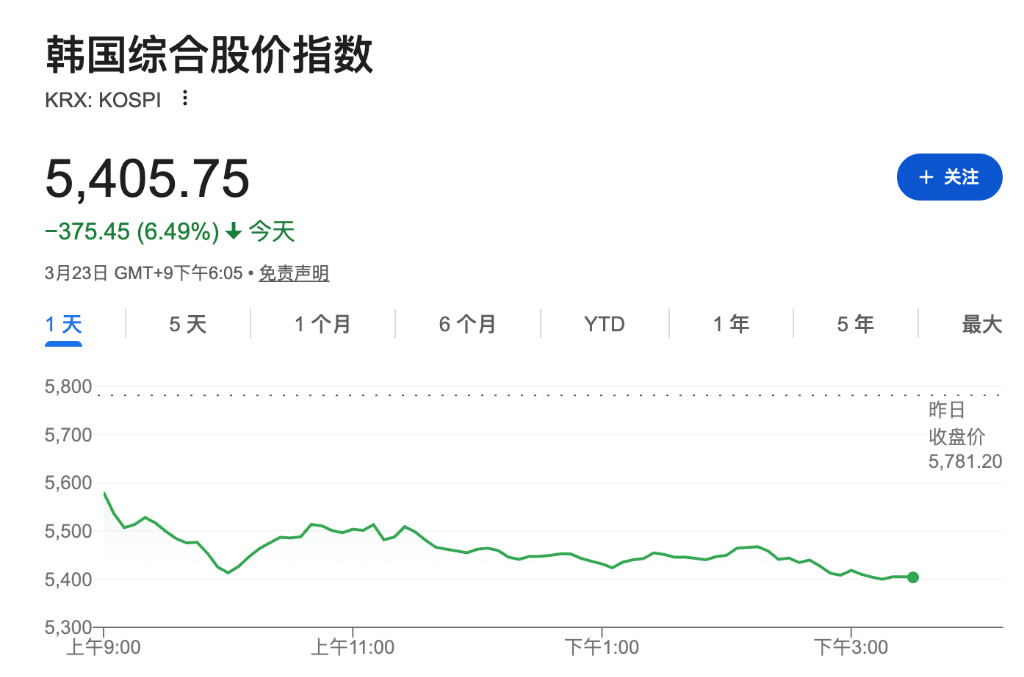
On March 23, the Korea Composite Stock Price Index (KOSPI) closed with a plunge of 6.49%, the largest single-day drop since March 4th, and has fallen 13% so far this month. The Korean won fell to 1517.3 against the US dollar, marking its lowest level since March 2009.
According to Xinhua News Agency, citing Iran's Tasnim News Agency and other Iranian media outlets, the Islamic Revolutionary Guard Corps of Iran stated in a declaration that if the United States strikes Iran's power plants, Iran will retaliate by targeting Israel's power plants and those in neighboring countries that supply electricity to US military bases. The situation carries the risk of further escalation, sparking global concerns over a deepening regional crisis, and dealing a major blow to the rally in Korean stocks previously fueled by the artificial intelligence boom.
Amid market turbulence, the South Korean government responded swiftly with policy measures. Budget Minister nominee Park Hong-keun stated that the government will promptly draft a supplementary budget plan. Previously, the government and the ruling party agreed on an extra spending plan of about 25 trillion won (approximately $16.6 billion) to support groups hit by soaring oil prices. Meanwhile, Shin Hyun-song, newly appointed Governor of the Bank of Korea on Sunday, said the central bank will seek a “balanced” monetary policy between inflation, growth, and financial stability.
Stock Market Tumbles Across the Board, Volatility Triggers Circuit Breakers
On Monday, the KOSPI closed at 5,405.75 points, plunging by 375.45 points or 6.49%, marking a new closing low since March 9. Intraday volatility triggered the circuit breaker mechanism (sidecar), the fourth time this month due to the Middle East situation, but the index continued to slide after the trigger. Out of 927 listed stocks, only 53 rose while 864 declined, with the market suffering a broad-based selloff.
Among blue chips, chip giant Samsung Electronics fell 6.57%, SK Hynix declined 7.35%, and stocks in the battery and automotive sectors also generally moved lower. In terms of capital flows, foreign investors were net sellers of about 3.7 trillion won, serving as the main drag for the index. Institutional investors also net sold. In contrast, retail investors stepped in against the trend, purchasing a record 7 trillion won in a single day, the largest daily net buy ever.
The bond market also faced selling pressure. The benchmark 10-year Korean government bond yield jumped 22.2 basis points to 3.880%, the highest since November 2023, reflecting a dual response of rising expectations for fiscal expansion and declining risk appetite in the market.
Analysts: No Need for Excessive Pessimism, But Market Patience is Wearing Thin
Eugene Investment & Securities analyst Huh Jae-hwan said, "Market hope for an imminent end to the war is fading." He also pointed out that, given the solid foundation of Asia's tech industry and government efforts for an extra budget, there is no need to be overly pessimistic about the market, "but market patience has become fragile."
The current downturn has reversed KOSPI's gains for the year. Previously, the index led the global market on the back of the AI hype before the Middle East conflict erupted, with a cumulative gain of 28% since the start of the year, but 13 percentage points have been wiped out this month. On the policy front, whether the support of the supplementary budget can stabilize market confidence remains to be seen.
Disclaimer: The content of this article solely reflects the author's opinion and does not represent the platform in any capacity. This article is not intended to serve as a reference for making investment decisions.
You may also like
Dow Jones Industrial Average bounces on Iran's latest Hormuz offer
U.S. stocks opened higher and fluctuated, the Japanese yen rebounded more than 1% intraday, 10-year U.S. Treasury yields broke above 5.22% again, and U.S. crude oil once fell nearly 3%.
After the release of U.S. consumer confidence data, the S&P and Nasdaq turned negative, while the Dow is poised to break a three-day losing streak but is set for a fourth consecutive weekly decline. Meta pulled back, falling more than 3% during the session. The U.S. 10-year Treasury yield surpassed 5.22% again, marking a new high for the third day in a row since 2007, while the 30-year yield reached its highest level since 2004. The yen/dollar pair surged 1.2% intraday, as Japanese and U.S. officials successively signaled concerns over the weak yen. Expectations for a diplomatic resolution between the U.S. and Iran are rising, halting crude oil's two-day climb.
US Treasury volatility surges, triggering alarms! BofA’s Hartnett warns of rising deleveraging risks as higher yields become main threat to the market
Bank of America strategist Michael Hartnett warns that the recent sharp rise in volatility in the US bond market is increasing the risk of broader deleveraging in financial markets.
U.S. diesel prices surge 83% this year! Apollo Chief Economist warns: Cost pass-through may make core inflation more stubborn, Federal Reserve can't ignore it
Torsten Slok, Chief Economist at Apollo Global Management, has warned that the inflation threat posed by the surge in U.S. diesel prices to historic highs may be more serious than the Federal Reserve currently realizes.
Crypto prices
More


