
US lawmakers publish crypto tax proposal without Bitcoin tax exemption

US Representatives Max Miller and Steven Horsford published a discussion draft bill on Thursday titled the ‘‘Digital Asset Protection, Accountability, Regulation, Innovation, Taxation, and Yields Act’’ or the ‘‘Digital Asset PARITY Act,” to overhaul the tax code for digital assets.
The Digital Asset PARITY Act seeks to overhaul the Internal Revenue Code of 1986 by adding provisions that would clarify the tax treatment of digital assets.
The legislation said that stablecoins are not subject to gains if the cost basis, or the amount paid by the investor, does not fluctuate by more than 1% of $1 or $0.01, according to the discussion draft.
Transaction costs incurred to acquire or move regulated dollar-pegged stablecoins cannot be counted toward an investor’s cost basis, according to the bill.
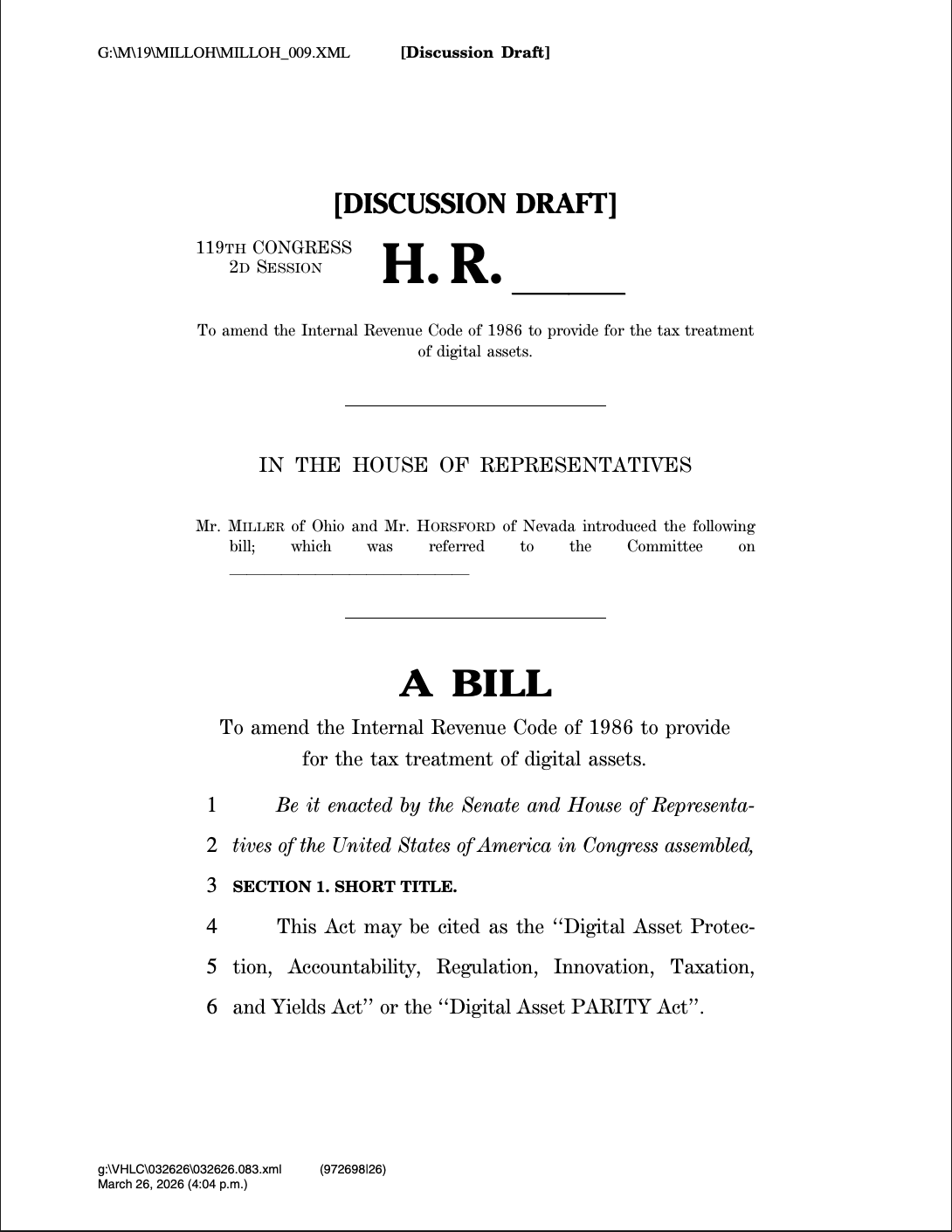 The Digital Asset PARITY Act. Source:
Digital Chamber
The Digital Asset PARITY Act. Source:
Digital Chamber
The bill also introduces a de minimis tax exemption for stablecoin transactions below $200, meaning that stablecoin transactions below the $200 threshold do not trigger tax or reporting requirements. A total annual exemption cap is yet to be determined.
Income from lending, staking or income earned through “passive” validator services is treated as part of the recipient's gross income every year, and calculated using “fair market” value, the draft said.
The Digital Asset PARITY Act has not yet been introduced to Congress; it was published as a discussion draft to open up debate between lawmakers, stakeholders and the crypto industry about how to overhaul crypto tax policy in the US.
 Rep. Steven Horsford, pictured center, and Rep. Max Miller, pictured right, speak about the future of crypto policy at the DC Blockchain Summit. Source:
Digital Chamber
Rep. Steven Horsford, pictured center, and Rep. Max Miller, pictured right, speak about the future of crypto policy at the DC Blockchain Summit. Source:
Digital Chamber
Crypto tax proposal highlights schism in the crypto industry
“We need digital asset tax clarity or activity will never fully onshore,” Cody Carbone, the CEO of crypto advocacy organization Digital Chamber, said in response to the discussion draft.
However, Bitcoiners noted that the bill includes only a de minimis tax exemption for stablecoins, not Bitcoin (BTC), similar to pending legislation, including the CLARITY crypto market structure bill, which also lacks a BTC de minimis tax exemption.
“This is the wrong direction to go in,” Pierre Rochard, CEO of The Bitcoin Bond Company, a BTC financial product issuer, said about the draft.
“It’s Bitcoin that should have a de minimis tax exemption. Stablecoins are not decentralized, and they are not permissionless. They’re not real money; they’re just fiat,” he added.
Disclaimer: The content of this article solely reflects the author's opinion and does not represent the platform in any capacity. This article is not intended to serve as a reference for making investment decisions.
You may also like
Slowing AI models may not necessarily be bearish: three structural tailwinds for traditional data centers outweigh rising interest rates
HSBC believes that the traditional growth logic of data centers is shifting from frontier model iteration to AI commercialization and diffusion. With the rise in inference demand and increased capital expenditure from cloud service providers, combined with tightening power and regulatory constraints, the supply-demand imbalance is expected to persist until 2028. Even with rising interest rates, the compound annual growth rate of AFFO per share is still expected to reach 11%–12% from 2025 to 2028, demonstrating strong earning resilience.
This time, will U.S. Treasury bonds crash U.S. stocks?
Bloomberg strategist Simon White warns that the recent rise in US Treasury yields is shifting from a "benign" increase driven by interest rate expectations to a disorderly surge fueled by expanding term premium. Market analysts note that higher long-term interest rates will simultaneously push up US stock valuation discount rates and corporate financing costs, intensifying liquidation pressure on highly leveraged assets. If interest rates above 5% become the new norm, US stock valuations will face ongoing compression pressure.
Eurosystem Launches Blockchain Platform for Tokenized Asset Settlements
Crypto prices
More


