
Crypto funds see first outflow in 5 weeks amid inflation fears, Iran tensions

Crypto investment products saw their first weekly outflows in five weeks last week, with $414 million exiting the market as investors grew cautious over rising inflation risks and escalating tensions in the Middle East.
The pullback came as expectations for the June Federal Open Market Committee (FOMC) meeting in the US shifted from potential rate cuts to rate hikes, signaling a tougher macro backdrop for risk assets, CoinShares reported Monday.
Total assets under management fell to $129 billion, returning to levels last seen in early February and “broadly comparable to April 2025, during the initial phase of Trump’s tariffs,” CoinShares head of research James Butterfill said.
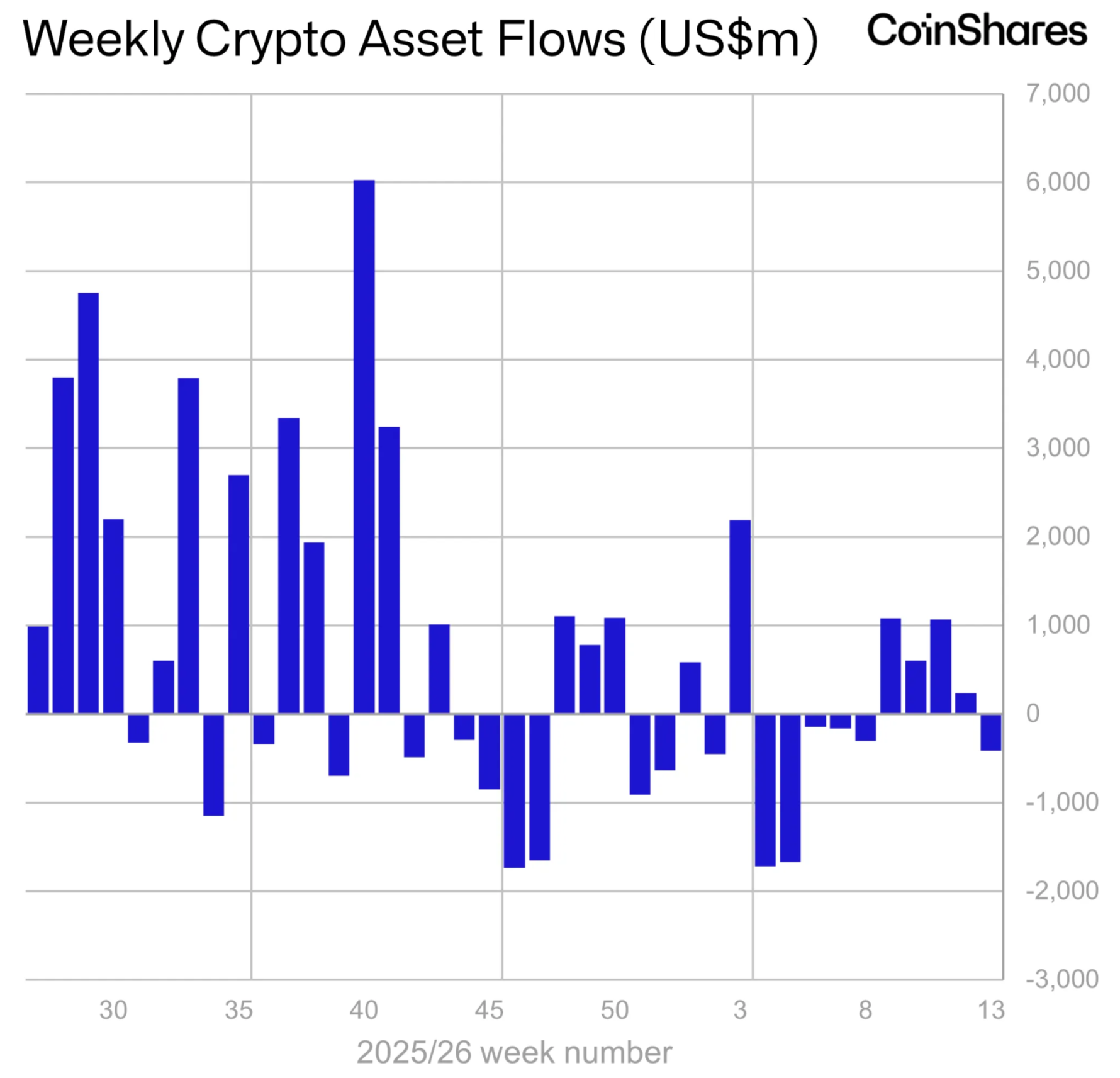 Weekly asset flows. Source: CoinShares
The reversal in flows suggests a shift toward risk-off sentiment, with macro concerns driving investor behavior and weighing on demand for digital assets.
Related:
Ether leads outflows
Ether (ETH) led the declines among major assets, with $222 million in outflows, pushing its year-to-date (YTD) flows to a net loss of $273 million, the weakest among tracked assets.
Bitcoin (BTC) also recorded $194 million in outflows during the week but remains in positive territory for the year, with $964 million in net inflows. Short-Bitcoin products saw an additional $4 million in inflows, suggesting some investors are positioning for further downside.
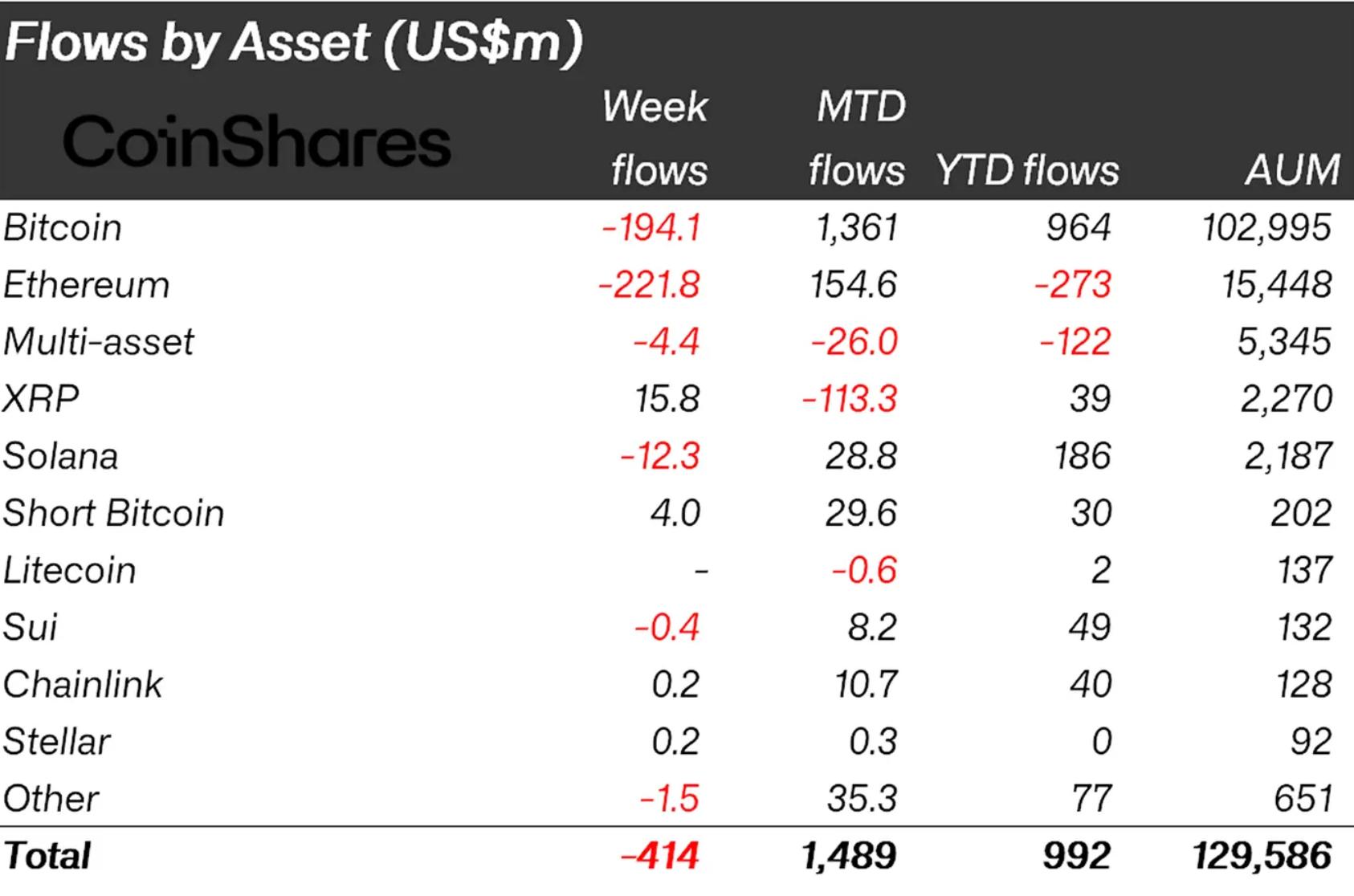 Crypto product flows by assets. Source: CoinShares
Solana (SOL) followed with $12.3 million in outflows, while XRP (XRP) stood out as one of the few assets to attract fresh capital, posting $15.8 million in inflows.
Related:
Spot Bitcoin, Ether ETFs see weekly outflows
Signs of risk-off sentiment are also emerging in crypto exchange-traded funds. Last week, spot Bitcoin ETFs snapped a four-week inflow streak and posted $296 million in net outflows last week, which followed more than $2.2 billion in inflows earlier in the month.
Spot Ether ETFs also extended their losses, recording $206.6 million in outflows for a second straight week.
Magazine:
Disclaimer: The content of this article solely reflects the author's opinion and does not represent the platform in any capacity. This article is not intended to serve as a reference for making investment decisions.
You may also like
Slowing AI models may not necessarily be bearish: three structural tailwinds for traditional data centers outweigh rising interest rates
HSBC believes that the traditional growth logic of data centers is shifting from frontier model iteration to AI commercialization and diffusion. With the rise in inference demand and increased capital expenditure from cloud service providers, combined with tightening power and regulatory constraints, the supply-demand imbalance is expected to persist until 2028. Even with rising interest rates, the compound annual growth rate of AFFO per share is still expected to reach 11%–12% from 2025 to 2028, demonstrating strong earning resilience.
This time, will U.S. Treasury bonds crash U.S. stocks?
Bloomberg strategist Simon White warns that the recent rise in US Treasury yields is shifting from a "benign" increase driven by interest rate expectations to a disorderly surge fueled by expanding term premium. Market analysts note that higher long-term interest rates will simultaneously push up US stock valuation discount rates and corporate financing costs, intensifying liquidation pressure on highly leveraged assets. If interest rates above 5% become the new norm, US stock valuations will face ongoing compression pressure.
Eurosystem Launches Blockchain Platform for Tokenized Asset Settlements
Crypto prices
More


