
Russia moves to narrow crypto trading to regulated intermediaries

Russia’s government has approved a package of draft bills that would channel domestic crypto trading through licensed intermediaries and sharply limit retail access.
The Finance Ministry said Monday that the government had approved a package of draft bills on the legalization of the circulation of digital currencies and digital rights in Russia.
“Under the new regulatory framework, transactions involving digital currency without regulated intermediaries are prohibited,” the ministry said. The package would tighten state oversight of digital assets while preserving limited access for non-qualified investors and broader access for qualified investors.
The framework introduces significant limits for retail investors, allowing purchases of the “most liquid digital currencies” to be defined by the Bank of Russia. Under the rules, retail investors must pass a test and are limited to purchases of up to 300,000 rubles ($3,700) per year through a single intermediary.
The proposal would still allow residents to buy crypto abroad using foreign accounts, provided those transactions are reported to tax authorities, signaling that Moscow is trying to domesticate crypto trading rather than ban it outright.
Crypto operators face licensing requirements
The approved package includes bills on digital currencies and digital rights, amendments to certain Russian legislative acts, as well as changes to the country’s administrative offenses code.
The framework establishes a licensing regime for entities involved in crypto operations, including digital exchanges and custodial services, while allowing banks and brokers to participate under specific regulatory requirements.
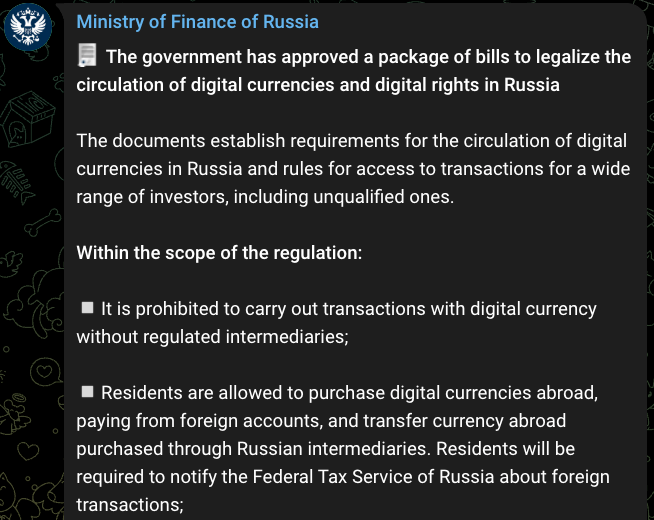 Source: Ministry of Finance of Russia (Minfin), translated by Telegram
“As for banks and brokers, they will be able to carry out such activities provided they comply with specific prudential requirements,” the announcement notes.
The package also provides for administrative liability for violations by organizations engaged in exchange activity, part of a broader push to police unlicensed crypto intermediation.
Critics say rules could backfire on oversight goals
While the government aims to formalize the sector, critics say the rules could have the opposite effect, pushing activity into unregulated channels.
“At a time when the rest of the world is moving toward liberalizing access to equity markets through tokenization, we are, for some reason, doing the opposite by pushing crypto into a framework of securities market regulation,” Exved founder Sergey Mendeleev told Cointelegraph.
“In the end, it will be like with casinos — people won’t play less, but everything will move out of state control into online and underground venues,” he said.
Disclaimer: The content of this article solely reflects the author's opinion and does not represent the platform in any capacity. This article is not intended to serve as a reference for making investment decisions.
You may also like
Bitcoin Stock Climbs Near 8-Month High as Huge Buyers Purchase More Coins; Caution Remains Necessary
SoFi tie-up shows stablecoins can provide alternative blockchain settlement rail
Slowing AI models may not necessarily be bearish: three structural tailwinds for traditional data centers outweigh rising interest rates
HSBC believes that the traditional growth logic of data centers is shifting from frontier model iteration to AI commercialization and diffusion. With the rise in inference demand and increased capital expenditure from cloud service providers, combined with tightening power and regulatory constraints, the supply-demand imbalance is expected to persist until 2028. Even with rising interest rates, the compound annual growth rate of AFFO per share is still expected to reach 11%–12% from 2025 to 2028, demonstrating strong earning resilience.
Crypto prices
More


