
JPMorgan: Here's the Complete List of Middle East Oil and Gas Losses!


Wallstreet Insights
On April 9, the J.P. Morgan commodities research team released a report that, for the first time, rigorously quantified the damage to energy infrastructure from conflicts in the Gulf region.
At a time when the market is often overwhelmed by vague headlines of “attacks,” this report offers professional investors a crucial benchmark to gauge the true impact of supply shocks.
The Real Picture: Over 60 Assets Impacted
Nearly six weeks after the outbreak of conflict, the level of destruction to infrastructure is hard to ignore. The report points out:
In the conflict, headlines often focus on the fact of the damage, not the scale. Facilities are 'hit,' infrastructure 'targeted'... but rarely do we receive meaningful quantitative and qualitative data that truly matters to the market.
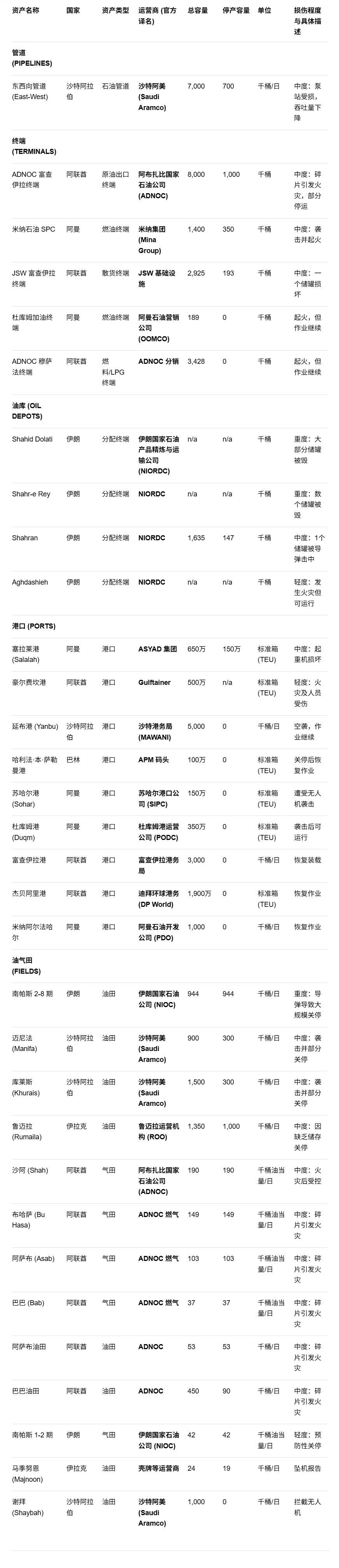
What we know is that in nearly six weeks since the conflict began, over 60 Gulf energy infrastructure facilities have been affected by drone and missile attacks, and about 50 of these suffered varying degrees of damage.
Although most attacks will not result in long-term interruptions, at least eight assets were severely damaged and face prolonged repair times.
For example, Qatar’s Ras Laffan oil and gas complex may require several years to recover 17% of its damaged production capacity, and Bahrain’s Sitra refinery was hit twice, suffering severe impacts.
Refineries Heavily Hit: 2.4 Million Barrels/Day Capacity Offline
The crude oil refining sector has been at the forefront of this conflict. It is estimated that a total of 20 affected refineries have been forced to shut down around 2.4 million barrels/day of capacity.
Although most facilities were taken offline for precautionary reasons or have already restarted, timelines for resumption still vary:
About 900,000 barrels/day of capacity can be restored within weeks, another 800,000 barrels/day may take about a month, while the remaining 700,000 barrels/day capacity (mainly in Bahrain’s Sitra and Iran’s Tehran refineries) will require much longer repair periods.

Saudi Declaration: From “Occasional Disruptions” to “Substantial Impact”
What truly alarmed the market was the Saudi authorities’ disclosure of the full extent of the damage.
As multiple key upstream, midstream, and downstream facilities (including east-west pipelines, Manifa and Khurais oilfields) within Saudi Arabia were confirmed attacked, the nature of the incident fundamentally changed. J.P. Morgan commented:
Saudi Arabia’s statement today details the damage, turning the narrative from occasional disruptions to a measurable supply shock.
Especially striking is that only a few hours after a ceasefire was announced, the east-west pipeline pumping station was attacked, resulting directly in a loss of 700,000 barrels/day throughput.
Given that this pipeline is a key bypass for about 5 million barrels of crude oil flow daily, the consequences from this strategic node being damaged are extremely far-reaching.
Disclaimer: The content of this article solely reflects the author's opinion and does not represent the platform in any capacity. This article is not intended to serve as a reference for making investment decisions.
You may also like
Here’s why BlackRock believes autonomous AI systems will drive next stablecoin boom
BlackRock expects exchange-traded compute futures as it pitches stablecoins for AI agents
Report: TSMC to Raise Wafer Foundry Prices by 3% to 6% Starting January Next Year, Order Visibility Extended to 2030
According to media reports, TSMC's advanced and high-priced processes such as 2nm and 3nm have seen the largest price increases; mature and specialty processes are subject to individual negotiation based on products, capacity utilization, and customer conditions. Currently, TSMC's 8-inch fabs have a capacity utilization rate exceeding 100%, and processes below 45nm are at full capacity. The construction of AI data centers is not only driving demand for GPU and HBM, but also boosting orders for mature processes such as PMIC, MCU, and analog ICs.
U.S. Treasury plans to repurchase up to $6 billion in long-term bonds, 30-year yield hits highest since 2007
This is the second round of enhanced long-term bond buybacks by the Treasury, this time focusing on 20- to 30-year government bonds. After the announcement of the planned upper limit, the yield on 30-year U.S. Treasury bonds continued to rise, at one point exceeding 5.4%. In the first round of enhanced buybacks two weeks ago, the upper buyback target was also $6 billion, which was lower than some market participants had expected, and the actual buyback amounted to only $5.2 billion due to insufficient competitive bidding, according to the Treasury.
Crypto prices
More


