
Polymarket odds of Hormuz Strait traffic normalizing by end of May spike to 73%

Polymarket prediction market odds of the Strait of Hormuz “returning to normal” by the end of May spiked to 73% on Friday, following news that Iranian officials have temporarily opened up the Strait of Hormuz as part of a ceasefire deal.
The odds climbed to a high of 82% on Friday, after Iranian Foreign Minister Seyed Abbas Araghchi announced that the Strait of Hormuz is open. Since that time, the odds have fallen back down to 73%. He said in an X post:
“The passage for all commercial vessels through the Strait of Hormuz is declared completely open for the remaining period of the ceasefire, on the coordinated route as already announced by the Ports and Maritime Organization of the Islamic Republic of Iran.”
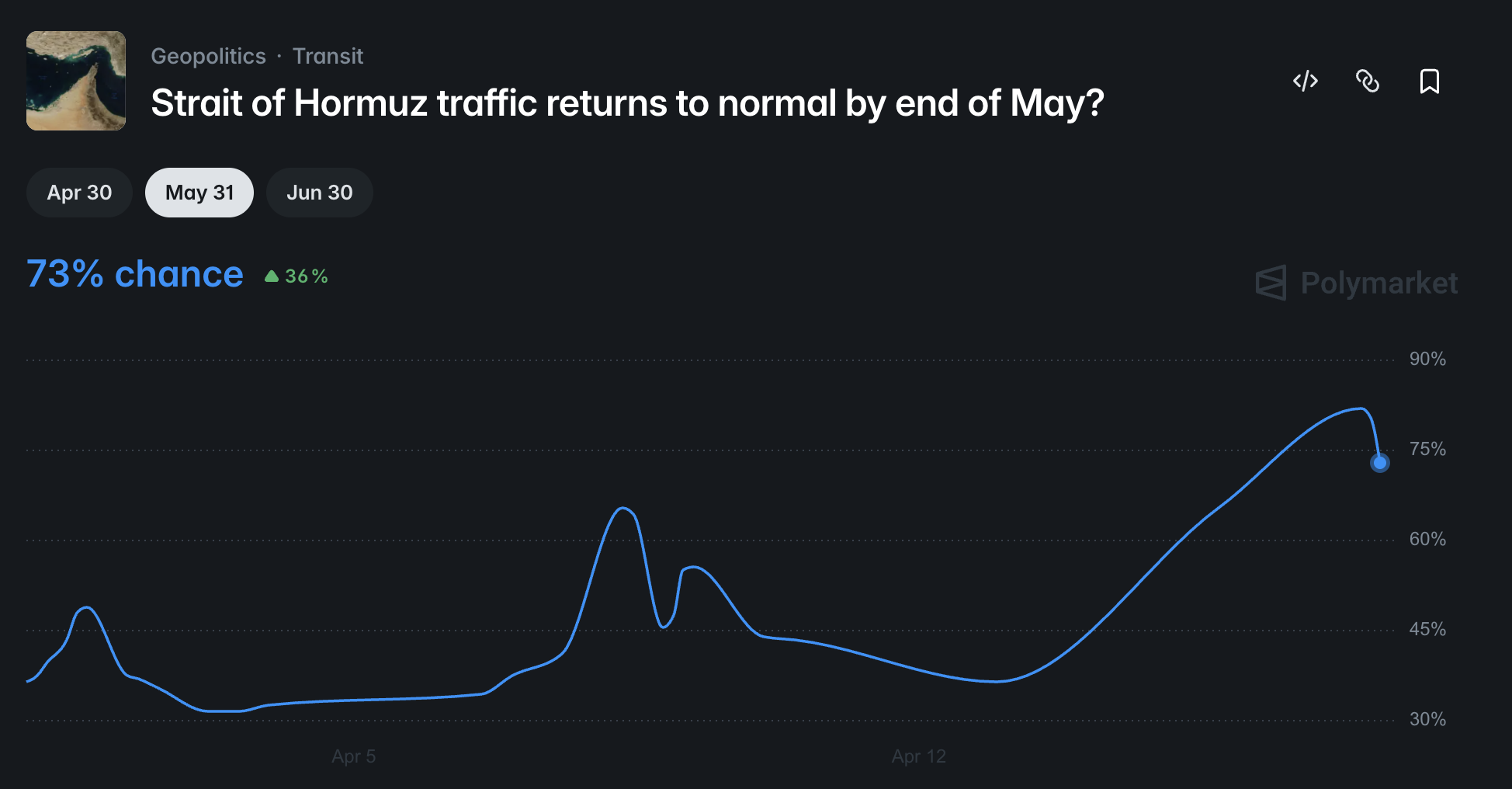 Polymarket odds for oil tanker traffic through the Strait of Hormuz returning to normal by the end of May 2026. Source:
Polymarket
Polymarket odds for oil tanker traffic through the Strait of Hormuz returning to normal by the end of May 2026. Source:
Polymarket
However, traders on the platform placed the odds of the Strait returning to normal activity by the end of April at just 40%.
The war in Iran sent shockwaves through financial markets, impacting crypto and energy prices, as investors and financial analysts react to political developments in the ongoing conflict.
Related: Iran conflict hints Bitcoin’s addressable market could exceed gold: Bitwise
Bitcoin rises on the ceasefire news, but the truce is “fragile”
The price of Bitcoin (BTC) surged on Friday in response to the temporary reopening of the Strait under the ceasefire, briefly tapping $78,000 before climbing down to about $77,358, the price at the time of publication.
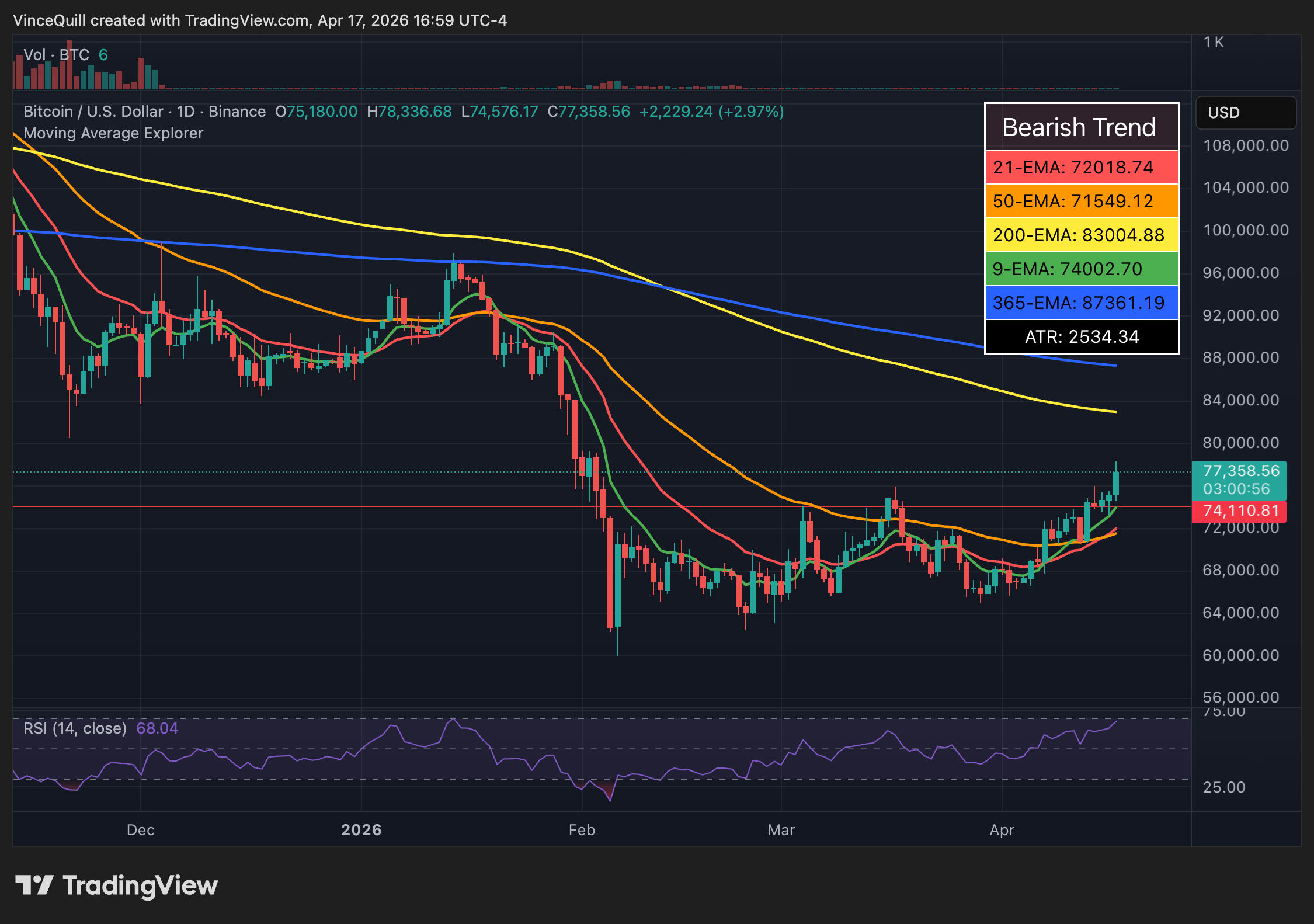 The price of Bitcoin surged after Iranian officials announced that the Strait of Hormuz would remain open during the ceasefire. Source: TradingView
Crypto market analyst Nic Puckrin told Cointelegraph that the ceasefire between the US and Iran announced in April is “fragile” and that core issues remain unresolved.
The fallout from the conflict will likely cast a shadow over financial markets for most of 2026, pushing back any interest rate cuts to Q3 2026 at the earliest, if rate cuts materialize at all this year, Puckrin said.
“A ceasefire that results in the end of geopolitical tensions, a sustained drop in oil prices toward $80, and ideally also softer-than-expected economic data that calms stagflation fears” are all needed for BTC to reclaim the $90,000 level, he said.
US President Donald Trump said on Friday that the US naval blockade on Iran would “remain in full force and effect” until the “transaction with Iran is 100% complete.”
Magazine: Should users be allowed to bet on war and death in prediction markets?
Disclaimer: The content of this article solely reflects the author's opinion and does not represent the platform in any capacity. This article is not intended to serve as a reference for making investment decisions.
You may also like
Here’s why BlackRock believes autonomous AI systems will drive next stablecoin boom
BlackRock expects exchange-traded compute futures as it pitches stablecoins for AI agents
Report: TSMC to Raise Wafer Foundry Prices by 3% to 6% Starting January Next Year, Order Visibility Extended to 2030
According to media reports, TSMC's advanced and high-priced processes such as 2nm and 3nm have seen the largest price increases; mature and specialty processes are subject to individual negotiation based on products, capacity utilization, and customer conditions. Currently, TSMC's 8-inch fabs have a capacity utilization rate exceeding 100%, and processes below 45nm are at full capacity. The construction of AI data centers is not only driving demand for GPU and HBM, but also boosting orders for mature processes such as PMIC, MCU, and analog ICs.
U.S. Treasury plans to repurchase up to $6 billion in long-term bonds, 30-year yield hits highest since 2007
This is the second round of enhanced long-term bond buybacks by the Treasury, this time focusing on 20- to 30-year government bonds. After the announcement of the planned upper limit, the yield on 30-year U.S. Treasury bonds continued to rise, at one point exceeding 5.4%. In the first round of enhanced buybacks two weeks ago, the upper buyback target was also $6 billion, which was lower than some market participants had expected, and the actual buyback amounted to only $5.2 billion due to insufficient competitive bidding, according to the Treasury.
Crypto prices
More


