
Nike hits rock bottom as China woes spark dip-buying talk

Nike shares have fallen to a decade-low range between $42 and $46 after a sharp drop from their 2021 peak.
- Nike shares fell to decade lows as weak China demand and brand pressure hurt investor sentiment.
- Converse revenue dropped sharply while Nike renewed wholesale partnerships and stepped back from its DTC focus.
- Nike sold RTFKT after ending Web3 services, while board member stock purchases drew fresh market attention.
Market watchers now focus on whether the company can steady sales after weak results in April 2026 and a long slide in investor confidence.
Meanwhile, the stock has erased years of gains and now trades far below its all-time high of $179.10. Technical data showed Nike’s monthly RSI at its lowest level on record, which placed the stock in deeply oversold territory.
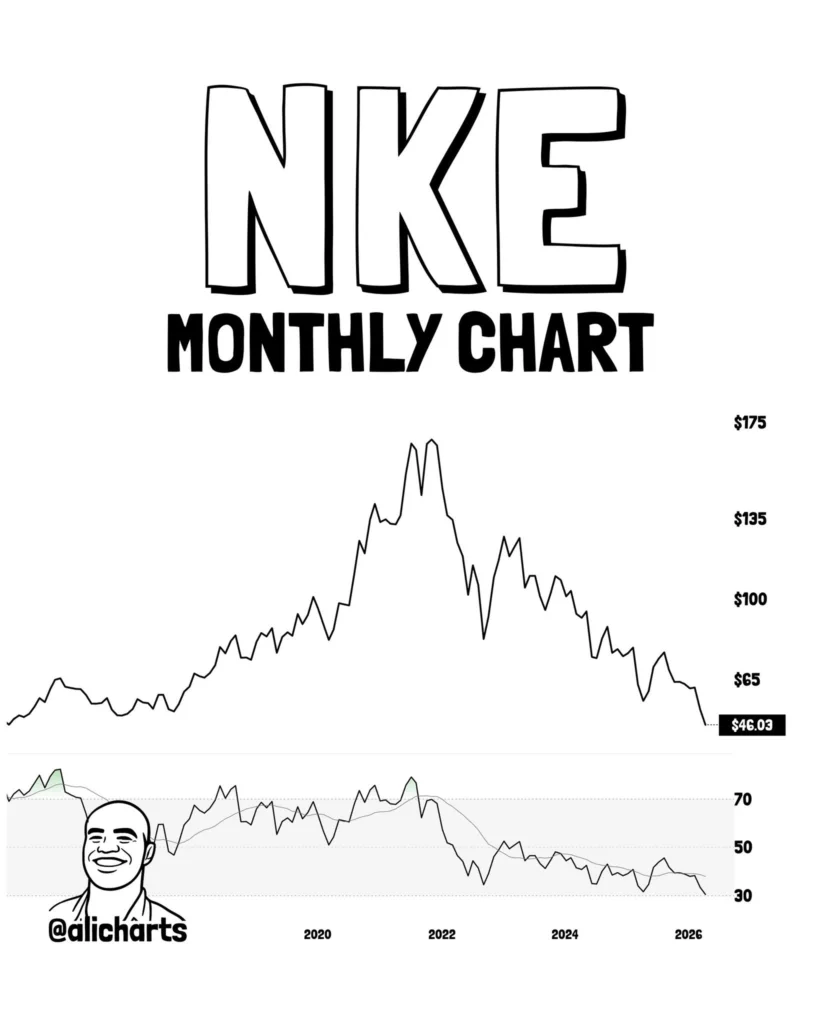 Source: Ali Martinez/X
China weakness adds to brand pressure
Nike continues to face heavy pressure in China, which has long served as one of its strongest growth markets. Reports pointed to a projected 20% decline in China sales as local consumer trends shift toward domestic sportswear brands.
Li-Ning and other Chinese companies have gained ground by expanding performance products and targeting mid-to-high-tier buyers. This trend has made it harder for Nike to hold its premium position as younger consumers increasingly favor local labels linked to “Guochao.”
Strategy changes follow softer demand
Nike has also faced weaker results in its lifestyle business. Converse recorded a steep revenue decline, which added to concerns about softer demand in categories that once supported the company’s broader brand appeal.
In response, Chief Executive Elliott Hill has moved to strengthen wholesale ties with retailers such as Foot Locker and Dick’s Sporting Goods. The change marks a step back from the direct-to-consumer model that Nike had pushed for years to support higher margins and tighter control over sales channels.
Moreover, Nike also sold digital fashion unit RTFKT in December 2025, as reported. The move followed an earlier decision to end Web3 services and pause NFT drops, while keeping some gaming-related wearables.
The sale came as the NFT market remained under pressure. Reports said the sector’s market value had dropped more than 67% over the past year, while major platforms shifted strategy and some events shut down. Nike has not disclosed the buyer or the financial terms of the RTFKT sale.
Nike’s board has still shown support during the downturn. Apple Chief Executive Tim Cook, who serves on Nike’s board, reportedly bought about $3 million in Nike shares, while director Bob Swan added about $500,000. Those purchases drew attention as investors weighed whether the company’s current problems reflect a long reset or a deeper decline.
Disclaimer: The content of this article solely reflects the author's opinion and does not represent the platform in any capacity. This article is not intended to serve as a reference for making investment decisions.
You may also like
XRP Pundit: First Thing You Should Do When You Become a Crypto Millionaire
 VIPTradFi Focus: Where Does the RWA Market Stand Today?
1. Crypto outperformed traditional equity indexes following the rate hike, but elevated interest rates remain a key constraint on cross-asset allocation. From September 12 to 18, BTC, ETH, and SOL gained 4.83%, 3.84%, and 9.96%, respectively, while the S&P 500 edged down 0.08%. The U.S. Dollar Index rose 1.11%, and the 10-year U.S. Treasury yield closed at approximately 4.998%. Improving risk appetite is therefore coexisting with elevated discount rates, raising the bar for RWA allocation: investors need to compare not only returns on the underlying assets, but also on-chain liquidity and collateral efficiency. 2. Growth in tokenized equities is occurring even as the overall RWA market remains under pressure. As of September 18, Distributed Asset Value across RWAs stood at $38.503 billion, down 1.13% week over week, while tokenized equities reached $3.056 billion, up 6.03%. This week's data are better explained by capital reallocating across different RWA segments than by a broad-based expansion of the entire RWA market. 3. For exchanges, the opportunity lies in connecting spot holdings, collateral, and derivatives. Reality's distributed asset value stands at approximately $155 million, while eligible rTokens can already be used within Bitget's UTA margin framework. Across CoinGlass's verifiable sample of 177 TradFi instruments, open interest reached approximately $11.498 billion, up 2.06% week over week, even as weekly trading volume declined 7.60%. The medium-term opportunity remains intact, but deeper utilization will depend on liquidity, collateral use, and sustained trading activity. 4.Assets to watch: BTC, ETH, SOL, NEAR, ZEC, gold, tokenized U.S. equities, COST. 5.Key metrics to watch: rToken collateral utilization, the durability of TradFi open interest and trading volume, and next week's employment and consumer data.

Gold prices fall Rs 1,331/10 gram, silver dips Rs 1,600/kg as Mideast tensions outweigh oil fall: Key levels to track
Strategists Say Market's ‘Wall of Worry' Is Healthy, Not a Warning Sign

Crypto prices
More


