
"Never seen such growth!" Claude Code triggers explosive increase, Anthropic's annualized revenue doubles to $4.4 billion in two months

Anthropic is rewriting the technology industry's growth records at an unprecedented pace.
According to the latest report from semiconductor and AI infrastructure research institute Semi Analysis, Anthropic’s annualized recurring revenue (ARR) has exceeded $44 billion. This figure is nearly five times greater than the approximately $9 billion at the end of 2025, meaning the company has added about $96 million in ARR every day in just a few months. A venture capitalist who reviewed Anthropic's data said, "We have studied IPOs of over 200 public software companies, and such a growth rate has never been seen before."
The core driver of this round of growth stems from the explosion of enterprise demand and the strong performance of the programming agent product Claude Code. Meanwhile, the Semi Analysis report shows that Anthropic's inference infrastructure gross margin soared from 38% a year ago to over 70%, indicating the company is not only expanding rapidly but also growing with greater efficiency.
Boosted by this, Anthropic is reportedly advancing a $50 billion round of financing, with a valuation exceeding $1 trillion, and Goldman Sachs, JP Morgan, and Morgan Stanley have entered early-stage communications.
Growth Curve: Unprecedented in Software History
Anthropic’s ARR trajectory has almost no historical benchmark.
According to disclosures by CEO Dario Amodei, since Anthropic gained its first revenue, annual revenue has grown about tenfold each year:
2022 ARR was about $10 million, 2023 about $100 million, December 2024 about $1 billion, September 2025 about $7 billion, December 2025 about $9 billion, February 2026 about $14 billion, March 2026 about $19 billion, April 2026 about $30 billion, and by May 2026 exceeded $44 billion (UTC+8).
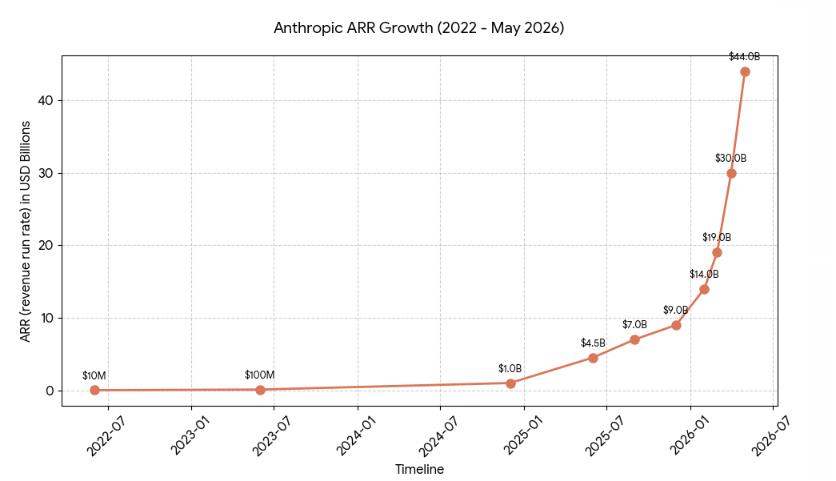
It is worth noting that the most significant acceleration stage occurred after February 2026—ARR surged from $14 billion to $44 billion (UTC+8) in just three months.
Claude Code is the key variable in the recent growth acceleration. This programming agent product was publicly launched in May 2025, reaching an annualized income of $2.5 billion by February 2026, and has continued to climb since then.
Since January 2026, Claude Code’s weekly active users have doubled. Some analyses estimate that about 4% of global public GitHub commits are now generated or completed with Claude Code, with enterprise usage contributing over half of its income.
The strategic value of Claude Code lies in its ability to bridge the conversion path between individual users and enterprise procurement.
Developers first use Claude Code for daily programming tasks; then the tool enters team codebases, eventually triggering unified procurement, permission configuration, and secure compliance integration at the company level. Personal usage habits thus translate into organizational processes, forming a natural penetration from To C to To B.
Comparatively, AWS took 13 years to reach $35 billion in annual revenue, Salesforce crossed the $20 billion revenue mark only in 2021 after being founded in 1999, and ServiceNow took about 20 years to exceed $9 billion. Anthropic has covered in one year what took other software companies over a decade or two to achieve.
Enterprise Customers: From Trial to Embedded Infrastructure
Anthropic’s main growth engine comes from the enterprise side, not consumer subscriptions.
The Semi Analysis report shows that 8 out of the Fortune 10 have become Claude customers; enterprise clients with annual spending over $1 million have expanded from more than a dozen two years ago to over a thousand today; and the number of clients with annual spending over $100,000 grew sevenfold in the past year.
In terms of market share, Anthropic’s proportion of enterprise AI spending relative to OpenAI rose from about 10% in early 2025 to over 65% in February 2026. Such a reversal speed is rare in the industry.
The structural change here is that the logic for enterprise procurement of Claude has shifted from "innovation projects" to "core operations." Departments such as legal, finance, consulting, and customer service are embedding Claude into stable workflows, and the procurement mode has shifted from traditional seat-based payment to usage-based billing. Semi Analysis points out that enterprises are not experimenting with Claude but are embedding it into critical business processes, signing long-term contracts and continually expanding usage.
Distribution advantages are also not to be ignored. Claude is currently the only cutting-edge AI model available simultaneously on AWS Bedrock, Google Cloud Vertex AI, and Microsoft Azure Foundry—the breadth of this coverage is unmatched by competitors.
Gross Margin Surge: Key Indicator of Business Quality
The most significant data point in the Semi Analysis report is perhaps the dramatic improvement in gross margin. Inference infrastructure gross margin increased from 38% to above 70%, shifting Anthropic’s narrative from "growth speed" to "business quality."
High-growth AI companies have long faced a central question: Is their revenue bought at the cost of compute losses?
Analysis indicates that significant improvement in gross margin shows Anthropic’s unit economics are improving, possibly owing to enhancements in inference efficiency, cache and routing optimization, higher hardware utilization, and load stability from enterprise contracts.
This is the underlying logic for investors being willing to offer a valuation of about 20 times ARR. If inference gross margins above 70% can be maintained, Anthropic would no longer be just a model company burning cash for growth, but much closer to an AI infrastructure company with software-level margin structure. By comparison, Anthropic is expected to turn profitable in 2028—earlier than competitor OpenAI’s anticipated post-2030 timeline.
IPO Outlook: The Real Test Beyond the Speedometer
Anthropic is reportedly considering going public as early as the end of 2026, aiming to achieve $26 billion in actual annual revenue by then. If $44 billion in ARR can be sustained, this target no longer appears aggressive.
But ARR is a speedometer, not a finish line. It reflects current growth momentum, not guaranteed annual average speed. Enterprise AI spending still needs to go through budget cycles: can the high-frequency usage in trial stages settle into long-term contracts, can developer enthusiasm convert into organizational renewals, and can the efficiency gains brought by Claude Code be accepted by large enterprises under audit, security, and compliance? These will determine the quality of Anthropic’s revenue.
Competitive pressure remains constant. OpenAI has the strongest consumer mindshare and developer ecosystem, Google holds synergistic advantages in cloud, Workspace, and TPU, Microsoft controls a massive enterprise distribution channel, and Meta continues to lower industry prices through open-source models.
Semi Analysis believes current enterprise demand for Claude is a structural, not cyclical, phenomenon. If $44 billion in ARR can be sustained, Anthropic will challenge not only OpenAI's valuation but also the entire industry’s imagination of an AI company’s growth ceiling.
Disclaimer: The content of this article solely reflects the author's opinion and does not represent the platform in any capacity. This article is not intended to serve as a reference for making investment decisions.
You may also like
XRP eyes $2 target as Evernorth secures $30M for institutional XRP purchases
JPMorgan: Custom chip shipments will surpass GPU in 2027; Broadcom TPU's "supply chain invisibility" does not indicate questionable orders
J.P. Morgan expects that by 2027, the shipment share of ASICs/XPUs will reach 54%, surpassing GPUs, with custom chips becoming an important new driver of AI computing power. The five-year TPU agreement between Broadcom and Google covers 2026 to 2031; although supply chain information is not transparent, this does not imply doubts about the orders, and revenue visibility remains strong. During the same period, demand for wafer equipment and storage is also strengthening, supporting the continuation of the semiconductor cycle.
US stocks' September downturn not over yet? Citadel strategist warns: Downward pressure still exists before month-end, potential turnaround in October
Citadel Securities strategist Rubner stated that as US stocks face the $7 trillion options expiration on "triple witching day" this Friday, there is still room for quantitative strategies to sell off, and the overlap of the stock buyback blackout period and pension fund end-of-quarter rebalancing means bearish forces will prevail before the end of the month. However, with the sharp decline in AI trading mania, combined with seasonal tailwinds in the fourth quarter, earnings season catalysts, and the restart of stock buybacks, he is optimistic about the market outlook for Q4.
Crypto prices
More


