
Ethereum Whale Risks $1 Million Loss on Large Short Position as Vitalik Buterin Vows to “Sell Less ETH”

A major cryptocurrency trader is facing big losses after making a huge bet against Ethereum (ETH-USD). The trader opened a short position worth over $100 million right before the token’s price started to climb back up. This aggressive market move happened even as Ethereum co-founder Vitalik Buterin promised that his team would cut down on ETH token sales. Speaking on the future of his organization, Buterin noted that they are prioritizing long-term survival, stating, “Yes, this means we sell less ETH.”
Big Market Players Bet Against Recent ETH Price Bounces
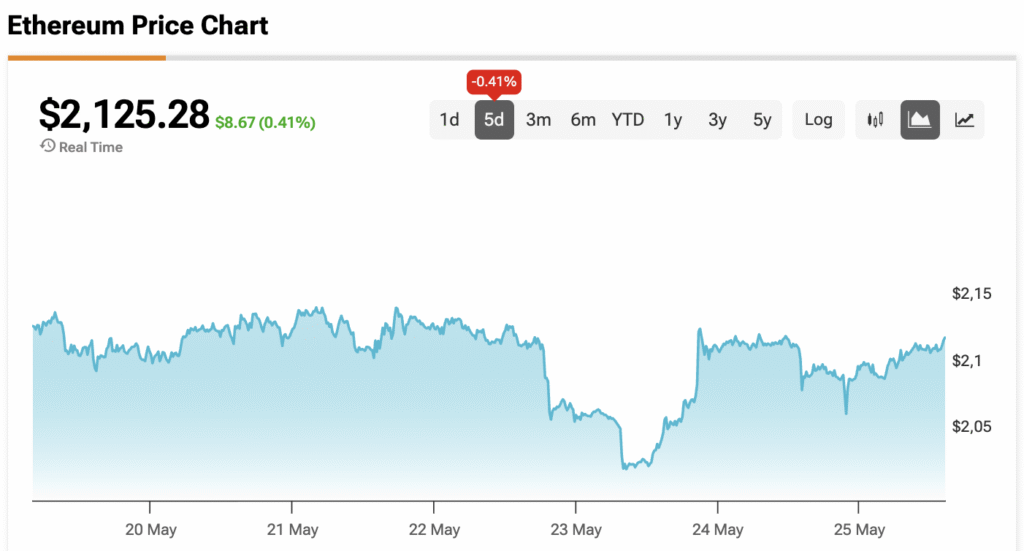
One large trading account used heavy leverage to bet that Ethereum’s price would drop below $2,094. The trade has quickly run into trouble because the token bounced back toward $2,115 following a brief weekend drop. If the price climbs just a bit higher to $2,150, the platform will automatically close the trade.
This forced closure could wipe out the entire position and cause over $1 million in quick losses. This highly risky trade shows that some wealthy individuals still expect ETH to fall. This negative outlook persists even though global political tensions are easing and the asset is trying to build a new price floor.
ETH Foundation Changes Spending Plans to Ensure Long-Term Focus
Vitalik Buterin came out to defend his group after several main researchers left the organization. He explained that his team is focusing tightly on a few critical goals like privacy and network security. The group has faced a lot of criticism from community members who say that regular ETH token sales hurt the price during weak market cycles.
Data shows that the organization already sold roughly 20,000 ETH tokens this year to raise $45 million. However, the group still holds more than 170,000 ETH tokens in its main reserves. The new promise to slow down these sales is meant to calm fears about unnecessary market pressure.
Institutional Fund Managers Cut Down on ETH Exposure
Big finance companies have been losing faith in Ethereum throughout the year. Several large investment groups chose to pull their money out after the asset showed weak performance compared to Bitcoin (BTC-USD). For example, Goldman Sachs (GS) cut its holdings in local exchange-traded funds by roughly 70%.
At the same time, specialized crypto investment funds have seen more than $945 million pull out of Ethereum products since the start of the year. Even some well-known, long-time backers have admitted to selling off their personal Ethereum holdings. Despite this trend, some market analysts say the underlying Ethereum ecosystem remains strong because it still handles most of the real activity and stablecoins in crypto.
At the time of writing, Ethereum’s price is sitting at $2,125.28.
Copyright © 2026, TipRanks. All rights reserved.
Disclaimer: The content of this article solely reflects the author's opinion and does not represent the platform in any capacity. This article is not intended to serve as a reference for making investment decisions.
You may also like
Korea's "Memory Chip Giants" Support Bullish Stock and FX Outlook! Citi Trading Head Favors Contrarian KRW Positioning Around 1400
The recent weakness of the Korean won may only be temporary, as the growth of South Korea’s chip industry is expected to boost the won and support its recovery against the US dollar before the end of the year. The Federal Reserve's hawkish stance and inflation concerns related to rising oil prices could cause the won to temporarily fall below the 1,400 won per US dollar level in the short term.
From "higher for longer" to "the new normal for longer": Oil price shocks combined with the AI bond issuance boom, the financial market ushers in the 5% U.S. Treasury yield as the "new normal"
The borrowing costs of governments around the world continue to rise, with investors demanding higher returns to attract them to hold long-term bonds. The increase in US Treasury yields even prompted Treasury Secretary Scott Besant to announce an expansion of long-term Treasury buybacks—but this intervention failed to prevent the 10-year US Treasury yield from surpassing 5%, reaching its highest level in nearly 20 years.
Oil prices and interest rates are rising, but US stocks still trust TACO
Oil prices have surpassed $100, the Federal Reserve is raising interest rates, and tensions in the Strait of Hormuz persist—Wall Street's bet on the "Trump will always back down" TACO trade is facing its most dangerous moment. The unexpected resilience of US stocks has actually reduced Trump's motivation for reconciliation; the real pressure valve lies in bond yields approaching the 4.946% warning line. Behind-the-scenes negotiations are reportedly ongoing, but this time, can the market's patience last until Trump changes course?
Claude leads 26% of R&D, Anthropic raises heated discussion on "AI developing AI" with its "AI slowdown theory"! The RSI training paradigm is catalyzing a major expansion in computing power demand.
Anthropic PBC's Claude chatbot has driven more than a quarter of the company's AI research and development work. The company found that Claude "led" 26% of Anthropic's R&D efforts and collaborated with employees to complete about 90% of the work. Anthropic plans to introduce third-party evaluators within the company and grant them access to internal processes, systems, and data to help track the progress of AI development.
Crypto prices
More


