Bitget App
Trade smarter
Buy cryptoMarketsTradeFuturesStocksEarnInstitutionAI & More
While Ripple Strengthens US Market Position, XRP Left Behind With 41% Downside Risk

While Ripple Strengthens US Market Position, XRP Left Behind With 41% Downside Risk

CryptoNewsNetCryptoNewsNet2026/05/27 19:27
By:CryptoNewsNet
Back to the list

While Ripple Strengthens US Market Position, XRP Left Behind With 41% Downside Risk

While Ripple Strengthens US Market Position, XRP Left Behind With 41% Downside Risk image 0  u.today 16 m
While Ripple Strengthens US Market Position, XRP Left Behind With 41% Downside Risk image 1

While fintech giant Ripple strengthens its position in the United States, $XRP is facing the risk of a large-scale technical pullback as the Bollinger Bands indicator on major timeframes by TradingView signals the risk of a 41% decline in the token's price to $0.77.

The situation exposes the main paradox of the current cycle - institutional interest in the ecosystem is growing, but the token itself is losing its key role in the company's commercial settlements.

Bollinger Bands highlight utility shift for $XRP

Technical pressure on the asset has been building for months. On the daily chart, the Bollinger channel is expanding while its lines slope downward, confirming the strength of sellers below the $1.32 level.

On a larger scale, this impulse is a continuation of the long-term downtrend that has been in place since July 2025 and within the weekly timeframe, the price is trapped below the middle line around $1.41-$1.44, while the lower boundary of the corridor has moved to $1.11.

However, the main threat is hidden on the monthly chart, where a bearish order block has formed, with its target aligning with the lower Bollinger Band at $0.77.
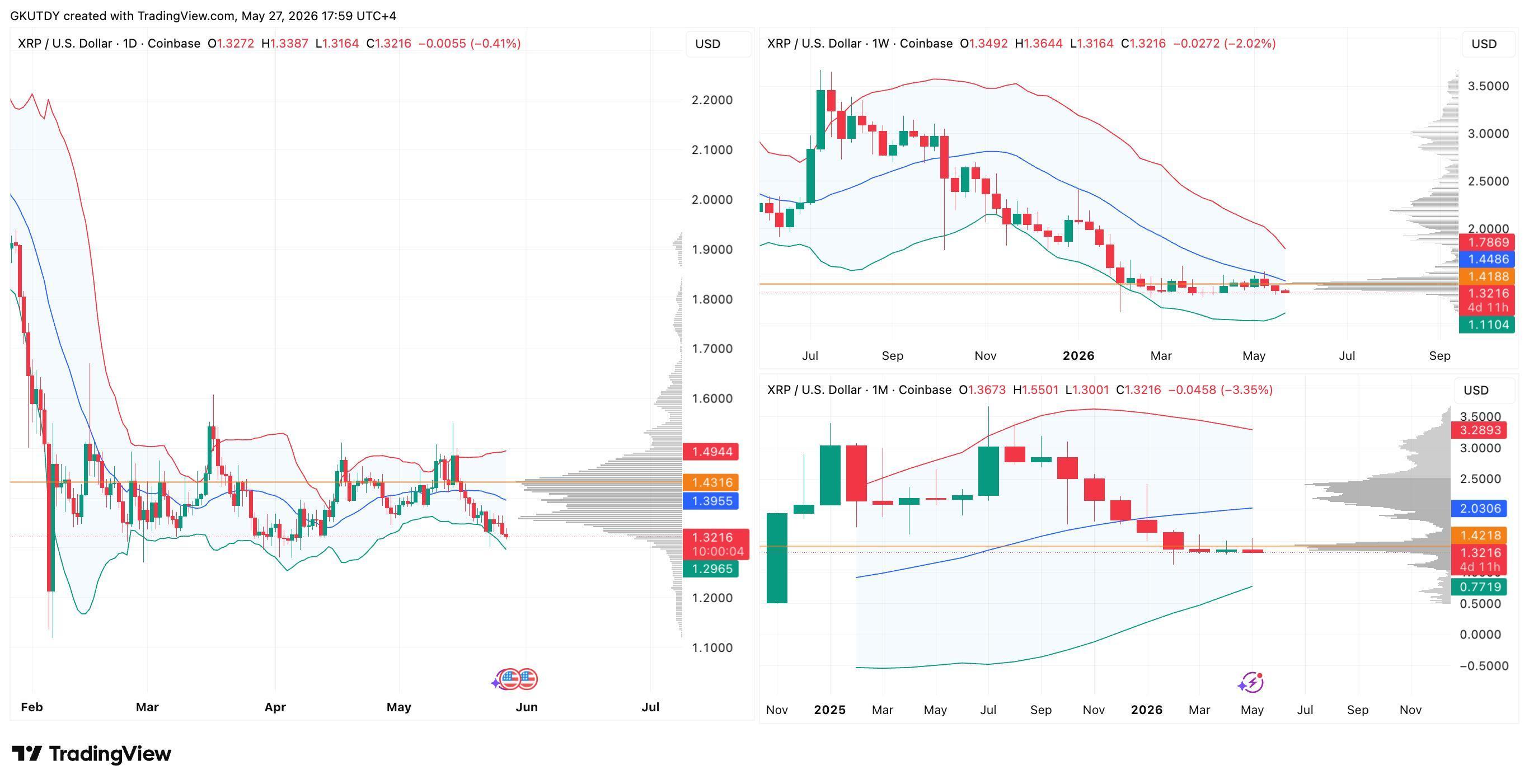
While Ripple Strengthens US Market Position, XRP Left Behind With 41% Downside Risk image 2 $XRP price action on daily, weekly, and monthly timeframes, Source: TradingView

The fundamental backdrop partly softens these risks, preventing the market from entering a phase of panic selling. As of today, net capital inflows into spot US $XRP ETFs have exceeded $1.4 billion, while the CLARITY Act, a bill designed to finally establish the legal status of digital assets, is advancing in the U.S. Senate.

However, behind the facade of these positive developments lies a structural change in Ripple's business, which appears to be depriving the token of support. As the company launches new institutional services, including under the Ripple Prime brand, it is increasingly moving commercial flows to the RLUSD stablecoin and fiat gateways. As a result, $XRP's direct utility value is being diluted.

Against this backdrop, average $XRP investor returns have now fallen to their lowest point since 2020, according to Santiment. If local support in the $1.30-$1.11 zone is broken, the technical vacuum could quickly send quotes toward the calculated target of $0.77.


0
0

Disclaimer: The content of this article solely reflects the author's opinion and does not represent the platform in any capacity. This article is not intended to serve as a reference for making investment decisions.

Understand the market, then trade.
Bitget offers one-stop trading for cryptocurrencies, stocks, and gold.
Trade now!

You may also like

From Saving Credit Suisse to Considering Cross-border Mergers: UBS (UBS.US) Faces a "Capital Siege", Is the Next Step Joining Forces with Wall Street?

As Switzerland's largest bank faces pressure from stricter capital requirements, several major international banks have approached UBS regarding potential mergers or other collaborations.

智通财经•2026/09/28 01:46
From Saving Credit Suisse to Considering Cross-border Mergers: UBS (UBS.US) Faces a "Capital Siege", Is the Next Step Joining Forces with Wall Street?

Volatility Divergence Between Individual Stocks and Index! Popular US Stock Trading: Go Long on Stock Options, Hedge with Index Options

With the divergence in the AI narrative, drastic fluctuations in oil prices, and U.S. Treasury yields soaring to a 20-year high, the degree of dispersion among S&P 500 constituents has risen to the 95th percentile in 30 years. As single-stock volatility continues to compress, entry costs have become relatively low, and the volatility gap between individual stocks and the index has widened again. This has opened a rare window for dispersed trading strategies such as "long single-stock options + short index options."

华尔街见闻•2026/09/28 01:21

US Treasury yield curve approaches inversion! Is the bond market questioning the outlook for the US economy?

The U.S. Treasury yield curve is rapidly approaching the inversion threshold—the spread between the 10-year and 2-year yields has narrowed to historic lows, and bank stocks have responded with a technical correction. This warning signal, regarded as a "hard rule" for recession, is tearing apart market consensus: some are betting the curve will soon invert, while others firmly believe economic resilience will mitigate the risk. Amid ongoing Federal Reserve rate hikes, the outcome of this bond market game may reshape the narrative logic of the entire asset market.

华尔街见闻•2026/09/28 00:31
US Treasury yield curve approaches inversion! Is the bond market questioning the outlook for the US economy?