
Crypto liquidations hit $935M as Bitcoin price dips to $72.6K

Bitcoin (BTC) sold off into the early Asian Trading session on Thursday as the drop to $72,600 produced significant liquidation of leveraged positions across the crypto market.
Key takeaways:
- Bitcoin price deviated 4.5% from its daily high of $76,050 on Wednesday, dropping to a six-week low of $72,620.
- Overleveraged crypto traders were liquidated out of nearly $935 billion in the past 24 hours.
- Traders say Bitcoin needs to hold above $70,000 to avoid a deeper correction toward $65,000 or lower.
Bitcoin price hits a 6-week lows below $73,000
The BTC/USD pair fell as low as $72,620 on Thursday, reversing all gains made since April 13 after the US reportedly carried out a new wave of military strikes on Iran.
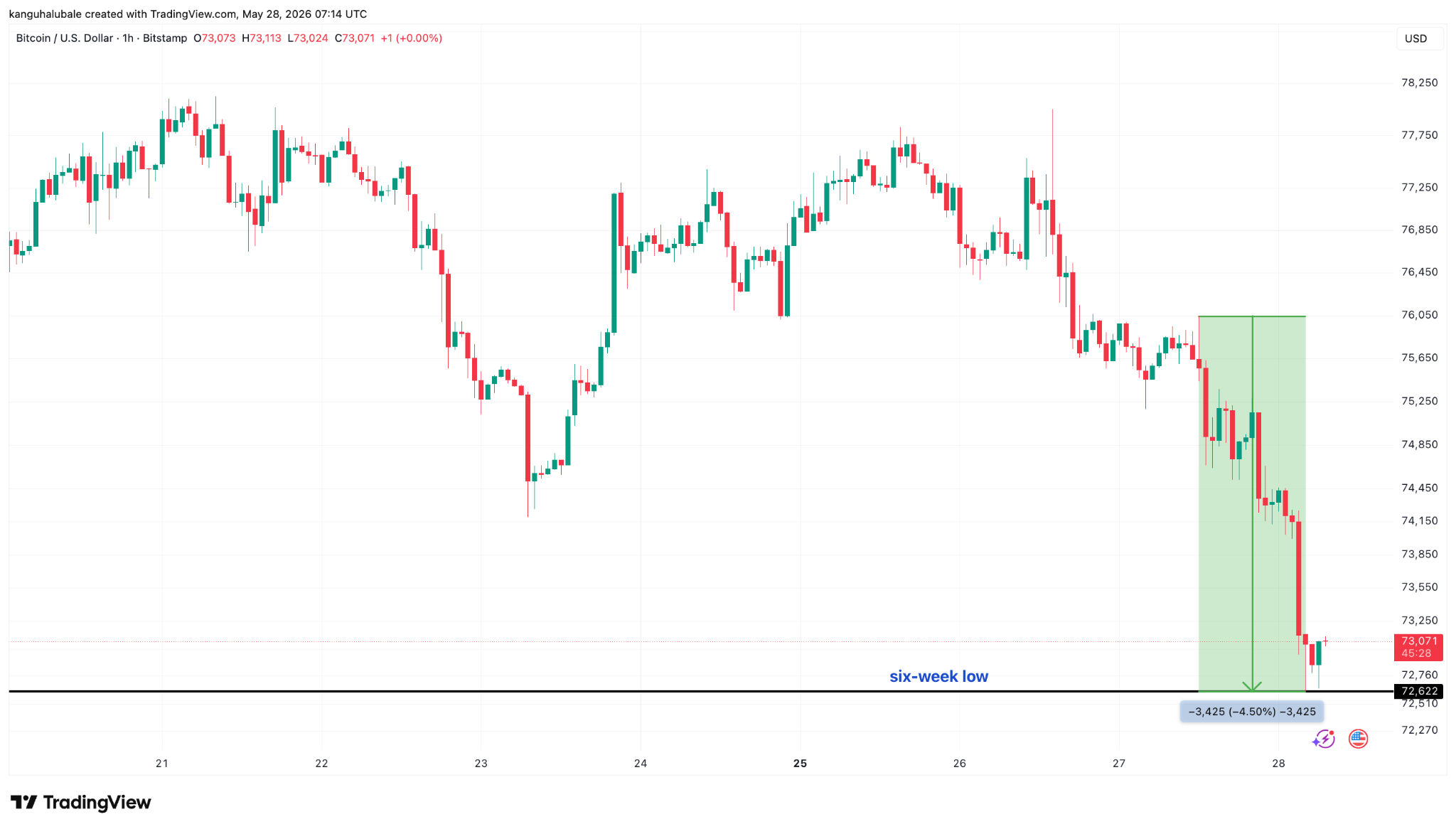
BTC/USD 1-hour chart. Source: Cointelegraph/
This was accompanied by significant drops in other top-cap cryptocurrencies, wiping out more than $80 billion from the crypto market over the last 24 hours.
The derivatives market suffered a similar fate. More than $874 million in long positions were liquidated, with Bitcoin accounting for $348.5 million of that total. Ether (ETH) followed with $228.5 million in long liquidations.
Across the board, a total of $935.6 million was wiped out of the market in short and long positions, as shown in the figure below.
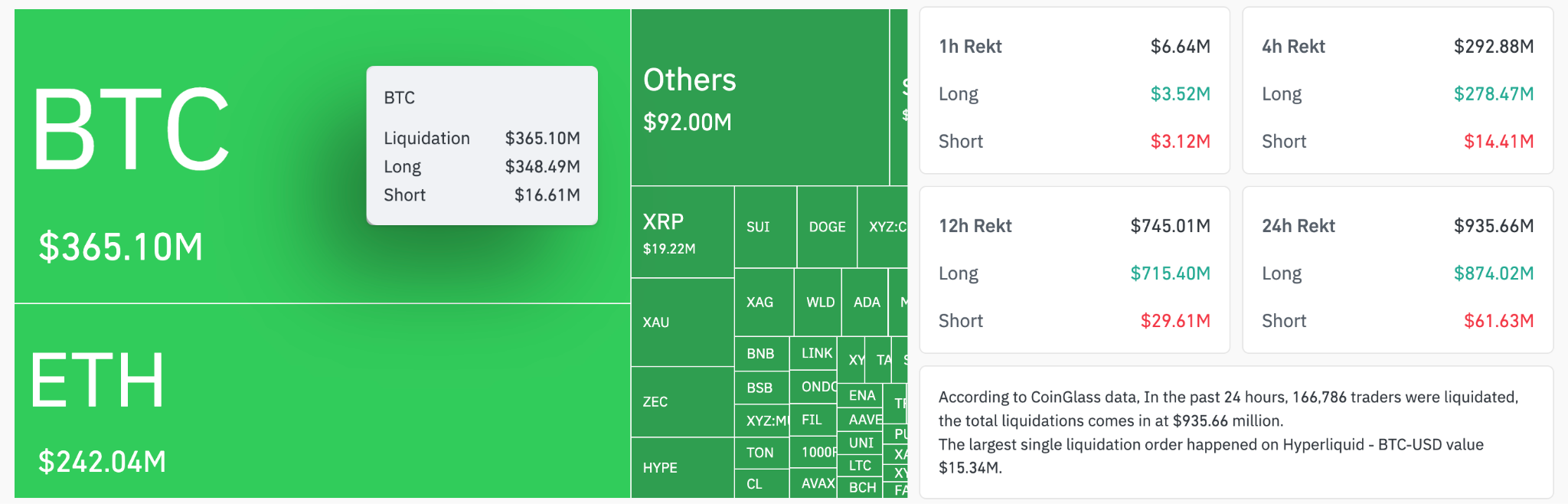
Crypto liquidations (screenshot). Source: CoinGlass
The single biggest liquidation occurred on Hyperliquid, where a $15.34 million BTC-USD long position was closed.
Additional data from CoinGlass showed a slight drop in Bitcoin’s futures open interest (OI) over the last 24 hours across all exchanges. The decline was more pronounced on the Chicago Mercantile Exchange and BingX, whose Bitcoin OI has fallen by 9.8% and 9% over the last 24 hours, respectively.
Even though futures longs (buyers) and shorts (sellers) are always matched, declining OI suggests reduced leverage and market participation, often signaling bearish sentiment. For example, a 30% decrease in OI between Jan. 14 and Feb. 6 was accompanied by a 38% drop in BTC price.
Meanwhile, US-based spot exchange-traded funds (ETFs) continue to post heavy outflows, indicating waning institutional interest. These ETFs have recorded outflows for eight consecutive days, totaling $2.6 billion. The $733 million in net outflows recorded on Wednesday marked the largest withdrawal since Jan. 29.
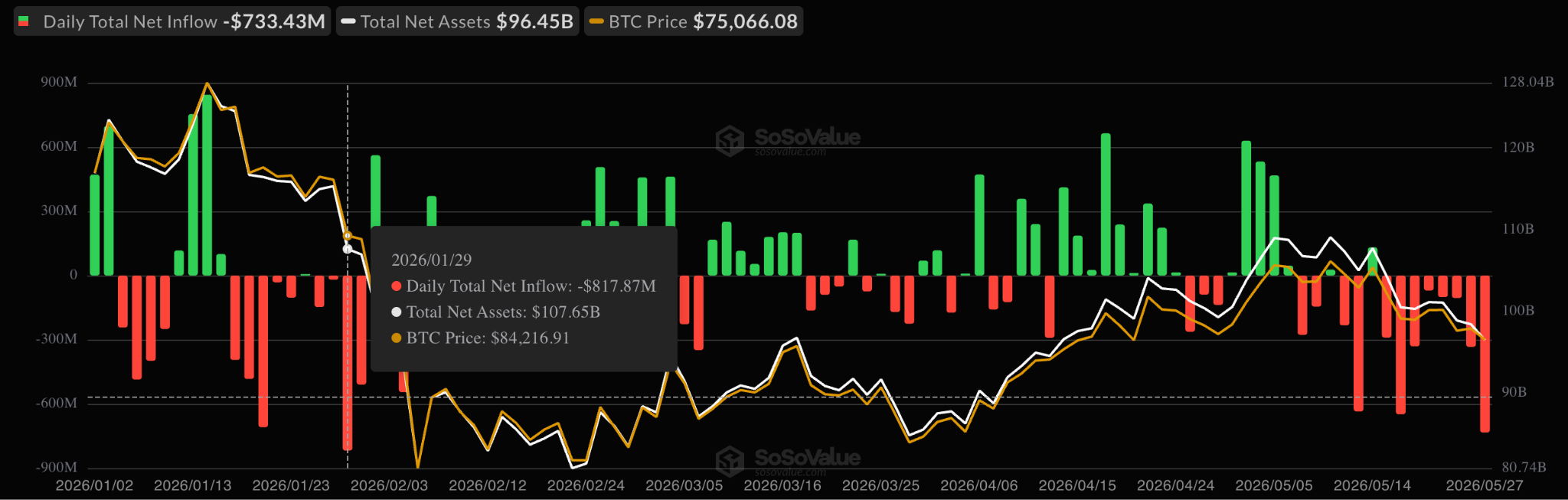
Spot Bitcoin ETF flows chart. Source: SoSoValue
As Cointelegraph reported, global Bitcoin investment products also posted outflows totaling $1.3 billion last week, adding to BTC’s headwinds.
$70,000 is now Bitcoin’s last line of defence
Bitcoin’s 4% drop over the last 24 hours has seen it lose the crucial $75,000 support, as the bears gained momentum.
Traders are now watching key support areas on the downside, including the 100-day simple moving average (SMA) at $73,000 and the demand zone above $70,000.
“Renewed US-Iran fighting overnight sent us lower with mass liquidations,” analyst Nicrypto said in a Thursday X post, adding:
“We have fallen well below the previous $75K support zone & are now at the critical $73K support.”
MN Capital founder Michael van de Poppe referred to Bitcoin’s latest sell-off as a “standard approach” typical of the final days of the month, “where markets correct as rebalancing takes place among asset managers.”
The analyst said, “Bitcoin showing weakness isn't a recipe for a new low,” unless it drops under the $71,400-$73,400 support area as shown in the chart below.
“This is my last stance of an important support zone; otherwise, I'd expect lower $60Ks to be tested for support.”
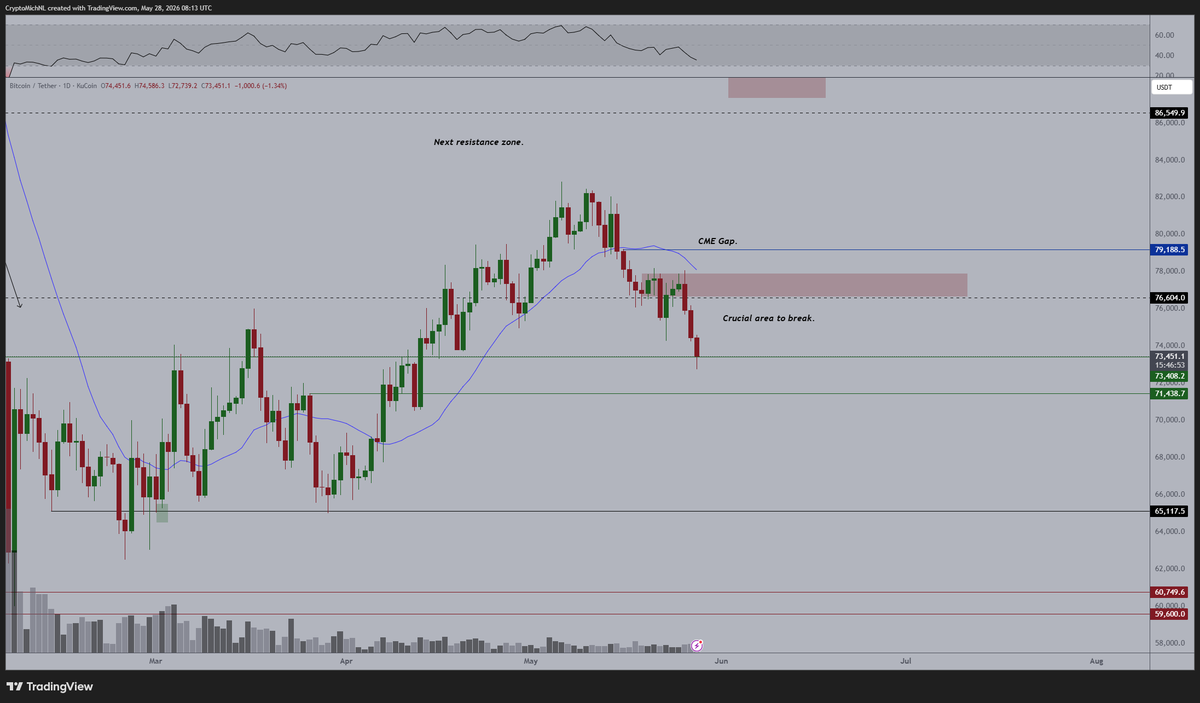
BTC/USD daily chart. Source: Michael van de Poppe
A daily candlestick drop below $70,000 could trigger another sell-off episode toward the target of an inverted V-shaped pattern at $65,000, as shown on the daily chart below. This would represent an 11.4% drop from the current price.
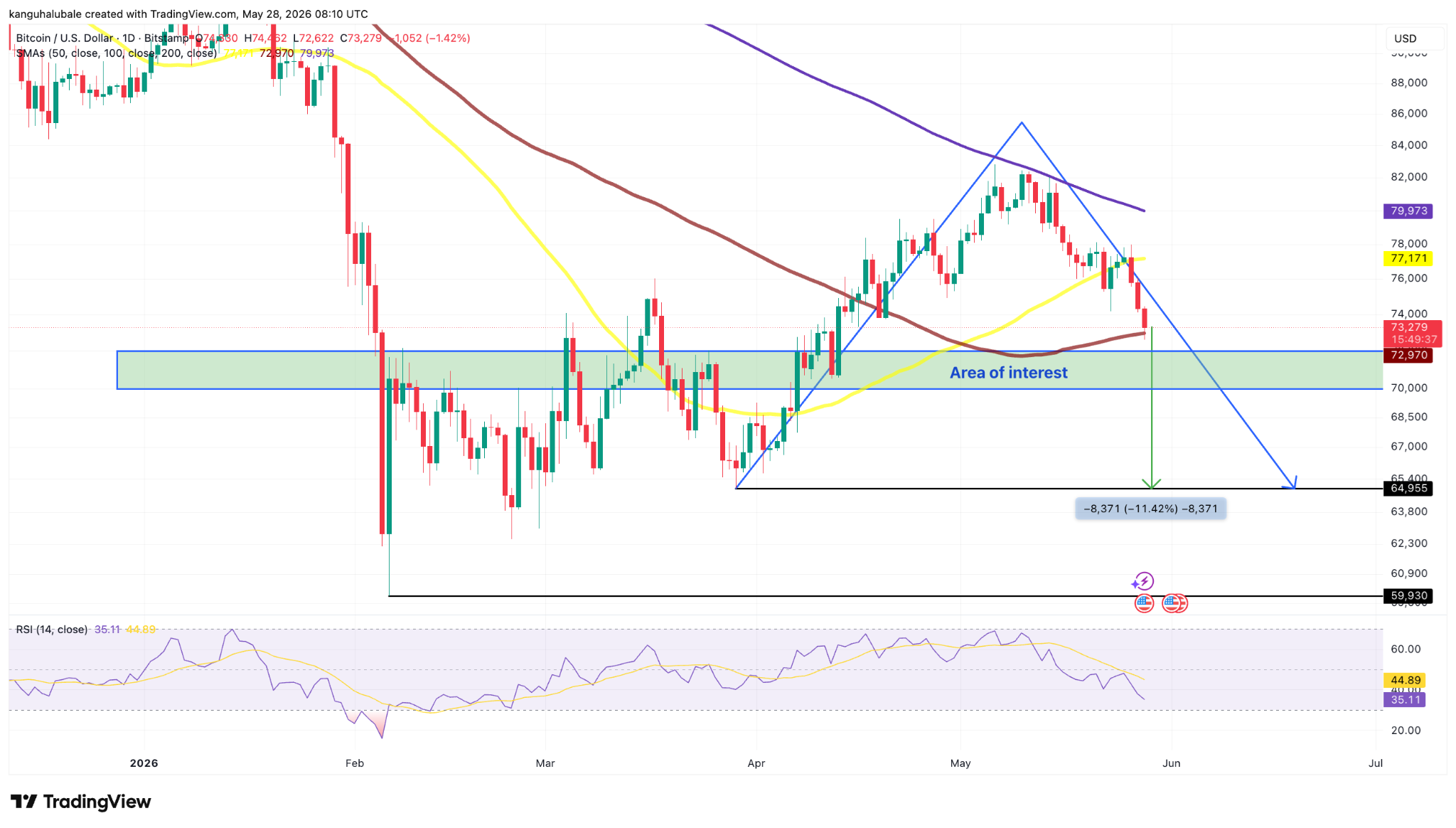
BTC/USD 1-day chart. Source: Cointelegraph/
As Cointelegraph reported, after losing support at $74,000-$76,000, BTC may then descend to the support line near $70,500, which is likely to attract buyers.
Disclaimer: The content of this article solely reflects the author's opinion and does not represent the platform in any capacity. This article is not intended to serve as a reference for making investment decisions.
You may also like
Delta Air Lines Lowers Profit Forecast as Fuel Cost Increase Outpaces Ticket Price Growth
Delta Air Lines lowers its annual profit forecast due to a $6 billion increase in fuel costs; sharply rising ticket prices test travelers’ willingness to pay. The company’s refinery business is expected to generate $700 million in profits to help offset the impact of fuel costs. Rajesh Kumar Singh, Reuters Chicago, October 9 – Delta Air Lines (DAL.N) lowered the midpoint of its annual profit forecast by nearly a quarter on Friday, as surging fuel costs offset the positive effects of strong travel demand and higher ticket prices. This downgrade highlights the increasingly severe challenges faced by U.S. airlines: if fuel prices remain high, will passengers be willing to accept further price hikes? Airlines have already increased ticket prices considerably this year, and analysts warn that further hikes could test travelers’ willingness to continue spending. The Atlanta-based airline expects its annual fuel spending to increase by about $6 billion compared to last year. Its third-quarter fuel expenses jumped 62% year-on-year to $4.1 billion, more than $500 million higher than July’s expectations. When asked about the reasons for the revised forecast, Delta CFO Erik Snell told reporters, “It’s entirely a fuel issue,” noting that crude oil and refined jet fuel prices have both increased since the summer. Delta now expects adjusted annual earnings per share of $5.10–$5.60, down from its July forecast of $6.50–$7.50. According to data from London Stock Exchange Group (LSEG), the new median of $5.35 is below analysts’ average forecast of $5.46. The company expects an adjusted pre-tax profit of $4.5 billion in 2026. According to LSEG, third-quarter adjusted earnings per share were $1.72, slightly below the average analyst forecast of $1.76. Its adjusted operating margin dropped from 11.1% to 9.4%. Delta is the first major U.S. airline to report third-quarter earnings; its competitors United Airlines (UAL.O), American Airlines (AAL.O), and Southwest Airlines (LUV.N) will release their results later this month. Ticket Price Increases According to the U.S. Bureau of Transportation Statistics, in the first eight months of 2026, U.S. airlines spent $42.9 billion on fuel for scheduled flights, nearly $13.2 billion more than in the previous year, despite a slight decrease in fuel consumption. Strong demand and limited seat growth have helped airlines pass higher fuel costs onto passengers. According to the U.S. Bureau of Labor Statistics’ Consumer Price Index, over the five months ending in August, average U.S. airfares increased about 25% year-on-year. With fuel prices remaining high and industry capacity growth set to further accelerate in the fourth quarter, analysts are closely watching whether airlines including Delta can raise ticket prices further without suppressing travel demand. Deutsche Bank analysts expect the industry’s proportion of fuel costs recouped through revenue to decline in the fourth quarter, with full recovery not expected until early 2027. Delta says demand remains strong. Snell noted that with fourth-quarter bookings already near 60%, the company expects revenue to increase by around 20% year-on-year. According to LSEG, Delta forecasts fourth-quarter adjusted earnings per share of $1.15–$1.65, with the median $1.40 roughly in line with analysts’ average expectation of $1.39. Refinery Advantage Delta holds an advantage over other major U.S. airlines: it owns a refinery near Philadelphia, which Snell expects will generate $700 million in profits this year. “We own a refinery, which gives us a hedge—part hedge—on fuel prices that no other airline has,” he said. Delta acquired the Monroe refinery in 2012, which processes crude oil into jet fuel and other products. While Delta must still pay market prices for fuel consumed by its airline operations, refinery profits remain within the company. When the price spread between crude oil and refined products widens, this helps offset fuel cost pressures for airlines sourcing externally. However, this protection depends on refinery margins; when margins fall, the refinery may also incur losses. Nevertheless, the refinery can only partially ease the impact of rising fuel prices. Even with an expected refinery benefit of 40 cents per gallon, Delta forecasts its fuel cost to rise from $3.61 per gallon in the third quarter to $4.25 per gallon in the fourth quarter. Snell said fuel costs are expected to remain high for some time. “Ultimately, fuel prices will come down. As to when, we’re not sure,” he said. (For the convenience of non-native English speakers, Reuters offers automated translations of its reports into several other languages. Due to possible errors or lack of context in automated translations, Reuters does not guarantee the accuracy of automated translation texts and provides them only for reader convenience. Reuters assumes no responsibility for any damages or losses from use of automated translation featur
SUI Price Pullback Sparks Debate: Correction or Next Buying Opportunity?
"SaaS Apocalypse" Debunked? Autodesk (ADSK.US) and Intuit (INTU.US) Lead Growth Against the Trend as Wall Street Reprices the "AI Eating Software" Narrative
This week, Autodesk and Intuit are expected to record their strongest weekly gains in months, defying pressure on the overall technology sector. This strong performance signals a renewed optimism in the market regarding the growth prospects of the SaaS (Software as a Service) industry.
Starlink Targets the US Mobile Communication Market, SpaceX (SPCX.US) Opens New Growth Opportunities: Wall Street Focuses on the Reshaping of the Telecom Industry Landscape
Combining the existing satellite capacity, SpaceX is supplementing its capabilities to upgrade from “occasional emergency connectivity” to “daily mobile service.” The satellite network provides wide-area coverage and fills ground blind spots, while low-frequency terrestrial networks improve connectivity inside buildings and in environments with complex obstructions. The two form a complement to each other.
Crypto prices
More


