
Solana Institute CEO says CLARITY Act must shield open-source developers

Solana Institute CEO Kristin Smith is urging the US Senate to pass the CLARITY crypto market structure bill with developer protections intact, arguing that open-source developers and blockchain infrastructure providers should not be regulated as financial intermediaries.
In a thread on the X social media platform, Smith said the market structure legislation “has a real shot at passing the Senate,” making it critical for lawmakers to preserve protections for software developers.
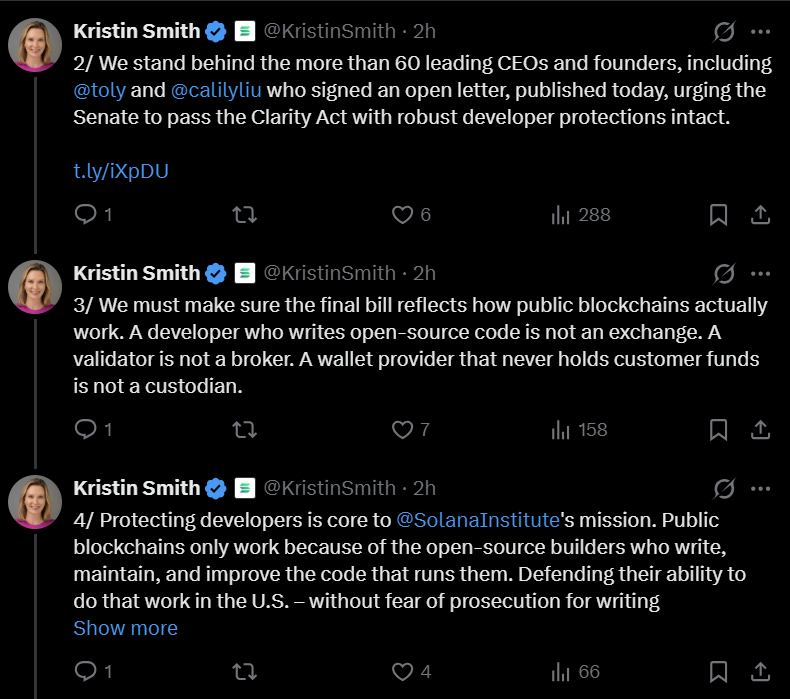
Source: Kristin Smith on X.com
Smith said more than 60 crypto CEOs and founders, including Solana co-founder Anatoly Yakovenko, signed an open letter urging the Senate to maintain robust developer protections in the CLARITY Act.
She said that open-source developers, validators and non-custodial wallet providers do not control user funds or execute transactions and therefore should not be treated as brokers or custodians.
Smith pointed to the Blockchain Regulatory Certainty Act (BRCA), which would provide legal certainty for noncontrolling software developers and blockchain infrastructure providers that do not custody customer assets or control transactions.
Introduced in January by Senators Cynthia Lummis and Ron Wyden, the bipartisan BRCA aims to prevent open-source developers from being classified as “money transmitters” solely for publishing software code.
The CLARITY Act cleared the Senate Banking Committee in May and was recently placed on the Senate Legislative Calendar, setting the stage for a possible floor vote later this summer.
Related: CLARITY Act will help reshore US crypto industry, attorney says
Echoes SEC commissioner Peirce's calls for developer protections
Smith’s comments echo recent remarks by US Securities and Exchange Commission Commissioner (SEC) Hester Peirce, who argued last week that publishing open-source blockchain code is protected speech and that developers should not be treated as financial intermediaries simply because others use their software.
Speaking at the IC3 Blockchain Camp at Princeton University, Peirce said that “many blockchain projects involve publishing open-source software, which is generally a protected activity under the First Amendment.”
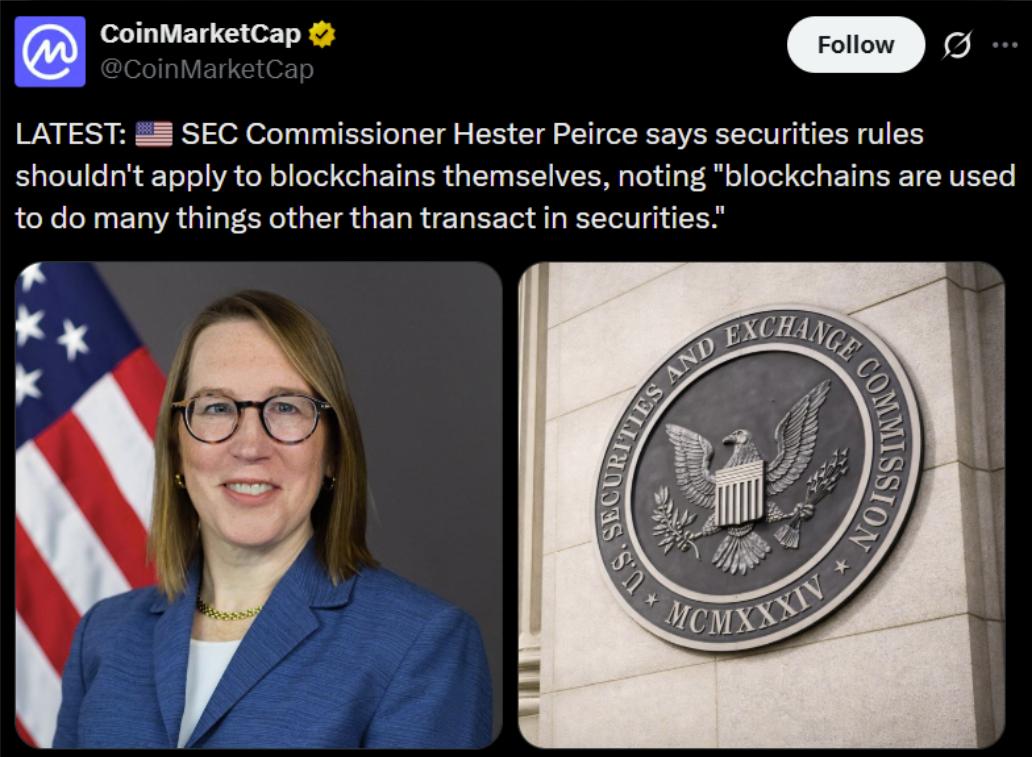
Source: CoinMarketCap on X.com
The SEC’s mandate regarding digital assets has evolved significantly under current Chair Paul Atkins, who vowed to end the agency’s “regulation through enforcement” approach to the industry.
Related: US lawmakers push back on Labor Department plans to include crypto in 401(k)s
Disclaimer: The content of this article solely reflects the author's opinion and does not represent the platform in any capacity. This article is not intended to serve as a reference for making investment decisions.
You may also like
XRP Pundit: First Thing You Should Do When You Become a Crypto Millionaire
 VIPTradFi Focus: Where Does the RWA Market Stand Today?
1. Crypto outperformed traditional equity indexes following the rate hike, but elevated interest rates remain a key constraint on cross-asset allocation. From September 12 to 18, BTC, ETH, and SOL gained 4.83%, 3.84%, and 9.96%, respectively, while the S&P 500 edged down 0.08%. The U.S. Dollar Index rose 1.11%, and the 10-year U.S. Treasury yield closed at approximately 4.998%. Improving risk appetite is therefore coexisting with elevated discount rates, raising the bar for RWA allocation: investors need to compare not only returns on the underlying assets, but also on-chain liquidity and collateral efficiency. 2. Growth in tokenized equities is occurring even as the overall RWA market remains under pressure. As of September 18, Distributed Asset Value across RWAs stood at $38.503 billion, down 1.13% week over week, while tokenized equities reached $3.056 billion, up 6.03%. This week's data are better explained by capital reallocating across different RWA segments than by a broad-based expansion of the entire RWA market. 3. For exchanges, the opportunity lies in connecting spot holdings, collateral, and derivatives. Reality's distributed asset value stands at approximately $155 million, while eligible rTokens can already be used within Bitget's UTA margin framework. Across CoinGlass's verifiable sample of 177 TradFi instruments, open interest reached approximately $11.498 billion, up 2.06% week over week, even as weekly trading volume declined 7.60%. The medium-term opportunity remains intact, but deeper utilization will depend on liquidity, collateral use, and sustained trading activity. 4.Assets to watch: BTC, ETH, SOL, NEAR, ZEC, gold, tokenized U.S. equities, COST. 5.Key metrics to watch: rToken collateral utilization, the durability of TradFi open interest and trading volume, and next week's employment and consumer data.

Gold prices fall Rs 1,331/10 gram, silver dips Rs 1,600/kg as Mideast tensions outweigh oil fall: Key levels to track
Strategists Say Market's ‘Wall of Worry' Is Healthy, Not a Warning Sign

Crypto prices
More


