
Bitcoin doesn't need Ethereum-style yield, says Strategy's Michael Saylor

Strategy executive chairman Michael Saylor said Bitcoin does not need staking, inflation or protocol-based yield mechanisms, arguing returns should come from financial products built around BTC.
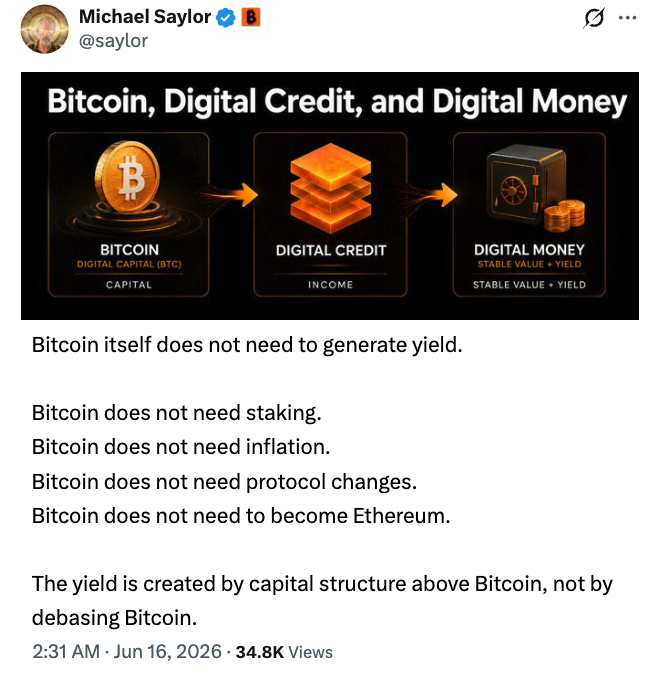
In an X post on Tuesday, Saylor outlined a five-layer “Digital Asset Stack” positioning Bitcoin (BTC) as the base for credit, money, yield and equity structures.
Saylor said Bitcoin should remain “pure digital capital” and that it “does not need to become Ethereum” to generate investor returns.
The framework reinforces Strategy's approach to Bitcoin as a treasury reserve asset, where returns are generated through financial products built around the company's Bitcoin holdings, the largest among publicly listed firms.
Digital credit and yield layer
Saylor's framework is centered around "digital credit" as financial instruments built around Bitcoin holdings, designed to generate returns while reducing exposure to BTC price volatility.
Under this structure, Bitcoin serves as collateral, while equity absorbs most of the price risk and credit instruments receive more stable returns.
Source: Michael Saylor
Saylor repeatedly referenced Strategy-style securities such as STRC, the company's perpetual preferred stock, positioning them as a key example of “digital credit.” In this framing, STRC-like instruments are not just company products but examples of a broader asset class built on top of Bitcoin through capital markets engineering.
Saylor argues credit instruments can smooth Bitcoin's price swings
Saylor said Bitcoin’s volatility is “not a flaw,” framing it as a natural feature of “high-energy capital” that can move sharply because it is scarce, global and traded around the clock. In his model, instruments like STRC are designed to damp those price swings by sitting above Bitcoin in the capital structure.
While Saylor did not directly discuss STRC’s volatility in the X post, he said credit instruments can experience varying levels of risk depending on factors such as market stress, liquidity and investor demand.
Related: Saylor’s Strategy buys 1,587 BTC for $100M, holdings hit 846.8K
“The important point is not that digital credit always has one fixed volatility number. It does not,” Saylor said.
Strategy’s preferred stock STRC closed at $95.20 on Monday, down 1.45%, according to Nasdaq data. The stock has a $100 stated par value and is structured to trade near that level.

Cointelegraph’s Ciaran Lyons (left) and Strategy founder Michael Saylor (right) at BTC Prague. Source: Cointelegraph/YouTube
The remarks reinforce Saylor's framing of Bitcoin as "digital capital" and Strategy's role in issuing "digital credit" built around it, including the view that Bitcoin sales are sometimes required to support the structure.
“If the company's policy is that we won't sell the Bitcoin, then the credit won't have value and the equity won't have value,” Saylor told Cointelegraph at the BTC Prague conference last week.
Magazine: Bitcoin, the ‘canary in the coal mine,’ XRP transaction demand falls 91.5%: Market Moves
Disclaimer: The content of this article solely reflects the author's opinion and does not represent the platform in any capacity. This article is not intended to serve as a reference for making investment decisions.
You may also like
The "debt black hole" behind the AI boom: $1.2 trillion external financing may be needed in the next five years
The rapid surge of AI is creating an unprecedented "debt black hole": according to Bank of America estimates, total capital expenditure for building AI data centers between 2025 and 2030 will reach as much as $5 trillion, with external financing needs of core cloud giants alone reaching $1.2 trillion to $1.5 trillion. Free cash flow is already running low for giants such as Amazon and Meta, while Nvidia and Broadcom have quietly taken on the role of "implicit guarantors"—marking the beginning of a capital gamble that is set to reshape global credit markets.
Analyst Makes Bold Prediction: Micron (MU.US) Expected to Surpass Microsoft (MSFT.US) in Fiscal Year 2027 Profit; Memory Prices Are the Key Factor
Is Micron (MU.US) expected to earn a net profit of $35 billion in a quarter, surpassing Microsoft's (MSFT.US) profits?
Warning Signs of US Stock Market Crash Reappear as in 2018 and 2022? Fed Tightening and US Treasury Supply Hit Amid Worsening Market Breadth, Liquidity Crisis May Be Approaching
Liquidity pressures may not yet be apparent on the surface of the market, but as market breadth in both stock and bond markets continues to deteriorate, these pressures are steadily accumulating internally.
X Finance Bull highlights $3,300 XRP price model filed with SEC
Crypto prices
More


