
Semiconductor exports up 206%! AI cycle canary sings again: Why does Korea's export boom continue?

On June 11, data released by the Korea Customs Service showed that in the first 10 days of June, South Korea's total exports amounted to $28.635 billion, marking an 85.9% year-on-year increase and setting a new record for the highest export value for the first 10 days of any month. This figure surpassed the previous high of $25.2 billion set in April this year. During the same period, the trade surplus reached $5.282 billion, with both exports and imports expanding significantly.
Even after eliminating the calendar effect of 1.5 additional working days year-on-year (totaling 7 days), daily average exports—which reflect actual endogenous momentum—still reached $4.09 billion, a robust 46.1% increase compared to the same period last year.
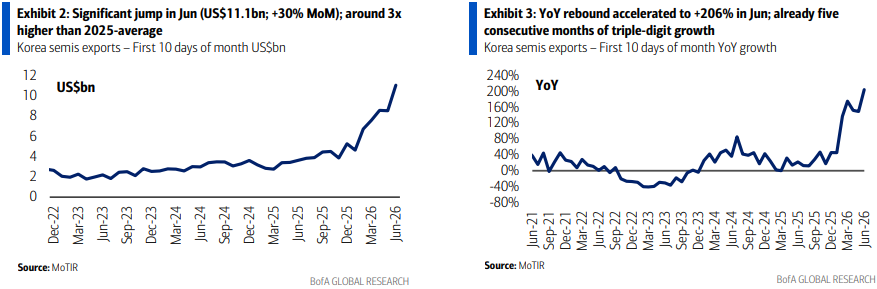
In this historic export boom, semiconductors played an absolutely dominant role. In the first 10 days of June, South Korea’s semiconductor exports soared to $11.068 billion, a staggering year-on-year increase of 205.8%, with their share of total exports rising to 38.7%—up 15.1 percentage points from a year ago—marking five consecutive months of triple-digit growth. This is also the first time Korea’s semiconductor exports surpassed $10 billion in just 10 days. In addition, exports of computer peripheral devices jumped 259.4% year-on-year. South Korea's strong export performance further demonstrates that the current AI-driven global technology cycle has not yet peaked; on the contrary, it is still accelerating.
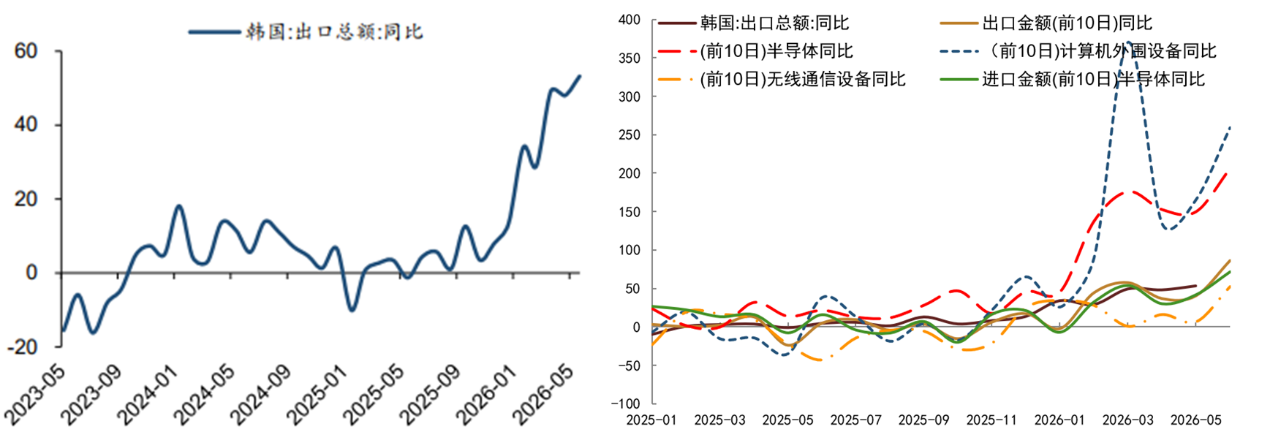
In terms of trade flows, South Korea’s exports saw comprehensive growth across all major economies: exports to its largest trading partner China doubled, increasing by 101.4% to $6.184 billion; exports to the US grew by 54.4% to $4.535 billion; and shipments to Vietnam and the EU surged by 102.9% and 46.0% respectively.
Global Canary Continues to Validate: AI Hardware Boom Cycle Accelerates
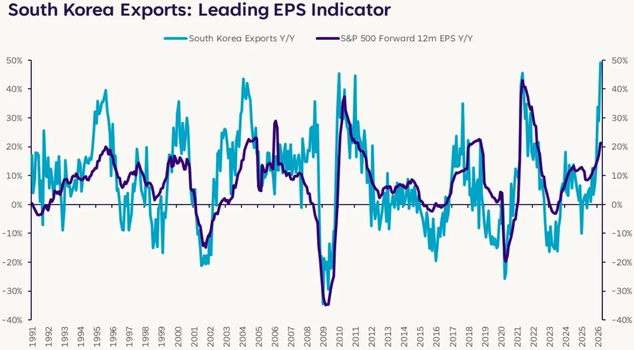
The South Korean economy is highly dependent on exports, which is why its trade data is often seen as the “canary in the coal mine” for the global economy. As a core supplier of global memory chips, Korea’s export data also serves as a strong leading indicator for the global technology cycle. The much better-than-expected data for early June not only highlights the continued strength of Korea’s export competitiveness, but also demonstrates that the expansionary momentum of the global AI industry chain is far from diminishing.
Disclaimer: The content of this article solely reflects the author's opinion and does not represent the platform in any capacity. This article is not intended to serve as a reference for making investment decisions.
You may also like
Equity Futures Largely Steady Pre-Bell; Oil Falls Amid Growing Optimism for Middle East Resolution
Valuation drops to a ten-year low! Jensen Huang calls Nvidia the "world's first growth-value stock", but investors don't seem convinced
Nvidia's price-to-earnings ratio has dropped below 17 times, which is only about half of its projected 2025 level. Although revenue and net profit for fiscal year 2027 are expected to grow by 90% and 99% respectively, the company's stock has risen only about 20% this year, significantly lagging behind the Philadelphia Semiconductor Index. Meanwhile, gross margin is expected to decline from 75% in the second quarter to below 72% in the fourth quarter. Rising memory costs and continued pressure from customers developing their own chips, as well as uncertainty over future AI capital expenditures, have become key factors for the market to reassess Nvidia's valuation.
Bitcoin Hashrate Stalls at 934 EH/s — Miners Are Leaving for AI
XRP price prediction splits traders as $27 black swan target ignites debate

Crypto prices
More


